Showing posts with label typhoon. Show all posts

Monday, March 16, 2015

Seychelles Warns of ‘Catastrophic’ Climate Change

Samuel walks through through the ruins of his family home with his father Phillip, on March 16, 2015 in Port Vila, Vanuatu.

March 16, 2015 12:01PM ET

The president of the Seychelles on Monday called on the international community to "wake up" to climate change after a massive tropical cyclone devastated the Pacific island nation of Vanuatu.

"The cyclone, which has just struck Vanuatu — a sister Small Island State — with such catastrophic effects and the tragic loss of lives is a clear manifestation of climate change, which some persist to deny," Seychelles President James Michel said in a statement.

"Today it is the South Pacific, tomorrow it could be us," he added.

His comments echoed those of Vanuatu President Baldwin Lonsdale. "Climate change is contributing to the disaster in Vanuatu," he said Monday, as relief agencies surveyed the scale of damage caused by Super Cyclone Pam.

Reports from the outer islands of Vanuatu on Monday painted a picture of utter destruction after the monster storm tore through the South Pacific island nation, flattening buildings and killing at least 24 people.

Disaster management officials and relief workers were struggling to establish contact with the islands that bore the brunt of Cyclone Pam’s winds of more than 185 mph, which destroyed homes, smashed boats and washed away roads and bridges as it struck late on Friday and into Saturday.

The official toll of 24 killed looked certain to rise as reports began to trickle from the hardest hit parts of the scattered archipelago.

"Many of the buildings and houses have been completely destroyed," Lonsdale told Reuters. "More than 90 percent of the buildings have been destroyed."

President James Michel blames devastating Cyclone Pam on global warming, issues warning to world

Military flights from New Zealand and Australia were bringing in water, sanitation kits, medicines and temporary shelters for the estimated 10,000 made homeless on the main island, with supplies being unloaded late into the evening at the airport. France and the United States were also sending aid.

Commercial flights resumed on Monday, bringing in more aid and taking out tourists.

Formerly known as the New Hebrides, Vanuatu is a sprawling cluster of more than 80 islands home to 260,000 people, about 1,250 miles northeast of the Australian city of Brisbane.

Perched on the geologically active Ring of Fire, Vanuatu of the world’s poorest nations suffers from frequent earthquakes and tsunamis and has several active volcanoes, in addition to threats from storms and rising sea levels.

Low-lying island nations, some of which are little more than three feet above sea level, are regarded as some of the most vulnerable to rising seas blamed on climate change.

"When will the international community wake up to reality and put our efforts and resources to get a binding agreement to reduce global warming and sustain the survival of our planet?" Michel said.

In November last year, Michel urged the planet’s small island nations to unite for an unprecedented campaign against climate change or else be treated as global "bystanders" and be allowed to drown. The Alliance of Small Island States, a group of 44 coastal and low-lying countries, repeated that goal and presented measures to keep the global temperature from rising even further at the climate change summit in Lima, Peru in December. More


Monday, December 8, 2014

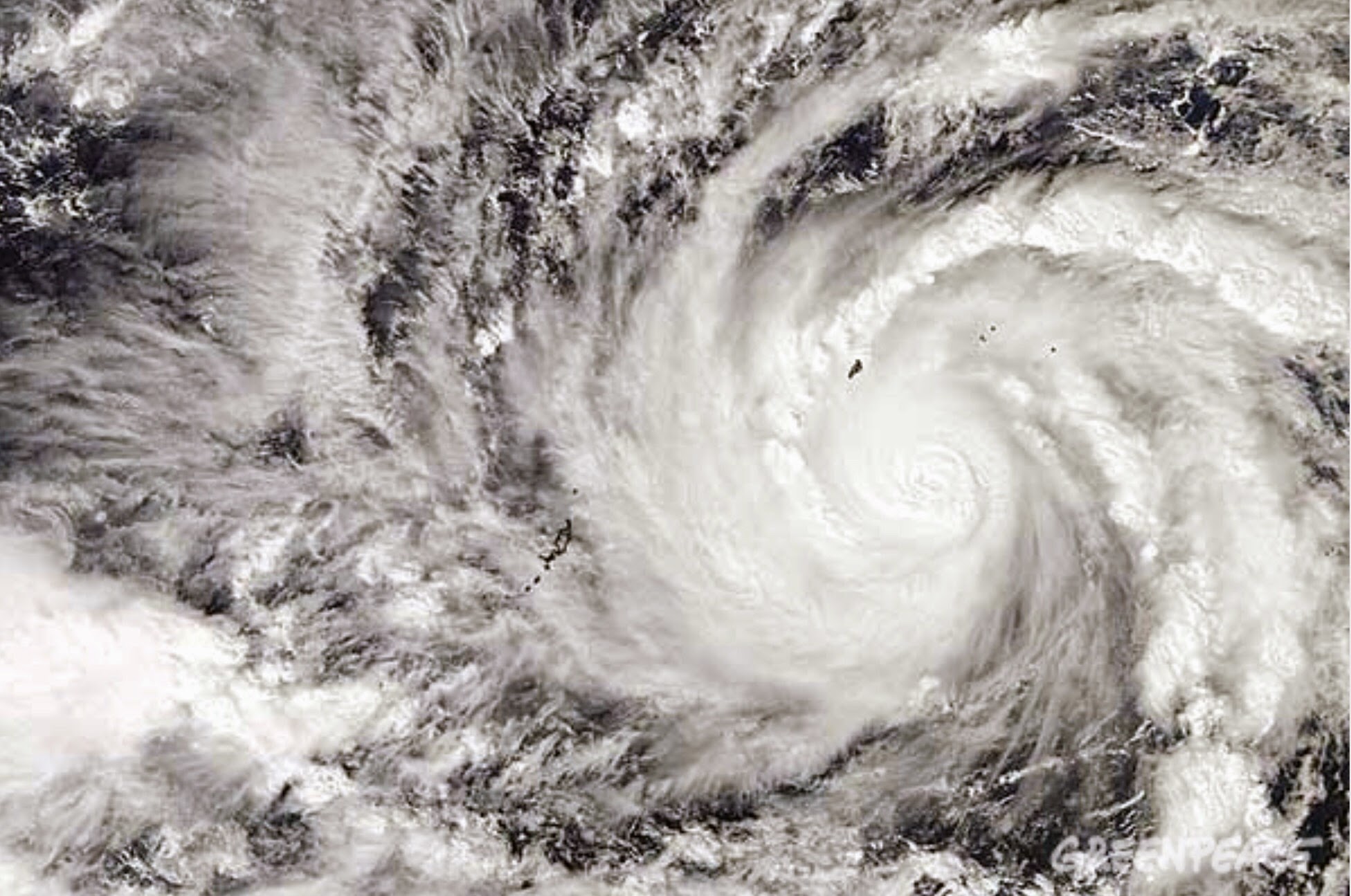
Typhoon Hagupit Hits Philippines: Climate Catastrophe Is Here Now! by Kumi Naidoo

As Typhoon Hagupit hits the Philippines, one of the biggest peacetime evacuations in history has been launched to prevent a repeat of the massive loss of life which devastated communities when Super Typhoon Haiyan hit the same area just over a year ago.

Typhoon Hagupit

“One of the biggest evacuations in peacetime” strikes a sickening chord. Is this peacetime or are we at war with nature?

I was about to head to Lima, when I got a call to come to the Philippines to support our office and its work around Typhoon Hagupit (which means lash). In Lima another round of the UN climate talks are underway to negotiate a global treaty to prevent catastrophic climate change. A truce of sorts with nature.

But these negotiations have been going on far too long, with insufficient urgency and too much behind the scenes, and not so much behind the scenes, interference from the fossil fuel lobby.

This year, like last year and the year before these negotiations take place against a devastating backdrop of a so-called ‘extreme weather event’, something that climate scientists have been warning us about if we don’t take urgent action.

Tragically, we are not taking urgent action. Nature does not negotiate, it responds to our intransigence. For the people of the Philippines, and in many other parts of the world, climate change is already a catastrophe.

Only one year ago, Super Typhoon Haiyan killed thousands, destroyed communities and caused billions of dollars in damage. Many survivors who are still displaced have this week had to evacuate the tents they have been living in as Typhoon Hagupit carves a path across the country as I write.

It’s too early to assess the impact so far—we are all hoping early indications will spare the Philippines of the same pain that was experienced after Haiyan.

Here in Manila, we prepare to travel to the impacted areas in the wake of Typhoon Hagupit, or Ruby, as it has been named. We will offer what minor assistance we can.

We will stand in solidarity with the Filipino people and we will call out those who are responsible for climate change, those who are responsible for the devastation and who should be helping pay for the clean up and for adaptation to a world in which our weather is an increasing source of mass destruction.

With heavy hearts we prepare to bear witness. We challenge those in Lima to turn their attention from the lethargy and process of the negotiations and pay attention to what is happening in the real world.

We call on them to understand that climate change is not a future threat to be negotiated but a clear and present danger that requires urgent action now!

Each year, the people of the Philippines learn the hard way what inaction on emissions mean. They might be slightly better prepared and more resilient, but they are also rightly more aghast that each year—at the same time—the climate meetings seem to continue in a vacuum, not prepared to take meaningful action, not able to respond to the urgency of our time and not holding accountable the Big Polluters that are causing the climate to change with ferocious pace.

Before leaving for Manila I also received a message from Yeb SaƱo, climate commissioner for the Philippines: “I hope you can join us as we bear witness to the impact of this new super typhoon. Your help would be very valuable in delivering a message to Lima loud and clear.”

Yeb was the Filipino chief negotiator for three years at the UN climate talks and recently visited the Arctic on a Greenpeace ship to witness the Arctic sea ice minimum. Two years ago in Doha, as Typhoon Pablo took the lives of many he broke through the normally reserved language of dispassionate diplomacy that dominates UN climate treaty talks:

“Please … let 2012 be remembered as the year the world found the courage to … take responsibility for the future we want. I ask of all of us here, if not us, then who? If not now, then when? If not here, then where?”

I am joining Greenpeace Philippines and Yeb to visit the worst hit areas, document the devastation and send a clear message from climate change ground zero to Lima and the rest of the world that the ones that are responsible for the majority of emissions will be held accountable by the communities that are suffering the impacts of extreme weather events linked to climate change.

We will call on the heads of the fossil fuel companies who are culpable for the unfolding tragedy to examine their consciences and accept their historic responsibility. They say the truth is the first casualty of war, in this war against nature, the truth of climate science is unquestionable.

Please join us. Please add your voice by signing our petition calling on Big Polluters to be held legally and morally accountable for climate damages. After signing the petition you will be redirected to a site where you can make a donation to the relief efforts of partner organizations. More


Tuesday, August 20, 2013

Save the Date: World Conference on Disaster Risk Reduction 2015

Subject to an anticipated decision of the UN General Assembly later in 2013, the Third United Nations World Conference on Disaster Risk Reduction (WCDRR) is to take place in Sendai City, Miyagi Prefecture, Japan, from 14 to 18 March 2015 (five days inclusive).


Hosted by the Government of Japan in cooperation with the United Nations Office for Disaster Risk Reduction (UNISDR), as secretariat of the International Strategy for Disaster Reduction, the WCDRR will review the implementation of the Hyogo Framework for Action and is expected to adopt a successor framework for disaster risk reduction.

The post-2015 framework for disaster risk reduction will build on the knowledge and practice developed through the implementation of the International Framework for the International Decade for Natural Disaster Reduction of 1989, the Yokohama Strategy and Plan of Action of 1994, the International Strategy for Disaster Reduction of 1999 and the Hyogo Framework for Action 2005-2015: Building the Resilience of Nations and Communities to Disasters. Pursuant to General Assembly resolution 66/199, UNISDR will continue to ensure extensive and inclusive multi-stakeholder consultations for a post-2015 framework for disaster risk reduction.

Kind regards,
UNISDR


*******************
International Day for Disaster Reduction 2013
http://www.unisdr.org/2013/iddr

The United Nations Office for Disaster Risk Reduction (UNISDR)
Visit our website: http://www.unisdr.org
Follow us on Twitter: http://www.twitter.com/unisdr
Find us on Facebook: http://www.facebook.com/unisdr

Share your Disaster Risk Reduction content: http://www.preventionweb.net/submit