Showing posts with label tuvalu. Show all posts

Tuesday, March 10, 2015

Climate change threatens human rights, Kiribati president tells UN

Pacific leaders tell Human Rights Council they fear for the future of their civilisations as climate impacts intensify

Just three weeks after the conclusion of the most recent climate negotiations, Geneva has once again offered a space for governments to consider how to address the human rights implications of climate change.

President Anote Tong

As the issue recently emerged as one of the elements that many countries wish to see integrated to the Paris climate agreement, these discussions provided insights on opportunities for states and UN bodies to better address this issue in the coming months.

Last Friday, the Human Rights Council hosted two high-level panels dedicated to the issue of human rights and climate change, with specific focus on the importance of international cooperation and on the impacts of climate change on the exercise of the right to food.

Representatives from small islands states called for urgent action to mitigate climate change, pointing at the fact that climate change threatens the progress made with the promotion of human rights.

The prime minister of Tuvalu Enele Sopoaga warned that climate change will worsen existing inequities in world already riven with inequality, poverty and conflict. Tuvalu, the prime minister warned, has neither the resources nor the capacity to cope with these impacts.

Kiribati’s President Anote Tong reminded the Human Rights Council that, despite all the efforts by his government, climate change remains an existential threat to his people.

“Who do we appeal and turn to for our people’s right to survive?” president Tong asked the Council. “If there is a major challenge on human rights that deserves global commitment, leadership and collaboration, this is the one: the moral responsibility to act now against climate change.”

Both Sopoaga and Tong challenged the Council to consider how the international community should respond to the climate crisis and to urge more strongly for climate action in order to protect the rights of the most vulnerable people.

Other speakers discussed in their interventions the benefits of integrating human rights into climate policies. UN Special Envoy on Climate Change (and former UN High Commissioner for Human Rights) Mary Robinson emphasized that a “human rights framing to our development and climate responses can maximize the potential for inclusion, participation and equality”.

Victoria Tauli-Corpuz, UN Special Rapporteur on the Rights of Indigenous Peoples, insisted more specifically on the importance to respect the rights of indigenous peoples, in particular land rights and participatory rights, when designing climate policies.

Quoting the fifth assessment report from the UN’s IPCC climate science panel, Victoria Tauli-Corpuz also highlighted that “indigenous, local, and traditional knowledge systems and practices, including indigenous peoples’ holistic view of community and environment, are a major resource for adapting to climate change, but these have not been used consistently in existing adaptation efforts”.

The panels were followed by an interactive dialogue with representatives from governments and civil society.

Several common threads emerged from this discussion, including the importance to fully implement the right of the public to take part in decision-making related to climate change, the recognition of the impacts of climate change on economic and social rights, and the importance to consider the linkages between the need to address climate change while protecting the right to development.

Several speakers also spoke in favor of two specific proposals for UN institutions: the importance to include strong references to human rights in the Paris 2015 climate agreement and the opportunity for the Human Rights Council to nominate a UN special rapporteur on human rights and climate change.

Germany also announced during the panels that the country would join the “Geneva Pledge on Human Rights and Climate Action” signed by 18 countries during the most recent round of climate negotiations.

However, the impact of the high political stakes related to the preparation of the Paris Climate Agreement could also be felt throughout the panels.

The interventions by most countries reflected mainly well-entrenched positions in the Council and at the climate negotiations.

The United States in particular suggested that attempts to push for the inclusion in the climate negotiations of references to the work of the Human Rights Council could lead to the “sabotage of the 2015 climate agreement”, a statement that many participants to the session considered out of tone with the discussions.

The panels were followed by the presentation, on Monday, of the report of the UN Independent Expert on Human Rights and the Environment John Knox.

In his presentation, Prof. Knox emphasized that climate change is likely the most serious threat to the enjoyment of human rights.

Referring to the Geneva Pledge as an example of a good practice to better integrate human rights and climate policies, he challenged relevant UN bodies, such as the Office of the High Commissioner for Human Rights, UNEP and UNDP, to establish focal points for human rights and climate change.

The ongoing discussions in Geneva this week are not expected to lead to immediate concrete results. These exchanges could nevertheless provide additional momentum when related sessions will resume in June, both in Geneva and in Bonn.

For the first half of the month, UN climate negotiations will continue to advance work towards the Paris climate agreement.

Momentum

Several governments having insisted last month on the need to insert human rights language in the negotiating text, the June meeting of the climate talks will be crucial to determine whether this proposals are retained in the draft agreement.

Upon the closing of the climate negotiations in Bonn, the Human Rights Council will gather once again in Geneva to consider, among other matters, the adoption of a new resolution on human rights and climate change.

Over the past two months, Geneva offered two opportunities for governments to deepen their understanding of the interplay between human rights and climate action.

The coming months will now be critical to determine whether, through the UN climate body and the Human Rights Council, states are willing to commit to take steps towards ensuring that climate policies address climate change in a way that promotes human rights at the same time. More


Wednesday, December 10, 2014

"If we save Tuvalu, we save the world

"If we save Tuvalu, we save the world" - UN Climate Convention, Peru


9 December 2014, Lima, Peru - The Prime Minister of Tuvalu paid homage to ancestors buried in Peru at the UN Climate Convention today. Taking the floor at the High Level Segment of the 20th Conference of the Parties, he began his statement acknowledging the interesting and tragic historical connection with Peru.

During the 1860's slave traders known as blackbirders took approximately 400 people from Tuvalu to work in Peru. None of them ever returned.

"There are Tuvaluans buried here on this land and we pay our respects to our ancestors who were brought here against their will," stated Hon. Enele Sosene Sopoaga, Prime Minister of Tuvalu - remembering the history of Tuvalu before looking to the future.


"I am here at this important meeting as the highest representative of the people of Tuvalu. I carry a huge burden and responsibility. I carry their hopes that there will be a future for Tuvalu. This is an enormous burden to carry. It keeps me awake at night. No national leader in the history of humanity has ever faced this question. Will we survive or will we disappear under the sea? I ask you all to think what it is like to be in my shoes."

On the frontlines of climate change, the greatest single threat to the island atoll, Tuvalu is heartened by the progress leading to a new climate change protocol made at the UN Climate Convention in Peru yet also very clear that they will not support a new protocol without a substantive programme on loss and damage. The new agreement must be agreed upon by the end of December, 2015 in Paris, the host of the next Conference of the Parties.

"Tuvalu, and I suspect most of the world, believes that reaching a comprehensive new protocol in Paris is absolutely essential. We cannot repeat Copenhagen. We cannot suffer the frustration and humiliation of being asked to accept a half-hearted response to a critical global crisis."

"The new protocol must be comprehensive it must cover all issues in a meaningful way. It has to include effective mitigation targets for all countries. It must deliver real outcomes on adaptation and loss and damage. It must deliver the necessary finance to transform our society. And it must deliver the technology and the necessary capacity building to ensure everyone can respond to climate change. All these pillars are essential."

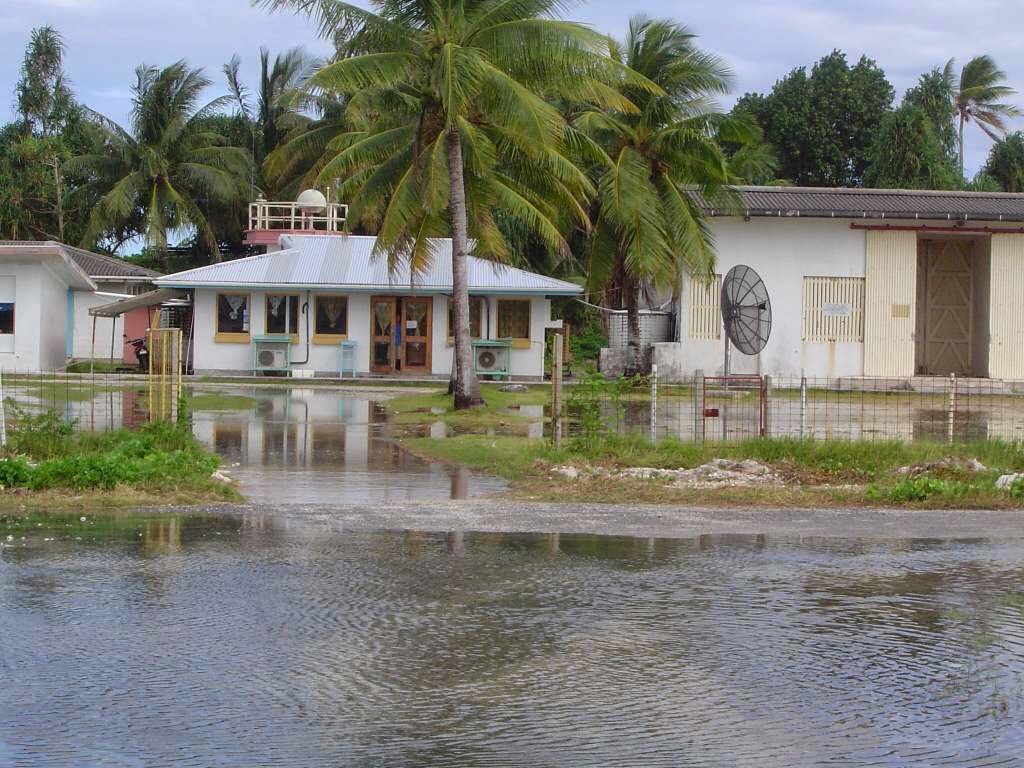
The coral atoll nation of Tuvalu consists of nine inhabited islands with the highest point above sea level being four meters. Now experiencing climate change impacts through saltwater intrusion into agricultural areas, lack of potable water and coastal erosion - the fate of Tuvalu is in the hands of the international community.

"I ask everyone who leaves this room to look into the eyes of the first child they see. I want everyone to look into the child’s eyes and imagine what those eyes will see in ten or twenty years. Will they see hell or will they see a sustainable planet."

"Let us stand proud in Paris. Let us look into the eyes of children and say, yes we have a real future for you. Let us make 2015 the year we saved the Earth! Let us make 2015 the year we saved Tuvalu. For if we save Tuvalu we save the world."

To access the full statement presented by Hon. Enele Sosene Sopoaga, Prime Minister of Tuvalu at the High Level Segment of the 20th Conference of the Parties to the United Nations Framework Convention on Climate Change please visit: http://unfccc.int/files/meetings/lima_dec_2014/statements/application/pdf/cop20_hls_tuvalu.pdf

Friday, August 8, 2014

Has the era of the ‘climate change refugee’ begun?

A far-flung scattering of islands in a turquoise sea, Tuvalu is one of the planets' smallest and most remote nations, just west of the International Date Line, just south of the equator.

Funafuti, Tuvalu

Tuvalu's coastline consists of white and sandy beaches, green palm trees and mangroves. It is hard to imagine that anybody would want to leave this small island nation, located between Australia and Hawaii, voluntarily. But Tuvalu has become the epicenter of a landmark refugee ruling that could mark the beginning of a wave of similar cases: On June 4, a family was granted residency by the Immigration and Protection Tribunal in New Zealand after claiming to be threatened by climate change in its home country, Tuvalu. The news was first reported by the New Zealand Herald on Sunday.

The small Pacific island nation sits just two meters above sea level. If the current sea level rise continues, experts believe the island might disappear in approximately 30 to 50 years. Tuvalu shares this existential threat with many other island nations and coastal regions, which have struggled for years to raise international awareness about their tragic plight. Predictions for climate change-induced displacement range widely from 150 to 300 million people by 2050, with low-income countries having the far largest burden of disaster-induced migration, according to the Internal Displacement Monitoring Center.

Those threatened by sea-level rise, droughts or other natural catastrophes face an epochal problem: Victims of climate change are not recognized as refugees by the International Refugee Convention. In the Tuvalu case, Sigeo Alesana and his family reportedly left the island nation in 2007 and moved to New Zealand, where they lost their legal status in 2009. The family was not able to obtain work visas and had to apply for refugee and protected persons status in 2012. Although the claims were dismissed in March 2013 and an appeal was turned down, the family's case was finally approved. The case was closely followed by immigration and environmental lawyers all over the world.

Sigeo Alesana and his wife claimed before the tribunal that climate change had made life in Tuvalu more difficult due to much more frequently occurring inundations, that caused coastal erosion and made it difficult to grow crops. The tribunal explicitly mentioned climate change in its assessment saying that Alesana's children were particularly "vulnerable to natural disasters and the adverse impact of climate change."

"I don't see it as delivering any kind of 'verdict' on climate change as such," says Vernon Rive, a Senior Lecturer in Law at AUT Law School in Auckland. The New Zealand decision is very specific because the family based its application for residency on three arguments, Rive says. First, the family members claimed to be refugees; second, they argued to be "protected people", and third, the family said its case fell under "exceptional humanitarian grounds." Each of these arguments is based on an existing convention regarding refugees, but the family only succeeded because it claimed "exceptional humanitarian grounds," which is a wording recognized in New Zealand's immigration legislation but not by many other governments.

In its judgment the New Zealand tribunal surprisingly acknowledged the humanitarian consequences of climate change among other factors, such as the presence of an elderly mother who required care. In its conclusion, however, the tribunal refrained from singling out climate change and stated that other factors would already have been sufficient to grant residency to the family. In other words: The tribunal avoided a clear decision on whether climate change can or cannot be reason enough for refugees to be granted residency. The mere fact that the tribunal mentioned the impacts of global warming as a contributing factor to the ruling is nevertheless remarkable. "What this decision will not do is open the gates to all people from places such as Kiribati, Tuvalu and Bangladesh who may suffer hardship because of the impacts of climate change," Rive says.

While the tribunal's decision may not have the same impact everywhere, it could send a strong signal to a number of nations, such as Sweden and Finland, that often grant asylum to people affected by natural disasters. According to French climate change migration expert François Gemenne, governments need to get to grips with the reality of climate change refugees, irrespective of legal conventions. "I believe that bilateral or regional arrangements are going to become necessary," says Gemenne, suggesting a raft of agreements will need to be put into place, between nations and among geopolitical blocs, that will ensure the protection of those displaced by rising waters.

But will there eventually be open doors for the victims of climate change? Some of the countries endangered by climate change fear that their citizens could effectively become "second class" citizens abroad. As a consequence, the island nation Kiribati – itself at risk from climate change – has set up a "Migration with Dignity" program which involves training its citizens as highly-skilled workers who are needed and welcomed in other countries if and when the residents of Kiribati are forced to move.

The recent New Zealand ruling could give smaller nations stronger leverage on the international stage. But do the world's leading statesmen, beset by a host of other crises, care? Michael Gerrard, Director for Climate Change Law at Columbia University, puts current progress in perspective: "The world community has not even begun to grapple with what is to come," he tells WorldViews in an e-mail. More


Wednesday, June 4, 2014

The Nations Guaranteed to Be Swallowed by the Sea

Imagine the street you live on is knee-deep in floodwater, and it’s ruining everything in sight, including your home. Now imagine that those awful floodwaters never, ever recede. Instead, the water just keeps rising and rising until your entire country drowns.

For a number of island nations, that's ultimately the significance of the recent reports about the unstoppable melt of the massive ice sheets of Antarctica and Greenland, along with hundreds of glaciers.

Tony de Brum (left) at UN climate
COP 19 in Warsaw with US chief
negotiator Todd Stern. Image: US
State Dept

“We’ve already lost some island atolls. On others the rising sea is destroying homes, washing away coffins and skeletons from graves,” Tony de Brum, the foreign minister of the Marshall Islands, told me. “Now with every full moon the high tides brings salt water into our streets. We’re moving further inland but can’t move much further."

The Marshall Islands are located in the northern Pacific Ocean, and are home to some 70,000 people spread out over 24 low-lying coral atolls. Low-lying, as in six feet above sea level on average. Not only do rising seas flood and erode shorelines, they also make groundwater too salty too drink and “poison” the land with salt so crops and even coconuts trees can’t grow.

Earlier this month Motherboard reported that the collapse of the West Antarctic ice sheet was underway, guaranteeing a minimum of three metres (10 feet) of sea level rise. Another study said the melting ice is 31 per cent faster now than between 2005 and 2011. Way up in Greenland, the same thing is happening, according to anew study in the journal Nature Geoscience. And then there was the recent US National Climate Assessment that found Alaska’s and Canada’s glaciers are pumping huge volumes of water into the ocean.

Add it all up and this means many small island nations like the Marshalls—along with countries like the Maldives, Tuvalu, Micronesia, Kiribati, Palau and others—will be swallowed by the sea. “Where are we to go? How are we to survive? What happens to our culture? Will we become wards of another state?” asked de Brum.

“The news from Antarctica should be sobering to anyone from a coastal region around the world,” said Ambassador Marlene Moses of the Republic of Nauru, a small island in the South Pacific home to fewer than 10,000 people.

Moses is also chair of the Alliance of Small Island States (AOSIS), a coalition of 43 low-lying island and coastal nations who are fighting hard to get countries like the US, Canada, China, Japan, and Australia to slash their CO2 emissions and keep future global warming below 1.5 C˚. Anything higher, they believe, and most of these nations will drown.

“I can tell you personally it has been very upsetting to witness what seems like an indifference to the plight of small islands,” Moses said.

When told of the recent science out of Antarctica and Greenland, Claire Anterea, a community worker from the central Pacific island nation of Kiribati responded in despair, “My gosh this is not fair! If the world can’t stop the glacier collapse who will save my people and my country?”

“We have a beautiful life here,” she said, “a simple and subsistence way of living. It is unexplainable to know that our beloved home will disappear.” Kiribati consists of 30-odd pancake flat coral atolls straddling the equator.

The government of Kiribati is hoping to buy thousands of acres on one of Fiji’s islands to relocate its 115,000 residents. While relocation may mean survival, the literal disappearance of their islands risks the overwhelming loss of their culture and identity. When you live on tiny islands in the middle of the enormous Pacific Ocean, land has a very special meaning.

“Without our land how can I explain to my children their roots? Where they come from in the first place?” she said. More


Monday, September 17, 2012

The royal visit to Tuvalu focuses on climate change

The Diamond Jubilee Royal Tour of the Pacific moves to Tuvalu tomorrow when Prince William and his wife Kate will be carried from their aircraft on multi-coloured throne chairs.

The visit will focus world attention on climate change as Tuvalu is at the forefront of small island nations already feeling the effects of rising sea levels.

But the Duke and Duchess of Cambridge will not have a chance to talk to Non-government organisations in Tuvalu working on keeping back the sea. More

______________________________________________________

For those who are not familiar with the plight of Small Island Developing States (SIDS) here is Ian Fry, the Tuvalu delegate to the United Nations Climate Change Conference in Copenhagen, Denmark, making an impassioned plea for legally binding agreements to be made by world leaders to save his nation and other low-lying island states. He notes that is is "an irony of the modern world that the fate of the world is being determined by some senators in the US Congress," and suggests that for President Obama to earn his Nobel Peace Prize by addressing the greatest threat to humanity and to security: climate change. Tearfully, he concludes: "The fate of my country rests in your hands."


Wednesday, July 25, 2012

UN rights expert urges international community to not turn its back on Tuvalu

19 July 2012 – A United Nations independent expert today called on the international community to not turn its back on the small island State of Tuvalu, where communities are being seriously affected by climate change.


“Climate change is an everyday reality for people in Tuvalu, and is slowly but steadily impacting their human rights to water and sanitation,” warned the Special Rapporteur on the right to safe drinking water, Catarina de Albuquerque, at the end of her first mission to the country. “Climate change will exacerbate water scarcity, saltwater intrusions, sea level rise and frequency of extreme weather events.”

As of 2010, 98 per cent of the population in Tuvalu had access to an improved source of water and 85 per cent had access to improved sanitation facilities, according to a joint report by the World Health Organization (WHO) and the UN Children’s Fund (UNICEF).

However, Ms. de Albuquerque noted, “these figures do not portray an accurate picture of the country’s situation and mask severe challenges currently faced by its population.” She noted that people cannot actually drink directly from the water storage tanks and have to boil it, despite previous efforts to improve the situation.

“People are still suffering from a lack of water in sufficient quantities on a continuous basis. Several people told me that they have no confidence in the sustainability of the water supply,” she said.

The Special Rapporteur called on authorities to ensure that the country’s water harvesting system is used to its maximum potential in old and new buildings, and urged the Government to immediately adopt and implement a national water strategy and plan of action covering the entire population.

“Access to water and sanitation must be affordable to all, in particular to those who have a lower income. The price paid for water, sanitation and hygiene must not compromise access to other human rights such as food, housing or education,” Ms. de Albuquerque said. “I call on the Government to bear this in mind when discussing and adopting new water tariffs or when advancing the use of composting toilets.” More