Showing posts with label Bahamas. Show all posts

Saturday, May 2, 2015

Caribbean “island laboratories” making a case for renewable, says Mazurier

In early March, Stéphane Tromilin, a sustainable energy attaché in the French government, gave a United Nations webinar on the French government’s work on French islands.

In it, he spent most of the time discussing the unique challenges of islands, specifically those in the Caribbean like Guadeloupe, but also noted an island’s value as “laboratories to develop renewable energy solutions.”

Christophe Mazurier, a European financier and climate defender, has seen these laboratories in action, specifically in the Caribbean, where he has a home in the Bahamas. While many of these nations are at greater risk of climate disasters - in the form of devastating hurricanes and other storms - than most other places on earth, many refuse to become victims of the global intransigence on climate change. Instead, many Caribbean nations are taking it upon themselves to be the change they wish to see in their developed-nation counterparts.

Guadeloupe, the overseas French territory mentioned earlier, is getting nearly 30 percent of its energy from solar, a number on par with climate leaders Germany. Aruba gets 20% of its energy from wind, and is aiming to be totally sustainable by 2020. Ten island nations, including the Bahamas, the British Virgin Islands, Grenada, Dominica and more have joined the Ten Island Challenge, launched by Richard Branson as a means to give these Caribbean island clear renewable goals and support them in meeting those goals.

Mazurier says that in many ways, the Caribbean’s move to solar was preordained. Not because they are at the forefront of climate change susceptibility, but because of their incredibly high energy costs. Most Caribbean island nations pay around 33 cents per kWh of energy, while for comparison the United States pays 10 cents per kWh. Even with the price of fuel bottoming out, and energy costs in places like Jamaica being cut in half, Jamaica and others were already well on their way to a renewable future.

In 2013, Jamaica signed a deal that would bring 36 MW of wind power for $63 million, which would help it divest from diesel oil in the long-term. By investing heavily in renewables now, the islands can avoid paying for diesel in the future… No matter how the price fluctuates. Mazurier says that this is the key for these Caribbean island nations, who don’t have multimillion dollar climate budgets. These nations cannot just throw money at the problem in hopes that they can play a role in the ultimate cooling of the climate. Their emissions are negligible in the grand scheme of things. The only aspect that can get these nations to buy in if they know they will ultimately pay less for energy than they do now. The positives for the overall climate and the state of the planet are simply a secondary byproduct of these finance-driven deals.

Whichever way it breaks out, says Mazurier, the Caribbean turn toward renewable energy is a refreshing and encouraging sign. The question now becomes: Can the larger nations take note of their island peers? More


Thursday, December 11, 2014

Bahamas takes on renewable energy challenge - Missed Opportunity for Cayman?

The Bahamas has become the latest recruit to Richard Branson's green energy drive for Caribbean islands.

Branson's Carbon War Room NGO is aiming to help islands in the region transition from expensive fossil fuel imports to using their own renewable energy resources as part of its Ten Island Challenge programme.

This week the Bahamas joined the push, committing to developing 20MW of solar PV generation in the outer Family Islands, bringing energy efficiency and solar solutions to a local high school, and replacing streetlights across the nation with energy efficient LED lights.

Carbon War Room plans to support these goals by providing the country's government with a range of technical, project management, communications, and business advisory services.

The Bahamas joins the islands of Aruba, Grenada, San Andres and Providencia in Colombia, Saint Lucia, and Turks & Caicos in the challenge, which aims to generate how small states can decarbonise in a cost-effective manner.

"The Bahamas' entry into the Ten Island Challenge signals another step forward for the Caribbean region in the effort towards a clean energy future," Branson said in a statement. "The progress made in The Bahamas will help inspire other islands to work towards accomplishing their renewable energy objectives."

While the focus to date has been on Caribbean islands, earlier this year Peter Boyd, Carbon War Room's chief operating officer, told BusinessGreen the programme could expand into the Pacific and to isolated communities, military bases, or mines. "There are island energy economies even if the 'island' isn't surrounded by water," he said at the time.


Wednesday, April 20, 2011

Ocean pollution causes food security crisis in Small Island Developing States (SIDS)


Nassau, The Bahamas –  Ocean pollution is threatening to deplete the commercial fisheries stock in the coral reefs of The Bahamas and other Small Island Developing States (SIDS) around the world.   

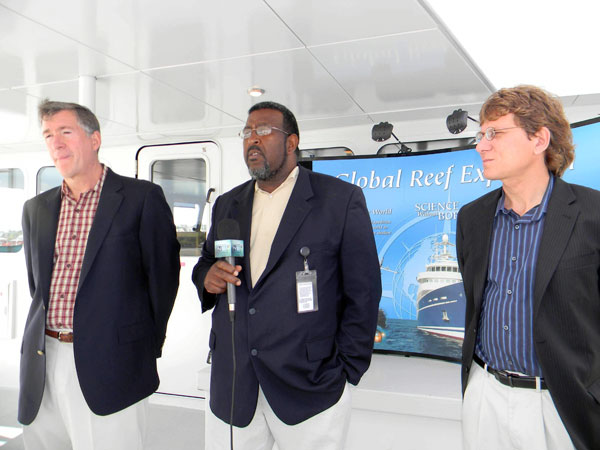
The Living Oceans Foundation chose The Bahamas to launch their research project that examines the coral reef systems of 25 island countries worldwide.   
“We are extremely pleased and we feel privileged that the Living Oceans Foundation has selected The Bahamas as the country to start this five-year incredible exploration to determine the state of the world’s coral reefs,” said Eric Carey, executive director of the Bahamas National Trust.   
“The Bahamas National Trust is working with other agencies like the Nature Conservancy, Friends of the Environment, the Andros Conservancy are really pleased to be partnering with the Foundation and organisations like the Ministry of the Environment, the department of Marine Resources to make this happen.”   More >>>