Showing posts with label SIDS. Show all posts

Thursday, May 10, 2018

1st Ocean Risk Summit

IISD/ENB+ @ 1st Ocean Risk Summit | 9 May 2018 | Southampton, Bermuda

On Wednesday, participants of the Ocean Risk Summit met throughout the day to hear opening remarks, keynote speakers, and presentations on ocean risk, describing and analyzing the changing ocean, and addressing ocean volatility. Two ‘deep-dive’ sessions took place in the afternoon, where panelists addressed in round-table discussions the topics of weather and climate, and health and security.

José María Figueres, Former President of Costa Rica and Founder of Ocean Unite, welcomed the risk management sector to the extended family of ocean partners, explaining that the ocean-related complex threats require a multi-sectoral response.

The Hon. C. Walton Brown, Minister of Home Affairs, Bermuda, welcomed the wide array of stakeholders represented at the Summit, and encouraged participants to commit to creating lasting change.

H. E. Peter Thomson, UN Special Envoy for the Ocean, emphasized that the ocean is the source of life on the planet, elaborating on its decline by the accumulating effects of a wide range of human impacts.
Mike McGavick, CEO, XL Group, stressed that “the risks are moving ashore with ferocity,” estimating that US$320 billion were lost last year due to natural disasters, and urging action to reverse ocean degradation.
Her Majesty Queen Noor of Jordan underscored the need to “reverse the damage we have inflicted on the vital oceanic system,” stressing that the next decade will be crucial for securing a sustainable future.
Read More

Wednesday, May 9, 2018

Credit Rating Agency Issues Warning On Climate Change To Cities


One of the largest credit rating agencies in the country is warning U.S. cities and states to prepare for the effects of climate change or risk being downgraded.

In a new report, Moody's Investor Services Inc. explains how it assesses the credit risks to a city or state that's being impacted by climate change — whether that impact be a short-term "climate shock" like a wildfire, hurricane or drought, or a longer-term "incremental climate trend" like rising sea levels or increased temperatures.

Also taken into consideration: "[communities] preparedness for such shocks and their activities in respect of adapting to climate trends," the report says.

"If you have a place that simply throws up its hands in the face of changes to climate trends, then we have to sort of evaluate it on an ongoing basis to see how that abdication of response actually translates to changes in its credit profile," says Michael Wertz, a Moody's vice president.


(https://www.npr.org/2017/12/01/567843604/credit-rating-agency-issues-warning-on-climate-change-to-cities?utm_campaign=storyshare&utm_source=twitter.com&utm_medium=social

Monday, April 30, 2018

Report and Event on Adaptation in Human Settlements: A Launch-pad For Action


UN Climate Change News 30 April 2018 - A newly released UN report details practical ways of adapting to climate change impacts such as increased flooding or intensifying storms in human settlements, from mega cities to villages.

Importantly, the report provides hands-on tools that national and subnational governments can use to build climate resilience in collaboration with communities, civil society organizations, research centres and the private sector.

Released by UN Climate Change and prepared under the Nairobi work programme, the report called “Adaptation in human settlements: key findings and way forward” aims to share good practices and lessons learned to date and will be taken forward at an event at the May Climate Change Conference.

The report is timely as both the contribution to climate action by cities as well as urbanization are increasing world-wide. Already more than 50% of the world’s population lives in urban areas, a number which is expected to near 70% by 2050.

Climate change is exacerbating the vulnerability of human settlements to natural and human-made hazards globally to a disproportionate degree, especially in developing countries, coastal and delta regions and small island developing States (SIDS). Read More

Thursday, March 29, 2018

Why Hong Kong has the toughest coral in the world

Why Hong Kong has the toughest coral in the world, and how agnès b is on a mission to help save it | South China Morning Post

The French research vessel Tara set sail from Lorient, northern France, in May 2016 and is on an epic two-year oceanographic mission to explore the coral reefs of the Pacific. On its 10-day port call in Hong Kong the 16-person team, known as “Taranauts”, hosted hundreds of visitors, but they were here primarily to study coral.
“Hong Kong is an interesting place to sample coral because of the economic development and its impact on ocean biodiversity; we look at the impact of the pollution,” says scientist Sarah Romac from Roscoff, France, speaking in the vessel’s wet laboratory.
The biggest surprise, the team found, was local coral’s resilience. Read More

Friday, March 23, 2018

Coral Reef Building and Energy Generation Protect Coast Lines

CCell - Turning waves into rock

We use energy from the waves to power underwater electrolysis to form limestone rock around steel mesh placed on the seabed. This technique was pioneered by BioRock to create artificial reefs, accelerating the accretion of limestone from 100s of years to less than 5.

CCell is an innovative technology that moves with the waves to simultaneously harness and dampen energy within the waves.

CCell and BioRock together, form a natural synergy, with an independent renewable energy source that enables large scale application of the BioRock technique. Read More

Wednesday, February 28, 2018

A major win for Small Island Developing States (SIDS)


A major win for Small Island Developing States (SIDS) who doggedly pursued this at the Green Climate Fund (GCF) board for years. Now, countries and #communities big and small are, justifiably, lining up to use this funding for small projects. #smallislands #climateaction #SDGs
#GCFund B.19 Board approval for first Simplified Approval Process project SAP001 with EIF Namibia @Green_Viewpoint

Saturday, February 17, 2018

Ibiza and Majorca plan for 100 per cent renewable energy by 2050


Ibiza and Majorca could be running on 100 per cent renewable energy by 2050, under plans unveiled by the islands’ government yesterday.

The proposed climate change law would make the islands some of the greenest in the world but could also pave the way for clashes with Madrid.

The Balearics generate less than 3 per cent of their electricity from renewable sources at present, primarily from solar panels. Coal-fired power plants, diesel generators and gas plants account for more than 70 per cent of supply, while most of the rest is imported from the mainland.

The plan would involve a phased shutdown of the islands’ main coal plant, at Alcúdia on Majorca, between 2020 and 2025, a proposal that has been rejected by the Spanish energy ministry. Joan Groizard, the Balearic islands’ energy director, said the target to move to entirely renewable energy would mean the islands needed to achieve “100 per cent renewable electricity long before 2050”.

Large car parks would have to install solar panels by 2025. By 2035, car hire companies would be forced to electrify their entire fleets and new non-electric vehicles would be banned from entering the islands.

Mr Groizard said he hoped that the law would help the islands “be recognised as a low-carbon destination, where the rest of Europe can not only enjoy a holiday but also learn something they can then apply to their own energy transitions”.

Sam Fankhauser, director of the Grantham Research Institute at the London School of Economics, said: “Going 100 per cent renewable by 2050 is a much more aggressive target for the power sector than most other countries have.”

Britain is aiming to cut its greenhouse gas emissions by 80 per cent compared with 1990 levels by 2050.


https://www.thetimes.co.uk/article/ibiza-and-majorca-plan-for-100-per-cent-renewable-energy-by-2050-gp6dpzptl

Saturday, February 3, 2018

Plastic Straws and the Cayman Islands

As a maritime nation should we ban plastic drinking straws?

One of the world's leading makers of single-use plastic drinking straws has told Radio 5 Live that the development of more environmentally friendly alternatives is "stuck".
John Sidanta, chief executive of Primaplast, said he was aware of rising global concern over levels of plastic pollution in oceans and landfills.
But he said affordable alternatives had yet to be developed.
At the moment, greener straws cost a hundred times more, he said.
Primaplast manufactures up to 600 million polypropylene plastic straws a month from its base in Tangerang, Indonesia, for markets in Europe and Japan, where they are sold alongside cartons of juice, milkshakes and yoghurt drinks.
Despite a useful life of just minutes, traditional plastic straws cannot degrade once disposed of and Mr Sidanta acknowledges their days are probably numbered.
Some firms are already beginning to curb their use.
The pub chain JD Wetherspoon and Pizza Express have announced plans to phase them out completely, while other firms, such as All Bar One, say they plan to substantially reduce the availability of plastic straws in their branches.
Cornwall may become the first county to ban them from bars and restaurants after a campaign by the group Final Straw Cornwall. Read More
#centre_of_excellence_cayman_islands

Friday, December 1, 2017

Mangroves Lack the Genetic Diversity to Adapt to Climate Change


Mangroves support coastal ecosystems around the world. In the tropics and subtropics, they rim coastlines and estuaries in thick green bands, providing shelter for everything from monkeys to Bengal tigers to critically endangered sloths. Considering their wide range and unique adaptations to saltwater environments, mangroves seem like an evolutionary success story. But the reality is that mangroves have surprisingly low genetic diversity, which will be a big problem as they attempt to adapt to changing conditions. New research suggests that mangroves may break rather than bend under the stress of the climatic changes to come.

Suhua Shi, an evolutionary biologist at Sun Yat-sen University in Guangzhou, China, and her colleagues surveyed the genetic material of six of the world’s roughly 100 mangrove species, examining 26 populations around the Gulf of Thailand and China’s Hainan Island. The team found that within each species, mangroves are so low in genetic diversity that individual trees are essentially indistinguishable from one another. This means they will have less chance of adapting to a changing world than more diverse species.


https://www.hakaimagazine.com/news/mangroves-lack-the-genetic-diversity-to-adapt-to-climate-change/

Thursday, November 30, 2017

New Policy Research Working Paper from the World Bank


A new Policy Research Working Paper from the World Bank evaluates the protective capacity of mangrove forests against storm surge in Bangladesh. Read more on this story and other #EcoDRR updates here: bit.ly/2Aa9ToK

Wednesday, September 13, 2017

Historic legacies affect climate change survival in Caribbean


The Caribbean Sea

Caribbean countries have campaigned for strong climate targets, captured in the campaign slogan '1.5C to stay alive.' This refers to the limit of warming beyond which the island states will become unviable in the face of threats including rising sea levels, flooding, ocean acidification and drought.

Drawing on evidence from diplomatic correspondence published in 2010, Dr Sealey-Huggins argues that the failure of the international community to adopt this target shows how the interests and preferred approach of powerful industrialised nations "are prioritised in the climate regime at the expense of Caribbean societies."

The paper also describes how diplomatic correspondence depicted financial aid being made conditional upon political support, and identifies "bullying tactics" and the use of intelligence resources to strengthen the negotiating position of more developed nations. Dr Sealey-Huggins suggests that the lack of capital resources in the Caribbean results in the region being particularly vulnerable to manipulation through the use of financial aid in this way. More

A lesson from Hurricane Irma: capitalism can’t save the planet – it can only destroy it


But there’s a flaw. Hurricanes do not respond to market signals. The plastic fibres in our oceans, food and drinking water do not respond to market signals. Nor does the collapse of insect populations, or coral reefs, or the extirpation of orangutans from Borneo.

The unregulated market is as powerless in the face of these forces as the people in Florida who resolved to fight Hurricane Irma by shooting it. It is the wrong tool, the wrong approach, the wrong system.

There are two inherent problems with the pricing of the living world and its destruction. The first is that it depends on attaching a financial value to items – such as human life, species and ecosystems – that cannot be redeemed for money. The second is that it seeks to quantify events and processes that cannot be reliably predicted.

Environmental collapse does not progress by neat increments. You can estimate the money you might make from building an airport: this is likely to be linear and fairly predictable. But you cannot reasonably estimate the environmental cost the airport might incur. Climate breakdown will behave like a tectonic plate in an earthquake zone: periods of comparative stasis followed by sudden jolts. Any attempt to compare economic benefit with economic cost in such cases is an exercise in false precision. https://goo.gl/1uBm3E

Saturday, September 9, 2017

Should Caribbean SIDS launch a Windies navy

Should Caribbean small island states initiate a Windies Navy for post-disaster rescue? Coordinated using the Zello App to communicate / coordinate, as did the Cajun Navy in Houston in the aftermath of Hurricane Harvey.

Holly Hartman, at the dining room table where she helped the Cajun Navy rescue Houstonians after Tropical Storm Harvey.


I downloaded an app. And suddenly, was part of the Cajun Navy. After two minutes of training, I was talking to people desperate for help.

After watching nonstop coverage of the hurricane and the incredible rescues that were taking place, I got in bed at 10:30 on Tuesday night. I had been glued to the TV for days. Every time I would change the channel in an attempt to get my mind on something else for a few minutes, I was drawn right back in.

I finally turned off the TV and picked up my phone to do a quick check of email and Facebook. I read an article about the Cajun Navy and the thousands of selfless volunteers who have shown up to this city en masse. The article explained they were using a walkie-talkie-type app called Zello to communicate with each other, locate victims, get directions, etc. I downloaded the app, found the Cajun Navy channel and started listening.

I was completely enthralled. Voice after voice after voice coming though my phone in the dark, some asking for help, some saying they were on their way. Most of the transmissions I was hearing when I first tuned in were from Houston, but within 30 minutes or so, calls started coming in from Port Arthur and Orange. Harvey had moved east from Houston and was pummeling East Texas.

As I was listening, I quickly figured out that there were a few moderators on the app that were in charge and very experienced in using this method of communication during emergencies. One in particular, Brittney, was giving directions, taking rescue requests, and prioritizing calls and rescues. At one point, she said something that made me realize she's a nurse, so I immediately understood why she was so effective in this situation.

A couple of other women (who were working from other parts of the country, not Houston) who had been taking calls from victims and logging in the information came on the line around 12:30 and said they had to sign off so they could get to bed. They asked if there was anyone who could work through the night to keep taking rescue requests and log them.

I sat up and turned on my light. I timidly pushed the "talk" button and said, "I can." More

Monday, August 28, 2017

Apply to be a 2018 Climate Change Fellow

AOSIS Climate Change Fellowship Program

18 Aug, 2017

AOSIS Climate Change Fellowship Program
In 2014 AOSIS established the Climate Change Fellowship Program. The program brings early career professionals from AOSIS member countries to New York for one year to participate as part of each Fellow’s national delegation to the UNFCCC and UNHQ.
Each year, candidates are selected to spend a year based in New York following climate change issues, including attending all major UNFCCC meetings. Fellows are expected to spend 80% of their time on AOSIS related matters and 20% on national issues.
During their fellowship, the Fellows receive comprehensive training on climate change issues, including on-going negotiation skills training and media training. It is expected that, after their fellowship, they will return to their home governments and continue to engage on climate change issues and in the UNFCCC process.
To date, 16 Fellows have participated in the program. With each class of graduating Fellows we continue to expand the Fellowship alumni network. This network provides mentoring opportunities between former and current Fellows and allows alumni around the world to share experiences and ideas relevant to their work on climate change.

Application Process

Applications for the AOSIS Climate Change Fellowship Program must be submitted by the applicant’s UN Mission in New York. Individuals interested in applying should contact their respective UN mission. The deadline for applications is October 10, 2017.
For more information, please contact the Fellowship Program coordinator, Amelia Linn (Amelia.linn@aosis.org.

The 2018 AOSIS Climate Change Fellowship Program is supported by the Government of Italy.

Monday, July 3, 2017

Our Oceans, Our Islands, Our Future


With the leadership of H.E. Tommy E. Remengesau Jr., President of Palau, H.E. Vincent Meriton, Vice-President of Seychelles, The Hon. Kedrick Pickering, Deputy Premier of the British Virgin Islands, Ambassador Spencer Thomas of Grenada, alongside Global Island Partnership members and friends, the Partnership coordinated a series of events that demonstrated the leadership of islands united in strong partnerships to implement Sustainable Development Goal 14 and support strong outcomes for the UN Oceans Conference held in New York at the United Nations.

Download the GLISPA Event Spotlight: Our Oceans, Our Islands, Our Future here.

Since its launch in 2006, the Global Island Partnership has engaged high-level leaders to catalyze US$150 million for island action and assisted 35+ countries to launch or strengthen major sustainable island commitments. The Partnership now has more than 25 members and 30 friends working together to build resilient and sustainable island communities. We welcome entities interested in supporting its mission to apply for membership. Learn more: http://www.glispa.org/participate

Our postal address: IUCN (GLISPA), 1630 Connecticut Ave NW #300, Washington, DC 20009, USA

Saturday, June 17, 2017

Monica’s political diary: ten steps to a better Bermuda

Monica Jones find party politics in Bermuda divisive and destructive. She would like to see all our elected representatives working with each other and with members of the public service, private sector and labour unions in dignified and respectful ways to do the following:

Monica Jones

1, Create schools that foster peace, tolerance, friendship and understanding. Where the potential of all children is developed, with teachers, families and students receiving support, learning enrichment and encouragement to realise this goal

2, For all bickering, quarrelling, complaining, point scoring, competition and power grabbing to stop. To stop denigrating, diminishing, complaining and criticising, and instead to support and encourage the best potential of each other and our community

3, To put the interests of the greater community first and for personal interests to be secondary. For those of us who are not in governance, to allow people in public office to have private lives, personal time and space

4, To draw on the differing wisdom, strengths, talents and capabilities of all involved in providing governance

5, To remember the goal of all laws is to foster peace, tolerance, good order — to foster human rights with the responsibility of treating all people as free and equal in dignity and rights

6, When decisions are made, give them time to see if they are correct or not. If decisions need to be tweaked or rethought in business, it’s simply done. To expect perfection the first time round in country governance is unrealistic. Circumstances change and new information comes to light. Change is inevitable. When we contribute to the process, and support and encourage change, then we are constructive and create a climate where it is OK to say “I made a mistake” or “In light of new information, I’ve realised we need to change course”

7, To create a culture and climate where it is understood that we all have differing beliefs, and it is a normal and ordinary part of being alive, and to access the collective wisdom and greatness of those beliefs

8, No more pedestals or heroes. We are all human beings. We are perfect and flawed at the same time. When we put people on pedestals, they always fall off. The best thing we can do is to support and encourage respectful and dignified behaviour. To laugh, to love and be in peace. Keeping the word “respect” in the centre of our lives. Doing unto others as we would have done unto us. The term “do unto others” means something different to each one of us

9, To pass laws and put strategies in place so as to achieve full employment. To protect and support the most vulnerable people in our society

10, We all have buttons and when those buttons are activated, they create any number of stories that are not the truth of who we are or who anyone else is. It’s called “cognitive dissonance”.

This happens to everyone. When we want to blame, criticise, complain or have repetitive negative thoughts, we can choose to press the pause button. To allow curiosity to trickle in.

To develop a greater sense of compassion for ourselves and others.

To practise opening our hearts and minds.

In politics and advertising, our buttons are deliberately manipulated to achieve a certain result. If we learn how our brains operate, we become able to deactivate our buttons and are much less susceptible to manipulation because we have created space for our deep-thinking brain to operate.

The process of questioning ourselves and asking whether our reaction is the truth or not is a lifelong practice. On the other side of each question is an opportunity that creates an immense amount of wisdom and personal power.

We have to stop looking outside ourselves for change to be brought about by someone else. A wise friend told me: “Change is like a jigsaw puzzle. There are many pieces and players, and the picture isn’t clear. It becomes clear as many people put in the pieces to solve the puzzle. There are many puzzles to be solved.”

Change is a journey, not a destination.

Each one of us has to ask how we can help.

As long as we keep on asking that question and are prepared to lead and follow, we’ll keep on moving forward. More

Thursday, May 4, 2017

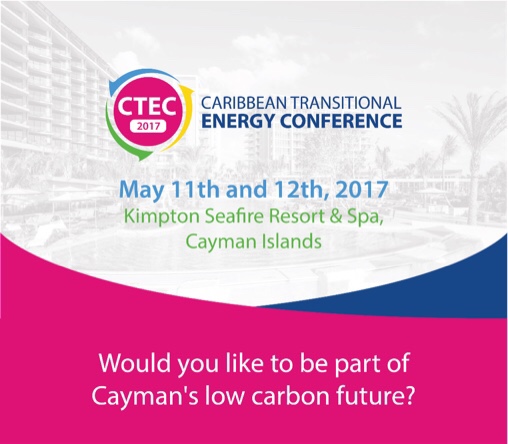
The Caribbean Transitional Energy Conference (CTEC)


Caribbean economies suffer from some of the highest electricity prices in the world.

Despite their abundance of renewable energy sources, Cayman has a relatively low level of renewable energy penetration; the economy continues to spend a large proportion of its GDP on imported fossil fuels and residents and businesses continue to pay some of the highest electricity bills in the region. This is a common situation among island nations.

There is a clear opportunity for Cayman to emerge as a regional leader in developing solutions to address climate change through the adoption of renewable energy which will reduce the dependency on fossil fuels and provide key environmental, social and economic benefits.

With the Cayman Islands National Energy Policy now in place, a framework for transition is complete and seizing upon that vision will be critical to affecting positive change for the Cayman Islands and all those who follow.

The recent achievements for islands at COP21 provide a strong driver for action focused on carbon reduction goals. Given that Cayman ranks highly among islands as carbon emitters, it is critical that we position ourselves as leaders in carbon reduction and meet the goals set out in the National Energy Policy and the Paris agreement.

Cayman seeks to stand with other islands in the region and across the world to embrace a low carbon future and to stand on the front line of demonstrating solutions to climate change while delivering cheaper, secure, reliable and economically feasible energy solutions.
Who should attend?

Be part of Cayman’s low carbon future by joining an event which seeks to set out our vision, renewable road-map and opportunities.

The event will bring together delegates from public, private and non-profit sectors, underlining our collaborative approach to a sustainable future- government officials, project developers, manufacturers, investors and key players across the non-profit landscape.

Join government official and industry leads and participate in interactive panel discussions that seek to establish what the journey ahead looks like and how we address the challenges and maximise the opportunities.

Make the most of key networking opportunities, bringing together local, regional and global participation.
For More Information and Register

Tuesday, April 11, 2017

Caribbean Transitional Energy Conference

WHY CAYMAN? WHY NOW?

Caribbean economies suffer from some of the highest electricity prices in the world. Despite their abundance of renewable energy sources, Cayman has a relatively low level of renewable energy penetration; the economy continues to spend a large proportion of its GDP on imported fossil fuels.

The Caribbean Transitional Energy Conference (CTEC) is about building our resilience as a small nation, about diversifying our energy sector and the way that we do business.

It is about ensuring sustainable social and economic growth through strong leadership, recognising the threat of climate change and the vulnerability of islands across the world and voicing our commitment to take the measures that we can take now. More

Monday, January 23, 2017

Five Pacific islands lost to rising seas as climate change hits

Five Pacific islands lost to rising seas as climate change hits

The submerged islands were part of the Solomon Islands, an archipelago that over the last two decades has seen annual sea levels rise as much as 10mm (0.4in), according to research published in the May issue of the online journal Environmental Research Letters.

The missing islands, ranging in size from 1 to 5 hectares (2.5-12.4 acres) were not inhabited by humans. But six other islands had large swaths of land washed into the sea and on two of those, entire villages were destroyed and people forced to relocate, the researchers found.

One was Nuatambu island, home to 25 families, which has lost 11 houses and half its inhabitable area since 2011, the research said.

The study is the first that scientifically “confirms the numerous anecdotal accounts from across the Pacific of the dramatic impacts of climate change on coastlines and people,” the researchers wrote in a separate commentary on an academic website.

The scientists used aerial and satellite images dating back to 1947 of 33 islands, as well as traditional knowledge and radiocarbon dating of trees for their findings. More

Friday, November 25, 2016

At the waters edge - Granada


Please see the recently released video featuring The Nature Conservancy’s At the Water’s Edge project, which combines unique community and natural infrastructure approaches to build resilient communities in the Caribbean island of Grenada.


At the Water’s Edge - About the video

The Nature Conservancy teamed up with local government, community members and partners to strengthen one of Grenville, Grenada’s most powerful allies against climate change – nature itself. The Caribbean fishing town has faced years of erosion caused by the degradation of a coral reef, destruction of mangrove forests and severe weather. In January 2015, the Conservancy piloted innovative hybrid reef structures, the full build-out of which will reduce wave energy, and restoremangroves along the shoreline of Grenville Bay. Watch the video to see as the underwater structures are installed by local fishermen using local materials and hear from community and project leaders. This unique approach to coastal resilience, which combines community engagement with nature-based solutions, is helping Grenville become resilient to the impacts of climate change, while  rebuilding the habitats their economy and culture rely on. You can learn more about this unique project from October’s Nature Conservancy Magazine cover story and check out the video here.


Video Link: https://www.youtube.com/watch?v=hGZs-JT1NJA&feature=youtu.be