Showing posts with label Governance. Show all posts

Sunday, April 26, 2015

Economic Legacy of Lee Kuan Yew: Lessons for Aspiring Countries

Developing countries have much to learn from Lee Kuan Yew, the first prime minister of Singapore who transformed the republic from a third world economy to one of the most advanced countries in one generation.

Lee Kuan Yew

The lessons for countries aspiring to learn from the Singapore development model are clear – strengthen institutions and improve governance.

But this is much easier said than done. To begin with aspiring countries need to improve the rule of law so that no one is above the law of the land. Equally crucial, they need to reduce corruption as corruption is regressive – small and medium-sized firms pay higher amounts in bribes than large firms.

Thirdly, they need to reform public institutions such as the civil service, bureaucracy, and public administration. Fourthly, they also need to improve the environment affecting the private sector through regulatory reforms, reforms of labour markets, and provision of clearly-defined property rights.

The dilemma is that such reforms generate benefits only in the longer term, making them hard for policymakers and politicians with a shorter time horizon to set as priorities. Yet without them, other policy measures to support sustained economic growth will become less effective and ultimately unravel.

Importance of good governance

Strong institutions and good governance – the economic legacy of Lee Kuan Yew for aspiring countries

The Singapore model of good governance is well-recognised. Development theorists of the past were of the view that economic development could be explained solely by factors like the availability of natural resources, high levels of saving and investment, and openness to foreign trade and investment.

More recently, the Growth Report published in 2008 by the Commission on Growth and Development headed by Nobel laureate Michael Spence has found that an additional factor has also to be good governance, based on mainly Singapore’s development experience under Lee.

As Senior Minister Goh Chok Tong, who participated in the Commission, puts it, for a delicious dish “besides having the right ingredients and the right recipe, you must have a master chef”.

Economic development does not just happen. It must be consciously chosen as an overarching goal by the government.

Good governance means a government that delivers political and economic stability, implements the correct macroeconomic policies, articulates a vision for the country and implements it.

This requires a capable, committed, and credible government, governments that people can trust in, and leaders who are above the board. An abundance of natural resources is neither necessary nor sufficient for a country’s economic development. What is required is good governance.

A case of good governance is Lee’s choice of the Singapore development model in the 1960s and beyond.

The Singapore Development Model

After the separation from Malaysia in 1965, Singapore was similar to a typical developing country of today. GNP per capita was about US$300, unemployment rates were high, and racial disharmony was rife. The announcement by the British in 1968 that they would withdraw their forces from Singapore was also expected to aggravate the unemployment situation further. How should jobs be created?

As the prime minister of a small country, Lee was always thinking big and making bold decisions in the interest of the country. Mr Lee adopted a development model based on export of labour-intensive manufactured goods to world markets. Lee invited multinational companies from all over to invest heavily in Singapore. Produce in Singapore and sell to the world, he told them.

To provide an attractive investment environment, the government built the appropriate infrastructure, cut tariffs and quotas, offered tax incentives, and implemented appropriate macroeconomic policies. The Economics Development Board (EDB) Singapore was established in 1961 to provide a business friendly environment to foreign investors and to convince them that Singapore was a good place to invest.

The National Wages Council (NWC) was also established in 1972 to make sure that the benefits of foreign investment were shared and also to accelerate Singapore’s move up the development ladder. Mr Lee also met foreign investors regularly and listened to them and their grievances.

Although pragmatic, Lee’s choice of an export-oriented development model driven mainly by foreign investment was a risky strategy at the time. This is because in the 1960s and 1970s, foreign investment was not welcome in the developing world.

The dependency theorists, in particular, argued that foreign investors from developed countries typically exploit cheap labour and extract natural resources of the developing countries. It is only after the success of the Singapore development model that export-oriented development strategies driven by foreign investment has been popularly adopted all over the world.

‘It’s not how you start but how you arrive’

In the 1980s and the 1990s the type of investment Singapore sought to attract shifted gradually from labour-intensive industries (eg, garments, textiles, and wigs) towards more high-tech and knowledge-based industries (eg, chips, wafer fabs, and disk drives).

Lee noted that, since the unemployment problem had been overcome, the new challenge was “how to improve the quality of the new investments and with it the education and skill levels of our workers”.

Lee’s attempt to make Singapore the Asian financial centre and global business hub is also bold. Unable to compete with Hong Kong then, Lee tried especially hard to convince foreign bankers and international financial institutions to come to Singapore by establishing integrity, efficiency, the rule of law, reliability, and stability.

In his words, “[the] history of our financial centre is the story of how we built up credibility as a place of integrity, and developed the officers with the knowledge and skills to regulate and supervise the banks, security houses and other financial institutions….”

Overall, Mr Lee’s development strategy which focused on strengthening institutions and improving governance was successful. Other developing countries will, however, face difficulties in adopting this strategy.

A case in point is South Asia. Countries in this region had begun their reform programmes in the early 1990s by focusing on macroeconomic areas – monetary and fiscal reforms, and industrial deregulation – which had contributed to a more rapid economic growth.

These reforms, however, eventually ran out of steam – because of red tape, endemic corruption, and lack of rule of law – and have contributed to the recent economic slowdown. Lee’s model followed his dictum, which he shared with the King of Bhutan: “It’s not how you start the journey that counts, but how you arrive.” More


Friday, November 28, 2014

Laying the Foundations of a World Citizens Movement

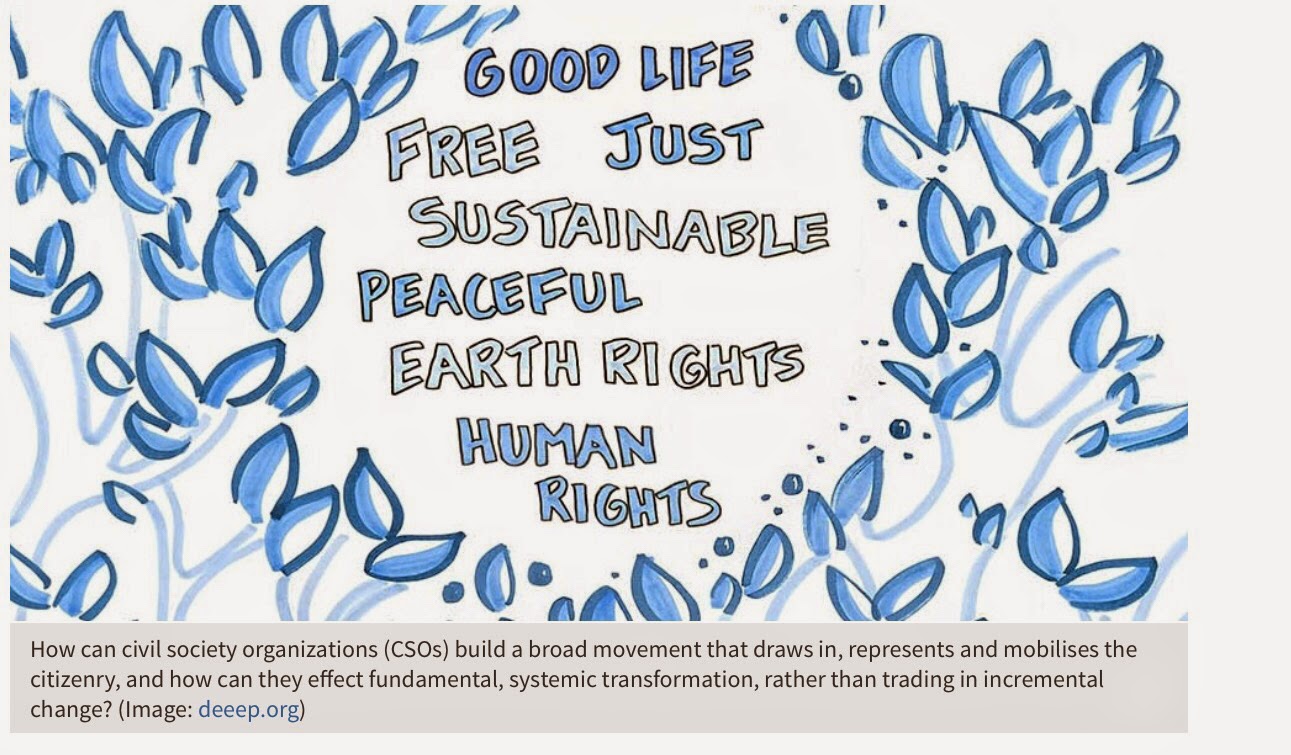
How can civil society organizations (CSOs) build a broad movement that draws in, represents and mobilises the citizenry, and how can they effect fundamental, systemic transformation, rather than trading in incremental change?

JOHANNESBURG, South Africa - Has organised civil society, bound up in internal bureaucracy, in slow, tired processes and donor accountability, become simply another layer of a global system that perpetuates injustice and inequality?

How can civil society organizations (CSOs) build a broad movement that draws in, represents and mobilises the citizenry, and how can they effect fundamental, systemic transformation, rather than trading in incremental change?

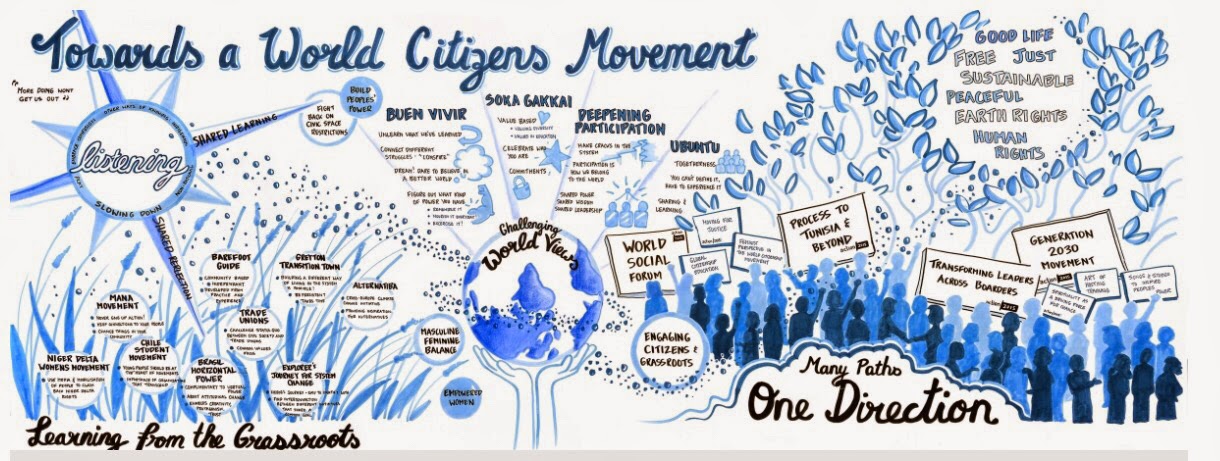
This kind of introspective reflection was at the heart of a process of engagement among CSOs from around the world that gathered in Johannesburg from Nov. 19 to 21 for the “Toward a World Citizens Movement: Learning from the Grassroots” conference.

Organised by DEEEP, a project within the European civil society umbrella organisation CONCORD which builds capacity among CSOs and carries out advocacy around global citizenship and global citizenship education, the conference brought together 200 participants.

“It is important that people understand the inter-linkages at the global level; that they understand that they are part of the system and can act, based on their rights, to influence the system in order to bring about change and make life better – so it’s no longer someone else deciding things on behalf of the citizens”
– Rilli Lappalainen, Secretary-General of the Finnish NGDO PlatformKey partners were CIVICUS (the World Alliance for Citizen Participation, which is one of the largest and most diverse global civil society networks) and GCAP (Global Call to Action Against Poverty).

The three-day gathering was part of a larger series of conferences and activities that were arranged to coincide during the 2014 International Civil Society Week organised by CIVICUS, which closed Nov. 24.

Global citizenship is a concept that is gaining currency within the United Nations system, to the delight of people like Rilli Lappalainen, Secretary-General of the Finnish NGDO Platform and a key advocate for global citizenship education.

At the heart of this concept is people’s empowerment, explains Lappalainen. “It is important that people understand the inter-linkages at the global level; that they understand that they are part of the system and can act, based on their rights, to influence the system in order to bring about change and make life better – so it’s no longer someone else deciding things on behalf of the citizens.”

The process of introspection around building an effective civil society movement that can lead to such change began a year ago at the first Global Conference, also held in Johannesburg.

The discourse there highlighted the need for new ways of thinking and working – for the humility to linger in the uncomfortable spaces of not knowing, for processes of mutual learning, sharing and questioning.

This new spirit of inquiry and engagement, very much evident in the creative, interactive format of this year’s conference, is encapsulated in an aphorism introduced by thought-leader Bayo Akomolafe from Nigeria: “The time is very urgent – let us slow down”.

Akomolafe’s keynote address explored the need for a shift in process: “We are realising our theories of change need to change,” he said. “We must slow down today because running faster in a dark maze will not help us find our way out.”

“We must slow down today,” he continued, “because if we have to travel far, we must find comfort in each other – in all the glorious ambiguity that being in community brings … We must slow down because that is the only way we will see … the contours of new possibilities urgently seeking to open to us.”

A key opportunity for mutual learning and questioning was provided on the second day by a panel on ‘Challenging World Views’.

Prof Rob O’Donoghue from the Environmental Learning Research Centre at South Africa’s Rhodes University explored the philosophy of ubuntu, Brazilian activist and community organiser Eduardo Rombauer spoke about the principles of horizontal organising, and Hiro Sakurai, representative of the Buddhist network Soka Gakkai International (SGI) to the United Nations in New York, discussed the network’s core philosophy of soka, or value creation.

A female activist from Bhutan who was to join the panel was unable to do so because of difficulties in acquiring a visa – a situation that highlighted a troubling observation made by Danny Sriskandarajah, head of CIVICUS, about the ways in which the space for CSOs to work is being shrunk around the world.

The absence of women on the panel was noted as problematic. How is it possible to effectively question a global system that is so deeply patriarchal without the voices of women, asked a male participant. This prompted the spontaneous inclusion of a female member of the audience.

In the spirit of embracing not-knowing, the panellists were asked to pose the questions they think we should be asking. How do we understand and access our power? How do we foster people’s engagement and break out of our own particular interests to engage in more systems-based thinking? How can multiple worldviews meet and share a moral compass?

Ubuntu philosophy, explained O’Donoghue, can be defined by the statement: “A person is a person through other people.”

The implications of this perspective for the issues at hand are that answers to the problems affecting people on the margins cannot be pre-defined from the outside, but must be worked out through solidarity and through a process of struggle. You cannot come with answers; you can only come into the company of others and share the problems, so that solutions begin to emerge from the margins.

The core perspective of soka philosophy is that each person has the innate ability to create value – to create a positive change – in whatever circumstances they find themselves. Millions of people, Sakurai pointed out, are proving the validity of this idea in their own contexts. This is the essence of the Soka movement.

His point was echoed the following evening in the address of Graca Machel, wife of the late Nelson Mandela, at a CIVICUS reception, in which she spoke of the profound challenges confronting civil society as poverty and inequality deepen and global leaders seem increasingly dismissive of the voices of the people.

Then, toward the end of her speech, she softly recalled “my friend Madiba” (Mandela’s clan name) in the final years of his life, and his consistent message at that time that things are now in our hands.

What he showed us by his example, she said, is that each person has immense resources of good within them. Our task is to draw these out each day and exercise them in the world, wherever we are and in whatever ways we can.

Those listening to Machel saw Mandela’s message as a sign of encouragement in their efforts to create the World Citizens Movement of tomorrow. More


Tuesday, September 2, 2014

Disaster risk and climate change dominate agenda at Small Island Developing States Conference

Over 2,000 delegates have gathered in the Samoan capital Apia for the 3rd International Conference on Small Island Developing States (SIDS).

The conference, which takes place every ten years, brings together representatives from governments, the UN, the International Federation of Red Cross and Red Crescent Societies (IFRC) and other development and civil society actors; to discuss emerging challenges facing countries in the three SIDS regions: the Pacific, the Caribbean, and the African, Indian Ocean, Mediterranean and South China Sea (AIMS).

President of the conference, Honourable Tuilaepa Lupesoliai Sailele Malielegaoi, Prime Minister of Samoa, said in his opening speech that sympathy and pity will not provide solace or halt the devastating impact of climate change.

“Our message is the same today as it was in Rio in 1992: climate change is a global problem, yet international action to address it remains grossly inadequate. We want all our partners to step forward and commit to address once and for all the root causes of climate change.”

This message was reinforced by UN Secretary General, Ban ki-Moon who highlighted the ever-increasing threat that many countries are confronting as a consequence of climate change. “The plight of millions of people in small island development states demands an international response. By failing to act, we condemn the most vulnerable to unacceptable disruption to their lives as a result of the actions of those a world away,” he said.

Sustaining development

The theme for SIDS 2014 is the sustainable development of Small Island Developing States through genuine and durable partnerships.

In his statement during the multi-stakeholder partnership dialogue on climate change and disaster risk management, IFRC president Tadateru Konoé, called upon governments to strengthen resilience and disaster preparedness as a first line of defence for vulnerable people.

“Small Island Developing States already cope with disproportionate consequences of disasters. The aim of IFRC and its member National Red Cross and Red Crescent Societies is to build their empirical knowledge and increase their resilience by bridging traditional community support systems with science and technology.”

During the conference the IFRC signed a three-year memorandum of understanding with the Secretariat of the Pacific Regional Environment Programme (SPREP) under which Red Cross National Societies in ten countries across the Pacific will work with National Meteorological Offices to make climate and weather information more accessible, relevant and user-friendly for users such as fishers and farmers.

“The partnership is about strengthening the local humanitarian response and reducing disaster risk by making climate and weather information relevant to the needs of communities living on the frontline of climate change,” said Jagan Chapagain, director of the IFRC in Asia Pacific.

Another unique project highlighted during a side event at the conference on displacement in the context of disasters and the effects of climate change was the ‘At the Water’s Edge’ project, involving the Grenada Red Cross, Government of Grenada, the Nature Conservancy and Grenada Fund for Conservation partnership. The project has shown how sharing community and environmental expertise through education, mangrove replanting and coral reef protection has helped to reduce disaster risk and strengthen the capacity of local communities to adapt to the effects of climate change.

In his closing remarks, President Konoé made it clear that while action was necessary to help communities adapt to the consequences of climate change, change in global policy is equally important. “The IFRC calls for the strong integration of climate change and disaster risk reduction into upcoming frameworks,” he said. “It is critical that governments arrive at a strong second Hyogo Framework for Action, a legally binding climate change agreement and a post-2015 development agreement with community resilience at its core. More