Showing posts with label Cayman. Show all posts

Saturday, June 17, 2017

Monica’s political diary: ten steps to a better Bermuda

Monica Jones find party politics in Bermuda divisive and destructive. She would like to see all our elected representatives working with each other and with members of the public service, private sector and labour unions in dignified and respectful ways to do the following:

Monica Jones

1, Create schools that foster peace, tolerance, friendship and understanding. Where the potential of all children is developed, with teachers, families and students receiving support, learning enrichment and encouragement to realise this goal

2, For all bickering, quarrelling, complaining, point scoring, competition and power grabbing to stop. To stop denigrating, diminishing, complaining and criticising, and instead to support and encourage the best potential of each other and our community

3, To put the interests of the greater community first and for personal interests to be secondary. For those of us who are not in governance, to allow people in public office to have private lives, personal time and space

4, To draw on the differing wisdom, strengths, talents and capabilities of all involved in providing governance

5, To remember the goal of all laws is to foster peace, tolerance, good order — to foster human rights with the responsibility of treating all people as free and equal in dignity and rights

6, When decisions are made, give them time to see if they are correct or not. If decisions need to be tweaked or rethought in business, it’s simply done. To expect perfection the first time round in country governance is unrealistic. Circumstances change and new information comes to light. Change is inevitable. When we contribute to the process, and support and encourage change, then we are constructive and create a climate where it is OK to say “I made a mistake” or “In light of new information, I’ve realised we need to change course”

7, To create a culture and climate where it is understood that we all have differing beliefs, and it is a normal and ordinary part of being alive, and to access the collective wisdom and greatness of those beliefs

8, No more pedestals or heroes. We are all human beings. We are perfect and flawed at the same time. When we put people on pedestals, they always fall off. The best thing we can do is to support and encourage respectful and dignified behaviour. To laugh, to love and be in peace. Keeping the word “respect” in the centre of our lives. Doing unto others as we would have done unto us. The term “do unto others” means something different to each one of us

9, To pass laws and put strategies in place so as to achieve full employment. To protect and support the most vulnerable people in our society

10, We all have buttons and when those buttons are activated, they create any number of stories that are not the truth of who we are or who anyone else is. It’s called “cognitive dissonance”.

This happens to everyone. When we want to blame, criticise, complain or have repetitive negative thoughts, we can choose to press the pause button. To allow curiosity to trickle in.

To develop a greater sense of compassion for ourselves and others.

To practise opening our hearts and minds.

In politics and advertising, our buttons are deliberately manipulated to achieve a certain result. If we learn how our brains operate, we become able to deactivate our buttons and are much less susceptible to manipulation because we have created space for our deep-thinking brain to operate.

The process of questioning ourselves and asking whether our reaction is the truth or not is a lifelong practice. On the other side of each question is an opportunity that creates an immense amount of wisdom and personal power.

We have to stop looking outside ourselves for change to be brought about by someone else. A wise friend told me: “Change is like a jigsaw puzzle. There are many pieces and players, and the picture isn’t clear. It becomes clear as many people put in the pieces to solve the puzzle. There are many puzzles to be solved.”

Change is a journey, not a destination.

Each one of us has to ask how we can help.

As long as we keep on asking that question and are prepared to lead and follow, we’ll keep on moving forward. More

Thursday, May 4, 2017

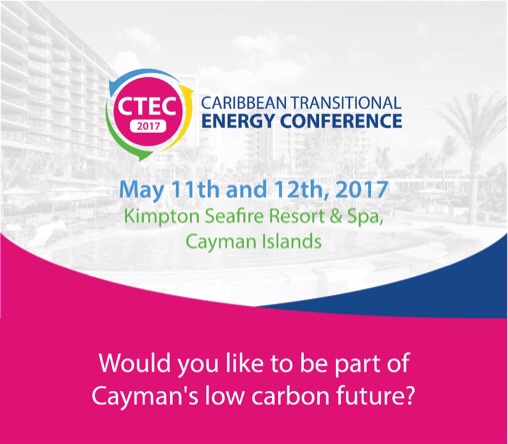
The Caribbean Transitional Energy Conference (CTEC)


Caribbean economies suffer from some of the highest electricity prices in the world.

Despite their abundance of renewable energy sources, Cayman has a relatively low level of renewable energy penetration; the economy continues to spend a large proportion of its GDP on imported fossil fuels and residents and businesses continue to pay some of the highest electricity bills in the region. This is a common situation among island nations.

There is a clear opportunity for Cayman to emerge as a regional leader in developing solutions to address climate change through the adoption of renewable energy which will reduce the dependency on fossil fuels and provide key environmental, social and economic benefits.

With the Cayman Islands National Energy Policy now in place, a framework for transition is complete and seizing upon that vision will be critical to affecting positive change for the Cayman Islands and all those who follow.

The recent achievements for islands at COP21 provide a strong driver for action focused on carbon reduction goals. Given that Cayman ranks highly among islands as carbon emitters, it is critical that we position ourselves as leaders in carbon reduction and meet the goals set out in the National Energy Policy and the Paris agreement.

Cayman seeks to stand with other islands in the region and across the world to embrace a low carbon future and to stand on the front line of demonstrating solutions to climate change while delivering cheaper, secure, reliable and economically feasible energy solutions.
Who should attend?

Be part of Cayman’s low carbon future by joining an event which seeks to set out our vision, renewable road-map and opportunities.

The event will bring together delegates from public, private and non-profit sectors, underlining our collaborative approach to a sustainable future- government officials, project developers, manufacturers, investors and key players across the non-profit landscape.

Join government official and industry leads and participate in interactive panel discussions that seek to establish what the journey ahead looks like and how we address the challenges and maximise the opportunities.

Make the most of key networking opportunities, bringing together local, regional and global participation.
For More Information and Register

Tuesday, April 25, 2017

The Climate War Room now has new .eco domain

The Climate War Room, an initiative of The Cayman Institute is committed to using a .eco domain, which is a new web address ending for anyone committed to positive change for the planet.


.eco is a new web address ending—known as a top-level domain—for anyone committed to positive change for the planet. .eco web addresses are available to any business, government, non-profit or individual working toward a sustainable future.

The .eco domain is backed by more than 50 environmental organizations including Conservation International, United Nations Global Compact and WWF and is a trusted symbol for the environmental community. www.climatewarroom.org

Monday, April 24, 2017

The Caribbean Transitionary Energy Conference (CTEC2017) was officially launched

The Caribbean Transitionary Energy Conference (CTEC2017) was officially launched this morning with a press conference at The Cayman Islands Government building this morning.

Remarks were given by Hon. D. Kurt Tibbetts OBE, JP, MLA - Cayman Islands Minister for Planning, Lands, Agriculture, Housing and Infrastructure, event organiser James Whittaker - CEO, GreenTech Group and President, Cayman Renewable Energy Association (CREA), and sponsor Pilar Bush, Executive Vice President of Marketing, Dart Enterprises Ltd. Visit our website to register

Tuesday, April 11, 2017

Caribbean Transitional Energy Conference

WHY CAYMAN? WHY NOW?

Caribbean economies suffer from some of the highest electricity prices in the world. Despite their abundance of renewable energy sources, Cayman has a relatively low level of renewable energy penetration; the economy continues to spend a large proportion of its GDP on imported fossil fuels.

The Caribbean Transitional Energy Conference (CTEC) is about building our resilience as a small nation, about diversifying our energy sector and the way that we do business.

It is about ensuring sustainable social and economic growth through strong leadership, recognising the threat of climate change and the vulnerability of islands across the world and voicing our commitment to take the measures that we can take now. More

Friday, August 7, 2015

What is holding back the Cayman Islands from implementing more solar and wind energy?

The Caribbean appears to be the ideal location for renewable energy development. Petroleum resources are scarce and renewable resources such as solar, wind and geothermal are plentiful. Energy prices are high as there is no opportunity for economy of scale benefits that large land masses enjoy. Added to that, climate change impacts pose a major threat to the region’s small-island economies that are largely dependent on tourism and agriculture.

Despite this, most Caribbean nations still use imported diesel or oil to generate 90-100% of their energy. So what has been the barrier to using renewables? Many people have pointed to the cost factor. Small economies mean that in most cases countries have difficulty in financing renewable energy projects that require high upfront capital. Also, regulations have been slow in setting clear rules for grid interconnection. These factors have led some international investors and developers to be cautious about entering the Caribbean market. http://bit.ly/1NeB0fj


Sunday, March 22, 2015

Could Cayman Become The Singapore Of The West?

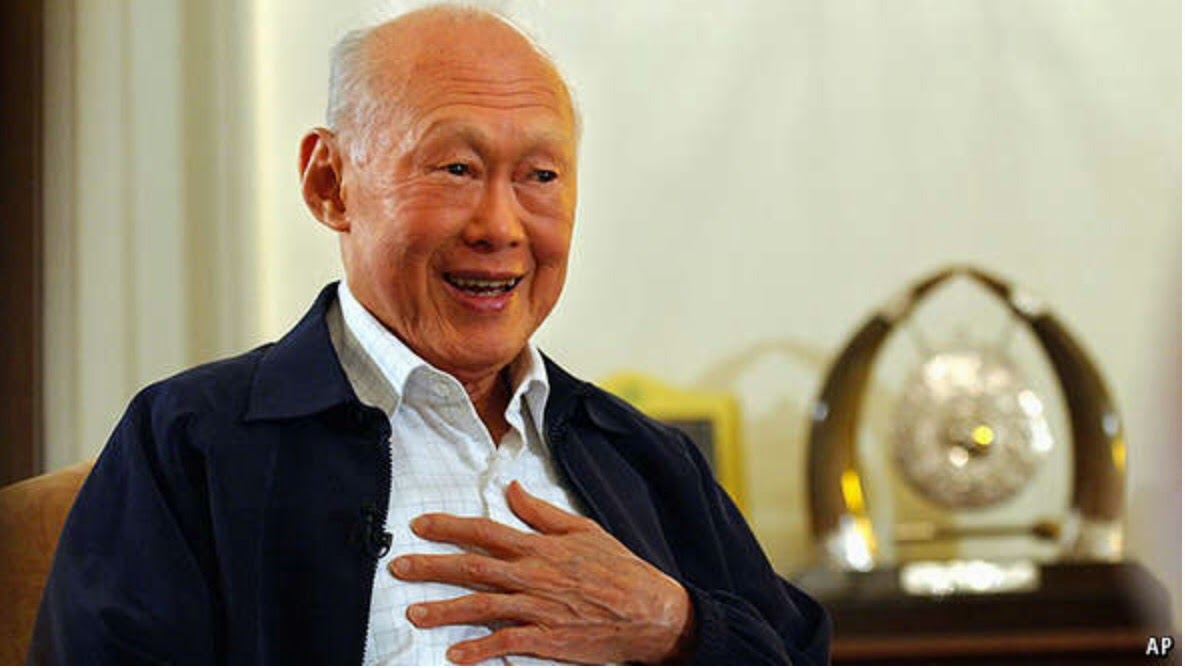
Lee Kuan Yew - Father of Singapore

Lee Kuan Yew - The wise man of the East

IF YOU seek his monument: look around Singapore. Prosperous, orderly, clean, efficient and honestly governed, it is not the work of Lee Kuan Yew alone. But even his severest critics would agree that Mr Lee, who died early on March 23rd (Singapore time) at the age of 91, played an enormous part. Singapore’s leader from before "self-government" from Britain in 1959, he was prime minister until 1990, and retired in stages, leaving the cabinet only in 2011, and remaining a member of parliament until his death. Under him Singapore, with no natural resources, has become one of the world’s richest countries. Many admirers look to it as a model, and Mr Lee as a sage. He did indeed have much to teach the world; but some, especially in China, draw the wrong lesson: that authoritarianism works.

Part of Mr Lee’s influence stemmed from his role as a clear-eyed, blunt-speaking geostrategist. He was an astute observer of the defining contest of our era—China’s emergence and how America reacts to it. He was also a respected interpreter of each to the other, and an important voice, with unique access in both countries, arguing for continued American engagement in Asia and for Chinese tolerance of it.

Critics mock Singapore for being like North Korea or as "Disneyland with the death penalty", as William Gibson described it in 1993. However, Mr Lee’s defenders argue that the restrictions are a small price to pay for stability and prosperity. GDP figures do not lie: Mr Lee’s policies have worked. Singapore is a thriving city-state. Unlike North Korea or Disneyland, it offers a real challenge to the liberal notion that growth, prosperity and freedom should and do go together.

China’s leaders, especially, are fascinated by Singapore’s style of one-party rule. They see flaws in "Western-style democracy": its short-termism; its disregard for non-voters such as children and foreigners; and its habit of throwing up unqualified leaders. Mr Lee’s "meritocracy" promises a solution.

But four peculiarities of Singapore make it look like an anomaly. First is its size. It is a city with a foreign policy, which means it has a cohesion that vast, diverse countries cannot match. Second, this cohesion is reinforced by the turbulent circumstances of its birth. After a painful divorce from Malaysia in 1965, the government has never let Singaporeans forget that a Chinese-majority island, surrounded by Muslim-majority Indonesia and Malaysia, would always be vulnerable. Geography is third. Singapore has flourished in part because of the failings of the rest of its region. Rather as Hong Kong’s prosperity was based on being Chinese but not entirely part of China, so Singapore is in South-East Asia, but not of it.

Only one Lee Kuan Yew
However, the most important reason for Singapore’s singular experience is Mr Lee himself. Incorruptible himself, he kept government unusually clean. He ensured that Singapore pays its ministers and civil servants high salaries. Under today’s prime minister, his son Lee Hsien Loong, the bureaucracy has remained orderly and clean. Unlike many other independence leaders, Mr Lee designed a system to outlast him. Singapore’s government claims it has faced enough electoral competition to keep it honest but not so much that there was a high risk of losing power. So it has been able to eschew populism and take decisions in the country’s long-term interests.

But in most countries, probity requires checks, balances and an opposition that is not always condemned as unpatriotic. In China, for example, Xi Jinping, two years into an anti-corruption campaign, shows no sign of winning the battle. Across much of the developing world, those in opposition are treated as traitors whether their criticisms make sense or not.

Even in Singapore the model may not outlast its creator for long. Singaporeans are having few children and ageing fast, so the government faces demands for more generous social-welfare provisions. And growth has become dependent on high levels of immigration, angering natives who feel the influx is suppressing their wages and making it impossible to get a seat on the tube. That balance between competition and inevitable re-election is shifting uncomfortably. The Singapore model may prove unsustainable even in Singapore. More


Friday, August 29, 2014

‘Mangrove Man’ inspired by world travel

He’s traveled half a million miles over the years – enough to go around the world 12 times, or to the moon and halfway back – so it’s little wonder that writer, photographer, conservationist and educator Martin Keeley continues to find inspiration for his work.

Keeley’s latest trips are with the Marvelous Mangrove education curriculum, a program that teaches schoolchildren about the importance of mangroves and the eco-systems which they support worldwide, as well as training teachers to teach both students and other teachers.

The program was developed by Cayman Brac-based Keeley in 1999 and initially was incorporated into Cayman’s primary school curriculum. It is part of the Mangrove Action Project, a conservation group comprised of more than 300 scientists and academics spanning more than 60 nations.

The Marvelous Mangrove program is now in 11 countries, with the expansion this year to South Sulawesi, Indonesia, and Queensland, Australia.

“For me, the mangrove trips continue to stimulate the creative process,” said the writer.

“They often inspire my poetry, and I reckon that in another six months or so I’ll have enough to publish another anthology. My photography also continues to benefit from my travels and exposure to other cultures and their environments.”

In addition, he says, he gets an in-depth perspective on the countries and the cultures where he works.

“I experience and observe firsthand their societies and the common problems they face – the huge and ever growing disparity between the obscenely wealthy and the desperately poor who are barely making it,” Keeley added.

“The contrasts I observed this summer between nations like Indonesia and Australia stimulate not only sympathy and anger between the haves and have-nots, but empathy with those whose daily struggle is that of survival, while others have little or no idea how lucky they are take for granted their secure and protective social environment.”

At the Indonesian trip, 30 teachers and educators spent three days in an intense workshop that, in the words of Keeley, “introduced them to the wonderful world of mangroves through hands-on science.”

A particular highlight was the surprise introduction of 15 school kids who came in and assisted for the afternoon, Keeley said.

“The setting is perfect, with elevated cabins connected by elevated walkways and the “hall” for the workshop itself in a Roman-style amphitheater that is open to the elements – roofed, but with shutters, not glass windows,” he said.

“The accommodation, theater and restaurant operate independent of the grid on solar power with water from local wells and storage systems which is treated through solar osmosis, although it sometimes has to be topped up by water trucks during the dry season. The food is all grown locally, and mostly seafood that is caught locally on a daily basis.”

The Australian leg of the trip, he said, was slightly different.

“Australia saw the launch of ‘Mangrovia,’ a huge inflatable red mangrove that students go inside to explore and hear storytelling,” Keeley said.

“In addition, Mangrovia’s creator, international festival artist Evelyn Roth, also designed and made 28 costumes of mangrove critters that are used in conjunction with the inflatable.

“Many Cayman students [and adults] have had similar experiences with my huge inflatable shark and the 30 mangrove critter costumes which go with it during the past 15 years! It’s an exciting way to learn.”

The issue of mangrove conservation has become more and more important in recent years, Keeley says, largely because of their environmental qualities.

“It has been known for many years, and the 2004 Asian Tsunami proved it beyond doubt, that mangroves are the first line of defense against major tropical storms, be they hurricanes or typhoons,” Mr. Keeley continued.

“Recent studies during the past six or seven years have also shown that, given the opportunity, mangroves will keep pace with sea level rise thereby extending that level of protection. In addition, recent research has shown that mangroves capture CO2 from the atmosphere and store it in leaves, roots, trunks and soil.

“No maximum storage capacity has been determined as the trees continuously store carbon in the soil for centuries or millennia. Obviously ripping out mangroves releases this stored CO2 and thereby adds to the acceleration of global warming.

“National governments from Vietnam and China to Belize and Guatemala have come to understand what local communities and scientists have been telling them for many years. Mangroves are the major source of more than 75 percent of reef species of fish and invertebrates – they are the spawning and nursery grounds for these species. Thousands of communities round the world rely on these aquatic species for their livelihoods and to feed their families.”

Next up for stamps on the increasingly-packed passport pages will be trips to Bangladesh and Kenya, scheduled for summer 2015. Keeley has already visited both briefly to get the ball rolling and he told Weekender that – funding permitting – translations of the materials and teacher training workshops will be introduced.

There seems no sign of slowing down there, either, for the Brac-based whirlwind.

“World-wide at least a dozen other countries are interested in the Marvellous Mangroves curriculum,” he concluded.

“As usual, it’s just a matter of time and, of course, money, to make it happen.” More


Friday, August 15, 2014

For the Caribbean, a United Front Is Key to Weathering Climate Change

PHILIPSBURG, St. Maarten, Jul 2 2014 (IPS) - As the costs of climate change continue to mount, officials with the Commonwealth grouping say it is vital that Small Island Developing States (SIDS) stick together on issues such as per capita income classification.

Seawall in Dominica

Deputy Commonwealth Secretary General (Economic and Social Development) Deodat Maharaj told IPS the classification affects the ability of countries like Antigua and Barbuda, Grenada and others to access financing from the international financial institutions.

“To my mind, the international system has to take special consideration of countries such as Antigua and Barbuda, Grenada and others,” he said.

“The example I like to use is the example of Grenada. You would recall Hurricane Ivan about 10 years ago. It damaged about 70 percent of the housing stock in Grenada. It cost a billion U.S. dollars in damages, equivalent to two years GDP.

“So the countries in the Caribbean can move from high income or middle income to almost zero income with an economic shock or natural disaster,” Maharaj added.

Maharaj, whose appointment took effect earlier this year, said the Commonwealth is preparing “an analytical framework based on research, a case, so that countries such as Grenada when there is a natural disaster their international debt obligation for a particular period of time will be suspended so that they don’t have to continue to pay their debt when it is that they have suffered a natural disaster.”

On the issue of collaboration, one of only three female prime ministers in the Caribbean has reaffirmed her country’s commitment to dealing with climate change and all the issues associated with the global phenomena.

“I would like to reaffirm my strong belief in collaboration with other nations,” Sarah Wescot-Williams, the prime minister of St. Maarten, told IPS.

“Economic issues have forced us to look at ways and means of getting together and we are working collaboratively with other Caribbean nations to mitigate the effects of climate change as well as social issues of unemployment, crime and health.”

Prime Minister of St. Maarten Sarah Wescot-Williams (left)

St. Maarten recently developed and approved its National Energy Policy “and as such we have very specific goals and objectives to reach by 2020 in terms of reduction and promoting alternative, new green ideas, new green products,” Wescot-Williams explained.

She reiterated a point made while addressing regional leaders recently. “I told them we should not only look out for the bigger impacts of climate change or look at those developments as something that is far from us, far from our homes, but look at small things like beach erosion, something that St. Maarten is seeing.

“A report has been issued not very long ago indicating that unless specific measures are taken, a great part of what is now land will no longer be as far as the smaller islands, including St. Maarten, are concerned.”

How they are ranked by financial institutions such as the International Monetary Fund (IMF) and World Bank is a major issue for Caribbean countries.

Camillo Gonsalves, a former ambassador to the United Nations, says it affects these countries’ ability to secure the required funding to effectively deal with climate change.

He noted that most Caribbean countries are ranked as middle-income countries, and using that metric alone makes his country, St. Vincent and the Grenadines, with its one-billion-dollar Gross Domestic Product (GDP), “richer than China”.

“If that is the metric by which we determine economic health and access to concessionary financing, and our ability to borrow ourselves out of a crisis or to spend ourselves out of a crisis, it is clearly a flawed measure,” he said.

He noted that within three hours last Christmas Eve, a trough system left damage and loss in St. Vincent equal to 17 percent of GDP, while the country also suffered natural disasters in 2010, and 2011 – the loss and damage from each of which was in double digits.

This, however, is the measure by which the World Bank, the IMF determine the economic strength of Caribbean countries, Gonsalves said, adding that these international institutions do not consider the region’s vulnerabilities.

“The Caribbean small island developing states are among the most heavily indebted states in the world,” Gonsalves said, noting that the debt-to-GDP ratio in the region ranges from 20 percent in Haiti – which received significant debt forgiveness after the 2010 earthquake – to 139 percent in Jamaica, with St. Kitts and Nevis and Grenada at 105 and 115 per cent, respectively, even as the European Union has set itself a debt-to-GDP ratio of 65 per cent.

“If your debt-to-GDP ratio is 139 percent and you are struck by a natural disaster… how do you borrow yourself out of that crisis? Where do you find money immediately to build your roads, your houses, your bridges, your hospitals that have been damaged? How can you set money aside in preparation for the next climate event if you have a debt to GDP ratio of over 100 per cent or approaching 100 per cent, and your debt servicing charges are that high?” Gonsalves said.

Agreeing with Wescot-Williams and Maharaj that there is strength in unity, Gonsalves, who serves as foreign affairs minister for St. Vincent and the Grenadines, said the upcoming Third United Nations Conference on Small Island Developing States (SIDS) in Samoa is an ideal opportunity for regional countries to do more than just talk about collaboration.

“The issue of how we are ranked and classified has to be rectified – not addressed, not flagged, not considered. It has to be rectified in Samoa. That has to be one of our prime objectives going into this conference,” he said.

The Samoa conference will be held from Sep. 1-4 under the theme “The Sustainable Development of Small Island States Through Genuine and Durable Partnerships”.

It will seek to assess progress and remaining gaps; renew political commitment by focusing on practical and pragmatic actions for further implementation; identify new and emerging challenges and opportunities for the sustainable development of SIDS and means of addressing them; and identify priorities for the sustainable development of SIDS to be considered in the elaboration of the post-2015 U.N. development agenda.

Maharaj said “one big challenge” for his organisation is the advancement of the interest of small states.

“When I think about the Caribbean and I think about development…we need to think about development not only in terms of five years, 10 years or 15 years,” he said.

“I would like to think about and imagine what will the Caribbean be in the year 2050 at the time when our grand- and great-grandchildren will be around and many of us won’t be here,” Maharaj added. More


Tuesday, January 28, 2014

New funding for marine parks expansion

Computer programmers are designing a smartphone app to allow boaters to assist with enforcement across an expanded network of marine parks.

The proposals, which include dramatically expanding the no-fishing zones around the Cayman Islands, will go through another round of public consultation this year, according to Environment Minister Wayne Panton.

Mr. Panton gave his personal support to the plan, saying Cayman’s current marine parks were “no longer enough” to protect the islands’ natural resources from the threat of overfishing and development.

His comments came as the U.K. based Darwin initiative announced more than $100,000 in new funding to research and address concerns raised in an earlier study.

This includes developing phone and iPad apps that will allow people to report poaching and other marine violations in real time.

Experts at Bangor University in Wales are working on the technology, which will also allow boaters to use the GPS function on their phone to identify if they are in a marine protected area and to check what regulations apply.

Department of Environment officers will also be equipped with tablets that allow them to log in to licensing databases from the field, saving time and paperwork.

Gina Ebanks-Petrie, director of the Department of Environment, said the technology would enable the department to do more with the same resources, enabling them to police a much wider marine protected area without a significant increase in manpower.

Researchers will also look at the impact of lionfish on Cayman’s reefs, including a study to discover if the invasive fish has adapted its behavior to hide from divers. The lionfish research will ultimately impact how culling is managed.

Further work is also being done on aggregation sites, used by various species of fish, most famously the Nassau grouper, for annual spawning events. Scientists believe many different species could be using the same sites year-round, making them “the maternity wards” of the ocean and potentially worthy of additional protection.

They also want to take a closer look at recreational fishing habits in Cayman.

The marine parks plan proposes to include concessionary zones with boat ramps for fisherman at various points adjacent to the no-take areas.

Dr. John Turner, a senior lecturer at Bangor University and Darwin Initiative project partner, said, “When you have a marine protected area, there are going to be more fish, there are going to be larger fish. These concessionary areas would allow people to benefit from the overspill.

“We need to know more about how sustainable this would be. We are very interested in asking what fish people expect to be able to catch in these zones. We need to know what people are fishing now and how they may be impacted by the marine reserve around.”

Cayman was hailed as a world leader in environmental protection when it first introduced marine parks in 1986. The proposal to expand the protected zones, which came from an initial study also funded by the Darwin Initiative, has been discussed for several years, with some protest, particularly from fishermen who fear a threat to their livelihood.

Among the proposals are expanding the no-take zones – from which no marine life can be extracted – from about 15 percent of the narrow marine shelf around the islands to between 40 and 50 percent of the shelf and extending them from shore to a depth of 200 feet, compared to the current depth of 80 feet.

Mr. Panton said he supported an expansion of marine parks. But he said the new government needed the opportunity to consult with the public before going ahead.

The “post-project” phase of the research will be completed by September, at which point Mr. Panton hopes to be able to bring a proposal to the Legislative Assembly.

He added, “The current marine parks have provided benefits but they are no longer enough to counter the growing threats from overfishing, coastal development, invasive species, disease of corals and other marine organisms as well as the impact of climate change.”

He said Cayman Islands’ population had doubled and there had been significant development, as well as an increase in visitors, since the parks were first introduced 28 years ago.

“The legal and regulatory framework is no longer sufficient. It needs to be enhanced, it needs to be improved,” he said. More


Sunday, February 5, 2012

Island nations want climate change in world court

 UNITED NATIONS: Small island nations, whose very existence is threatened by the rising sea levels brought about by global warming, are seeking to take the issue of climate change before the International Court of Justice.

Johnson Toribiong, president of Palau, said Friday his country and other island nations had formed an expert advisory committee to bring the issue before the U.N. General Assembly. That would allow the world court in the Hague to determine the legal ramifications of climate change under international law.
”If 20 years of climate change negotiations have taught us anything, it’s that every state sees climate change differently. For some, it is mainly an economic issue … for others it’s about geopolitics and their past or future place in the global economy, but for us it’s about survival,” Toribiong said.
”Pacific countries are in the red zone, a swell of ocean where waters have risen two or three times higher than anywhere else in the world. That differential might explain why we speak about climate change so urgently and we look to everyone in every corner of the United Nations to find a solution,” he added.
Michael Gerrard, director of the Center for Climate Change Law at Colombia University and a member the advisory committee, said the idea is to have a court determination compelling developed nations to control emissions of the greenhouse gases believed to cause global warming in the absence of an international treaty. More
 

Saturday, February 4, 2012

Interview with John Ashton, UK's Special Representative for climate change

 “It was the voice of the Caribbean that changed the world at Durban,” says John Ashton, the UK Foreign Secretary’s Special Representative for Climate Change. 
The Caribbean, perhaps more than any region in the world, faces an existential threat from global climate change. It is that threat which has spurred the region to band together and provide a voice to larger countries, urging them to confront the realities of what is a clear and present danger. Accordingly, climate change was a major subject of discussion at the recent UK-Caribbean Forum in Grenada, a country that has been putting climate issues at the forefront. To learn more, Caribbean Journal talked to Ashton about Caribbean-UK climate talks, regional integration and what Caribbean intervention meant at Durban.

What were the major points of discussion on climate at the forum?

Well I came here in this visit sort of on the back of my experiences in Durban at the end of last year. And I think there’s a very important experience from Durban that deserves to be much better understood around the world. In the last night, the final few hours of Durban, this whole 20 years of global climate diplomacy was on knife-edge – if it had gone the other way, we would not able to pick up the pieces. You can have a Copenhagen experience but you can’t have it twice – it would have turned into a zombie process. 

What was it that made the critical difference? It was the voice of the Caribbean, and particularly [Grenadian Foreign Minister] Karl Hood’s intervention. But Karl Hood’s intervention was kind of on the shoulders of a really sustained effort on the part of some Caribbean leaders, like former President Jagdeo of Guyana, of people and institutions like the Climate Change Coordinating Centre in Belize – for example, and all of that effort came to a kind of crescendo that night. Because what needed to happen that night was for there to be an overwhelming emotional momentum in favour of a high-ambition outcome. And in the end, in that kind of circumstance, it was only the voices of the vulnerable countries – the people who were going to be existentially damaged by climate change soon – we’re all going to be existentially damaged by climate change if we don’t get a grip on it – but it will happen in a sequence. And you needed to hear from those countries that really are on the front line of it, and the Caribbean participants, and particularly Grenada, in their capacity as chairman of AOSIS, were right at the front of that. And just remembering back, it was this intervention that then triggered a number of others interventions that created that overwhelming momentum in the room. More
 

Monday, January 23, 2012

Climate Change: A Serious Threat

 This short video was produced by the Caribbean Community Climate Change Centre for viewing at the 17th Conference of the Parties (COP) in Durban, South Africa.

It underscores the gravity of the threat of climate change to the Caribbean region and the role that the CARICOM Climate Change Centre (CCCCC) plays in preparing the region for these threats. 

More specifically, it outlines the impending threats to tourism, agriculture, public health and other sectors while also explaining, through interviews with senior staff, the extensive achievements of past and current regional projects and initiatives. 
 
The video ends on a cautionary note, pointing to the urgency of policy to commit to a reduction in emissions in order to stem the tide of climate related impacts.  http://www.youtube.com/watch?v=HjR3mdwqVUM.  
 

Wednesday, January 11, 2012

Working with nature in and for islands

 What can we learn from islands on ecosystem-based adaptation (EbA) in a changing climate: from practice to policy? Read the summary and download presentations of the event on the topic convened at the Rio Conventions Pavilion during the recent United Nations Climate Change Conference (UNFCCC COP 17), in Durban, South Africa. 

During the event on Ecosystem-based Adaptation in a Changing Climate: From Practice to Policy? Lessons learnt from islands Ambassador Ronald Jumeau, Permanent Representative of the Republic of Seychelles to the United Nations reminded that Islands are places of high biodiversity and that local economies and identity are highly dependent on islands ecosystems and associated natural resources. Yet islands are highly vulnerable to climate change impacts and least able to address them effectively. ‘Working with nature’ as EbA proposes is an attractive and cost-effective measure to build the resilience of island environments in the face of climate change. 


The event outlined the complexity of developing effective EbA responses from problem identification through to policy, strategic partnerships, good practice guidelines and the need for strategic adaptation of plans. These plans should be supported by good science and vulnerability assessment and lead to implementation, political advocacy and the need for innovative financial mechanisms.The full summary of the event can be accessed here. It includes the key messages on:Implementing climate change adaptation programmes in island regions: A European Union perspective on the role of EbA;What can we learn from implementing EbA in islands and island territories: From practice to policy;Principles and guidelines for mainstreaming EbA in policy making and project development;Debt-for-Adaptation-Swaps in SIDS.All presentations can be downloaded from the links on the the right-hand side of this page.The event was organized by IUCN and the European Commission as partners to the Rio Conventions Pavilion, with participation of the Global Islands Partnership (GLISPA), IUCN Commission on Ecosystem Management (CEM), and IUCN Members: BirdLife International and The Nature Conservancy (TNC). For more information on this session, please contact Dominique Benzaken, IUCN.For information on other adaptation-related events at the UNFCCC COP 17, please write to the Adaptation Hub or visit the Adaptation Hub online. More