Showing posts with label belize. Show all posts

Thursday, July 2, 2015

Jet Blue’s Climate Change & Tourism Scholarships

The JetBlue Foundation is offering two scholarships for students to attend the Centre for Responsible Travel (CREST) and the Puntacana Ecological Foundation’s Innovators Think Tank. This is a unique opportunity for students to learn about key issues involving climate change and tourism. Applications will be due July 10th and a decision will be made by July 13th. CREST will be handling applications. More

The Caribbean Community Climate Change Centre (5CCCCC's) http://caribbeanclimate.bz/ is the region’s premier climate change focused blog. It is produced by the Belmopan, Belize-based Caribbean Community Climate Change Centre (CCCCC). The Centre coordinates the region’s response to climate change. Officially opened in August 2005, the Centre is the key node for information on climate change issues and the region’s response to managing and adapting to climate change.

The Centre maintains the Caribbean’s most extensive repository of information and data on climate change specific to the region, which in part enables us to provide climate change-related policy advice and guidelines to the Caribbean Community (CARICOM) member states through the CARICOM Secretariat. In this role, the Centre is recognised by the United Nations Framework Convention on Climate Change (UNFCCC), the United Nations Environment Programme (UNEP), and other international agencies as the focal point for climate change issues in the Caribbean.

The Centre is also a United Nations Institute for Training and Research (UNITAR) recognised Centre of Excellence, one of an elite few. Learn more about how we’re working to make the Caribbean more climate resilient by perusing The Implementation Plan.


Friday, February 6, 2015

We are building a network of Climate Change Clubs!

The Caribbean Community Climate Change Centre (CCCCC) welcomed a group of 25 students from the Belmopan Comprehensive High School today for an interactive climate change exchange.

The visit forms part of a broader engagement with young people in an effort to create a network of school-based environmental clubs with a strong climate change focus across the region. The initiative is being piloted by the Centre in five (5) schools in Belmopan, Belize with support from the Ministry of Forestry, Fisheries and Sustainable Development (MFFSD) under the "Enhancing Belize’s Resilience to Adapt to the Effects of Climate Change" project which is funded by the European Union.

The participating schools are:

Belmopan Comprehensive High School

Belize Christian Academy

Belmopan Baptist High School

Our Lady of Guadalupe High School

Belmopan Methodist High School

Through this means of youth engagement, we are using a mixture of specially designed games, discussions, music and other tools to:

  1. Increase sensitisation and awareness of climate change impacts and community vulnerability;
  2. Heighten ability to link personal actions to the broader climate change discussion;
  3. Increase capacity to conduct vulnerability assessments of communities; and
  4. Identify practical adaptation measures to reduce vulnerability.

This initiative will include 60 to 90 minute weekly meetings, experiential learning including presentations, highly interactive group exercises, discussions and outreach efforts. These clubs are intended to be student-led entities with the support of a designated staff member. More


Wednesday, October 22, 2014

Belize Fights to Save a Crucial Barrier Reef

BELIZE CITY, Oct 20 2014 (IPS) - Home to the second longest barrier reef in the world and the largest in the Western Hemisphere, which provides jobs in fishing, tourism and other industries which feed the lifeblood of the economy, Belize has long been acutely aware of the need to protect its marine resources from both human and natural activities.

However, there has been a recent decline in the production and export of marine products including conch, lobster, and fish, even as tourism figures continue to increase.

"What happens on the land will eventually reach the sea, via our rivers." -- Dr. Kenrick Leslie

The decline is not helped by overfishing and the harvest of immature conch and lobster outside of the standard fishing season. But the primary reason for less conch and lobster in Belize’s waters, according to local experts, is excess ocean acidity which is making it difficult for popular crustacean species such as conch and lobster, which depend on their hard, spiny shells to survive, to grow and mature.

According to the executive director of the Caribbean Community Climate Change Center (CCCCC), Dr. Kenrick Leslie, acidification is as important and as detrimental to the sustainability of the Barrier Reef and the ocean generally as warming of the atmosphere and other factors generally associated with climate change.

Carbon dioxide which is emitted in the atmosphere from greenhouse gases is absorbed into the ocean as carbonic acid, which interacts with the calcium present in the shells of conch and lobster to form calcium carbonate, dissolving those shells and reducing their numbers. Belize also faces continuous difficulties with coral bleaching, which has attacked several key sections of the reef in recent years.

Dr. Leslie told IPS that activities on Belize’s terrestrial land mass are also contributing to the problems under Belize’s waters. "What happens on the land will eventually reach the sea, via our rivers," he noted.

To fight these new problems, there is need for more research and accurate, up to the minute data.

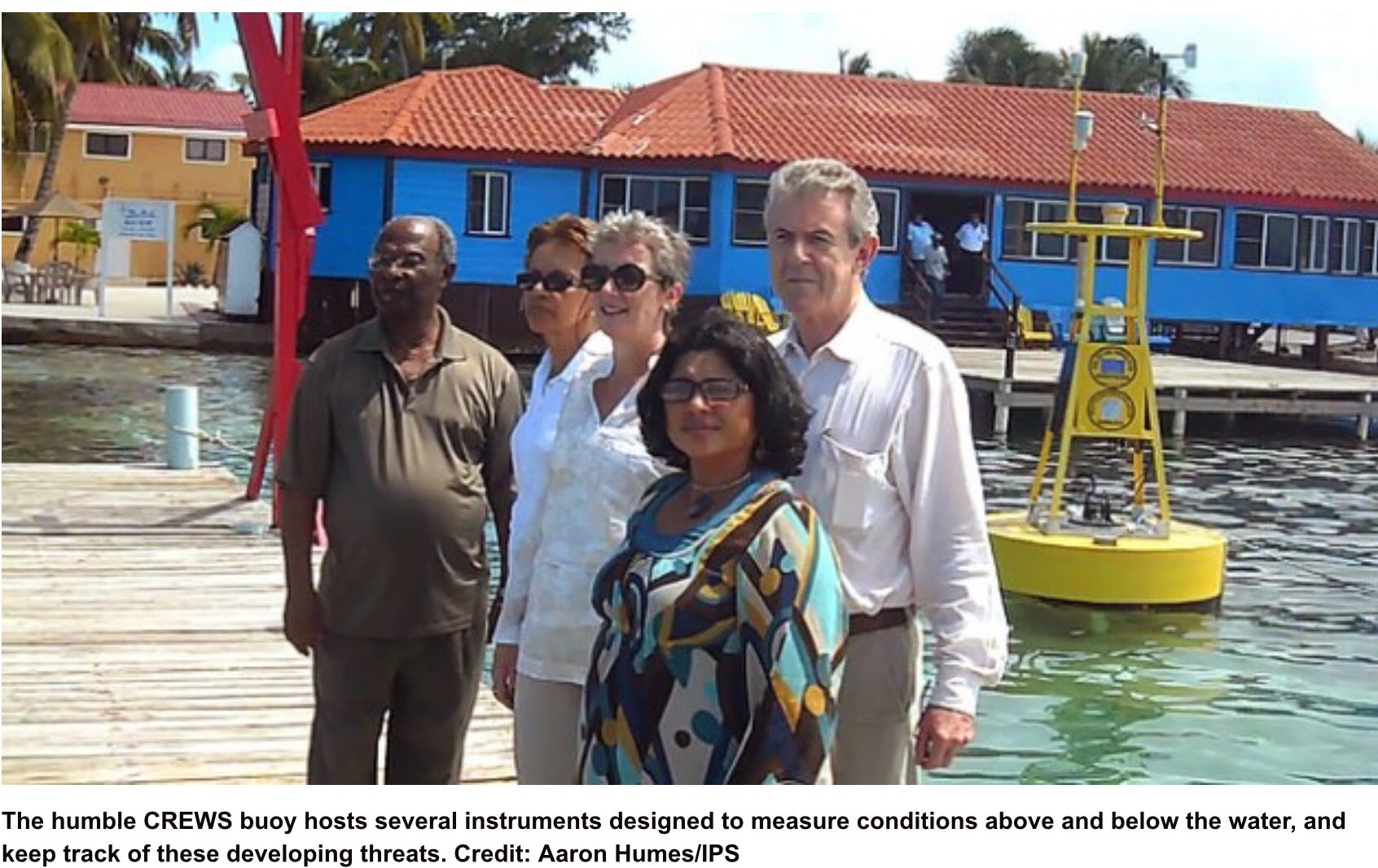
Last month, the European Union (EU), as part of its Global Climate Change Alliance Caribbean Support Project handed over to the government of Belize and specifically the Ministry of Forestry, Fisheries and Sustainable Development for its continued usage a Coral Reef Early Warning System (CREWS) buoy based at South Water Caye off the Stann Creek District in southern Belize. More