Showing posts with label Carribean Community Climate Change Centre. Show all posts

Saturday, May 16, 2015

Weak climate deal would jeopardise new development goals - experts - TRFN

LONDON, May 15 (Thomson Reuters Foundation) - The world's chances of achieving new international development goals will be slim without more ambitious action to curb climate change, researchers said.

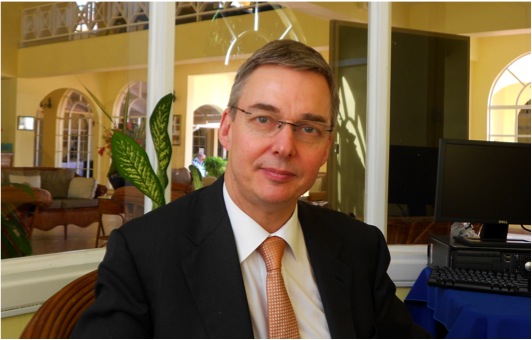
Dr. Ulric 'Neville' Trotz

Pakistan, for example, is unlikely to be able to end poverty by 2030 if accelerating climate change brings worse weather disasters, water scarcity and other problems, a new report from the UK-based Climate and Development Knowledge Network said.

But if global warming is held to 2 degrees Celsius - the aim of negotiations toward a new U.N. climate deal at the end of the year in Paris - Pakistan would have only a "low" risk of failing to eradicate poverty, the report said.

Planned new sustainable development goals (SDGs) aimed at ending poverty, improving gender equality, and giving access to water and clean power have a much higher chance of being achieved if action to limit climate change is ambitious, the report's authors said.

But if weaker efforts on climate change put the world on track for a 3 to 5 degree Celsius temperature rise, Asia and sub-Saharan Africa could see poverty rates 80 percent to 140 percent higher, the report found.

If the new sustainable development goals, expected to be agreed in New York in September, have strong targets, they could lift ambition in the year-end climate deal, the report said.

"There's a simple message: Climate action is developmental action," said Ulric "Neville" Trotz, a science advisor at the Caribbean Community Centre for Climate Change in Belize.

Countries need to fully incorporate climate action into national development plans, he added.

The report, by a team of economic policy and development experts, is one of the first attempts to put rough numbers on how the two new global deals due this year on climate change and sustainable development might interact.

States are negotiating over a proposal for 17 new sustainable development goals, backed by 169 targets, focused on everything from reducing inequality, hunger and climate change to managing forests and oceans better and promoting sustainable economic growth.

At the climate negotiations in December, leaders will aim to put in place an agreement, which would take effect in 2020, to curb carbon emissions and help poorer countries adapt to climate change and adopt a cleaner development path.

ZERO POVERTY, ZERO EMISSIONS

There are huge areas of overlap, experts say, not least because climate change impacts - such as water insecurity and more weather-related disasters - can cut harvests and incomes, and lead to children leaving school, as well as forcing governments to divert development funds to disaster relief.

"There's a simple message: Climate action is developmental action," said Ulric "Neville" Trotz, a science advisor at the Caribbean Community Centre for Climate Change in Belize.

Investing in cleaner, cheaper energy could not only cut climate risks but also improve health and provide the power needed to spur economic growth, the researchers said.

Many Caribbean islands, for example, rely on expensive imported fossil fuels, making their economies uncompetitive.

They are also extremely vulnerable to climate-related impacts, such as sea-level rise and stronger storms, said economist Anil Markandya, one of the report's authors.

"Unless we change the architecture of our energy sector, we might as well forget development under the SDGs," Trotz said.

Funding that change would require international support, such as from the new Green Climate Fund (GCF), he added.

Andrea Ledward, head of climate and environment for Britain's Department of International Development and a GCF board member, told a launch event for the report there is a need to "break down the firewall" between funding for climate and development projects because the two areas are so closely tied.

Rich nations have committed to mobilise by 2020 an annual $100 billion in climate finance that is "new and additional" to existing funding.

Jonathan Reeves of the International Institute for Environment and Development said that while climate and development funding streams could be merged, the accounting must be kept separate to ensure the money is "new and additional".

He warned that the least-developed countries have the most to lose if efforts to address climate change fail.

"If your country is going to be submerged within a couple of generations by sea-level rise, you're not even going to be thinking about achieving the SDGs," he said.

Ilmi Granoff, a researcher with the Overseas Development Institute in London, said public support for an ambitious climate deal and strong sustainable development targets could be won by focusing on a new, understandable aim for all countries: "zero poverty and zero emissions within a generation". (Reporting by Laurie Goering; editing by Megan Rowling) More


Friday, February 6, 2015

We are building a network of Climate Change Clubs!

The Caribbean Community Climate Change Centre (CCCCC) welcomed a group of 25 students from the Belmopan Comprehensive High School today for an interactive climate change exchange.

The visit forms part of a broader engagement with young people in an effort to create a network of school-based environmental clubs with a strong climate change focus across the region. The initiative is being piloted by the Centre in five (5) schools in Belmopan, Belize with support from the Ministry of Forestry, Fisheries and Sustainable Development (MFFSD) under the "Enhancing Belize’s Resilience to Adapt to the Effects of Climate Change" project which is funded by the European Union.

The participating schools are:

Belmopan Comprehensive High School

Belize Christian Academy

Belmopan Baptist High School

Our Lady of Guadalupe High School

Belmopan Methodist High School

Through this means of youth engagement, we are using a mixture of specially designed games, discussions, music and other tools to:

  1. Increase sensitisation and awareness of climate change impacts and community vulnerability;
  2. Heighten ability to link personal actions to the broader climate change discussion;
  3. Increase capacity to conduct vulnerability assessments of communities; and
  4. Identify practical adaptation measures to reduce vulnerability.

This initiative will include 60 to 90 minute weekly meetings, experiential learning including presentations, highly interactive group exercises, discussions and outreach efforts. These clubs are intended to be student-led entities with the support of a designated staff member. More


Sunday, February 5, 2012

Island nations want climate change in world court

 UNITED NATIONS: Small island nations, whose very existence is threatened by the rising sea levels brought about by global warming, are seeking to take the issue of climate change before the International Court of Justice.

Johnson Toribiong, president of Palau, said Friday his country and other island nations had formed an expert advisory committee to bring the issue before the U.N. General Assembly. That would allow the world court in the Hague to determine the legal ramifications of climate change under international law.
”If 20 years of climate change negotiations have taught us anything, it’s that every state sees climate change differently. For some, it is mainly an economic issue … for others it’s about geopolitics and their past or future place in the global economy, but for us it’s about survival,” Toribiong said.
”Pacific countries are in the red zone, a swell of ocean where waters have risen two or three times higher than anywhere else in the world. That differential might explain why we speak about climate change so urgently and we look to everyone in every corner of the United Nations to find a solution,” he added.
Michael Gerrard, director of the Center for Climate Change Law at Colombia University and a member the advisory committee, said the idea is to have a court determination compelling developed nations to control emissions of the greenhouse gases believed to cause global warming in the absence of an international treaty. More
 

Saturday, February 4, 2012

Interview with John Ashton, UK's Special Representative for climate change

 “It was the voice of the Caribbean that changed the world at Durban,” says John Ashton, the UK Foreign Secretary’s Special Representative for Climate Change. 
The Caribbean, perhaps more than any region in the world, faces an existential threat from global climate change. It is that threat which has spurred the region to band together and provide a voice to larger countries, urging them to confront the realities of what is a clear and present danger. Accordingly, climate change was a major subject of discussion at the recent UK-Caribbean Forum in Grenada, a country that has been putting climate issues at the forefront. To learn more, Caribbean Journal talked to Ashton about Caribbean-UK climate talks, regional integration and what Caribbean intervention meant at Durban.

What were the major points of discussion on climate at the forum?

Well I came here in this visit sort of on the back of my experiences in Durban at the end of last year. And I think there’s a very important experience from Durban that deserves to be much better understood around the world. In the last night, the final few hours of Durban, this whole 20 years of global climate diplomacy was on knife-edge – if it had gone the other way, we would not able to pick up the pieces. You can have a Copenhagen experience but you can’t have it twice – it would have turned into a zombie process. 

What was it that made the critical difference? It was the voice of the Caribbean, and particularly [Grenadian Foreign Minister] Karl Hood’s intervention. But Karl Hood’s intervention was kind of on the shoulders of a really sustained effort on the part of some Caribbean leaders, like former President Jagdeo of Guyana, of people and institutions like the Climate Change Coordinating Centre in Belize – for example, and all of that effort came to a kind of crescendo that night. Because what needed to happen that night was for there to be an overwhelming emotional momentum in favour of a high-ambition outcome. And in the end, in that kind of circumstance, it was only the voices of the vulnerable countries – the people who were going to be existentially damaged by climate change soon – we’re all going to be existentially damaged by climate change if we don’t get a grip on it – but it will happen in a sequence. And you needed to hear from those countries that really are on the front line of it, and the Caribbean participants, and particularly Grenada, in their capacity as chairman of AOSIS, were right at the front of that. And just remembering back, it was this intervention that then triggered a number of others interventions that created that overwhelming momentum in the room. More