Showing posts with label England. Show all posts

Friday, January 4, 2013

Island community St Helena renews plea for internet cash from UK

BBC News

By Dave Lee Technology reporter,


Residents on the remote South Atlantic territory of St Helena have renewed their plea for the UK to back plans to bring broadband to the island. The British Overseas Territory needs £10m to connect to a submarine cable. The island's 4,200 residents currently rely on a slow satellite connection, which campaigners say is stunting the island's growth.

The Foreign Office has said a "full economic assessment" was needed before any new link could be funded. The UK, like several other countries, refused to sign a proposed UN treaty regarding wide-ranging changes to internet governance at a conference in Dubai last month. It meant a clause requiring states to aid in connecting remote communities will not now be enforced, removing any obligation or commitment for the government to work with communities such as St Helena. "The UK did not sign the revised International Telecommunication Regulations last week in Dubai, and has no intention of doing so in the future," the Foreign Office said in an email. "We will therefore not be bound by the provisions contained in the Treaty when it comes into force on 1 January 2015."


'Revolutionise' Campaign group A Human Right, which is supported by the UN, has called on the Department for International Development to contribute a substantial amount to the engineering costs of connecting the island to the South Atlantic Express, a new superfast fibre optic cable being laid by South African firm eFive. Dr Rosalind Thomas, eFive's chief executive, agreed last year to alter the cable's path to bring it closer to the island, opening up the prospect of connecting it. An investment of around £10m, campaigners said, would be enough to latch on to the cable and "revolutionise" the island - with private backers contributing further costs.

Due to the island's location, it is well-placed to support infrastructure relating to satellite operations, including base stations and communication hubs. The campaign successfully convinced eFive to re-route the cable's path The government is already spending £250m on the island to build a new airport in a bid to encourage high-spend tourism to the island which is one of the most remote on earth. "The plan [for the airport] is to establish high-spending tourism on the island which will be quite a challenge," said Christian von der Ropp, organiser of the campaign. "If you spend an additional £10m or a bit less getting this cable landed, there would be a huge opportunity for social and economic development. "This is something that would revolutionise the island, and people's perspectives there. And I believe it would relieve British taxpayers." Currently, the UK government spends £20m a year on supporting the island. 'Economic and social benefits' In an email to A Human Right, the Foreign and Commonwealth Office said telecommunications on the island was the responsibility of the St Helena Government. "We are aware of eFive Telecom's plans to lay a fibre-optic cable connecting South Africa and Brazil and the St Helena Government's initial discussions with them about the feasibility and costs of a spur link to St Helena," the Foreign Office said.

St Helena has a population of 4,000

Residents are known as Saints

It measures 47 sq miles and lies 1,200 miles from the African mainland

An estimated 7,000 St Helenan families are living in the south of England

Source: St Helena Development Association (SHDA)


"If the developers proceed with the project then a full economic assessment would be needed to consider the extent of the economic and social benefits that such a link could bring to St Helena."

Campaigners hope that with better internet access local residents, particularly young people, will be less inclined to leave the island for study and work purposes.

Mike Olffon, owner of the island's radio station Saint FM, told the BBC that getting access was prohibitively expensive.

"Internet here at the moment is tremendously expensive because it's satellite - it's well over £100 a month. We have no choice.

"It is important for the development of the island, if we want to have IT services and internet-related business.

"The population would very much look forward to the government's help to pay the money." More


This is unfortunately typical of the England's Foreign and Commonwealth Office (FCO). Just the name of the department that governs the colonies 'Foreign and Commonwealth Office' sums it up. If the colonies are possessions and the residents are citizens why do they fall under the Foreign and Commonwealth Office? It is typical FCO deniability. Editor



Saturday, February 4, 2012

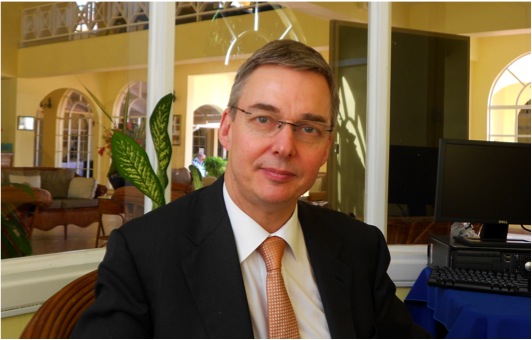
Interview with John Ashton, UK's Special Representative for climate change

 “It was the voice of the Caribbean that changed the world at Durban,” says John Ashton, the UK Foreign Secretary’s Special Representative for Climate Change. 
The Caribbean, perhaps more than any region in the world, faces an existential threat from global climate change. It is that threat which has spurred the region to band together and provide a voice to larger countries, urging them to confront the realities of what is a clear and present danger. Accordingly, climate change was a major subject of discussion at the recent UK-Caribbean Forum in Grenada, a country that has been putting climate issues at the forefront. To learn more, Caribbean Journal talked to Ashton about Caribbean-UK climate talks, regional integration and what Caribbean intervention meant at Durban.

What were the major points of discussion on climate at the forum?

Well I came here in this visit sort of on the back of my experiences in Durban at the end of last year. And I think there’s a very important experience from Durban that deserves to be much better understood around the world. In the last night, the final few hours of Durban, this whole 20 years of global climate diplomacy was on knife-edge – if it had gone the other way, we would not able to pick up the pieces. You can have a Copenhagen experience but you can’t have it twice – it would have turned into a zombie process. 

What was it that made the critical difference? It was the voice of the Caribbean, and particularly [Grenadian Foreign Minister] Karl Hood’s intervention. But Karl Hood’s intervention was kind of on the shoulders of a really sustained effort on the part of some Caribbean leaders, like former President Jagdeo of Guyana, of people and institutions like the Climate Change Coordinating Centre in Belize – for example, and all of that effort came to a kind of crescendo that night. Because what needed to happen that night was for there to be an overwhelming emotional momentum in favour of a high-ambition outcome. And in the end, in that kind of circumstance, it was only the voices of the vulnerable countries – the people who were going to be existentially damaged by climate change soon – we’re all going to be existentially damaged by climate change if we don’t get a grip on it – but it will happen in a sequence. And you needed to hear from those countries that really are on the front line of it, and the Caribbean participants, and particularly Grenada, in their capacity as chairman of AOSIS, were right at the front of that. And just remembering back, it was this intervention that then triggered a number of others interventions that created that overwhelming momentum in the room. More