Small Island Developing States (SIDS) are threatened by Rising Sea Levels, Climate Change, Energy Security, Food Security and Water Security. This blog will attempt to post articles and reports that may be useful to these vulnerable states around the globe.
Within the Caribbean, there is a growing awareness of the need for a new economic paradigm for inclusive and sustainable development, in order to deliver solutions for the most pressing challenges which are made worse by international economic and environmental crises.
In the backdrop of the limited diversification of the countries’ economies and their dependence on natural resources, green economy offers a viable option to increase competitiveness and resilience of the region’s economies and merge prosperity and growth for all with sustainability.
"I commit my Government to working assiduously with the Social Partnership to ensure that the measures indentified in Barbados’ Green Economy Scoping Study, which can contribute to a more prosperous and environmentally sensitive Barbados, will be implemented expeditiously" said Freundel J. Stuart, Prime Minister of Barbados.
“We see a green economy not only as the area of renewable energy, but we see the green economy as a means of providing new opportunities for our people in St. Kitts,” said Earl Asim Martin, Deputy Prime Minister of St. Kitts and Nevis.
"We are also showing that it is possible to create a better, environmentally sustainable national economy without compromising our citizens’ legitimate aspirations for increased prosperity," said Bharrat Jagdeo, Former Prime Minister of Guyana
Effective green economy strategies and programmes must address barriers to change that affect the whole Caribbean region. In searching for alternatives to “business-as-usual”, emphasis should be placed on redirecting investments and creating economic incentives that lead to sustainable development and poverty eradication.
UNEP, in cooperation with the CARICOM Secretariat and with financial support of the European Union, is supporting the region through a Caribbean Green Economy Initiative.
The outcomes of project, as well as the experiences and lessons learned during its implementation should offer ideas and opportunities for scaling up green economy transition in other countries and regions especially in island states in the Pacific, Africa and elsewhere.
Please download the project flyer on green economy in the Caribbean here.
EFFORTS TO preserve the country’s water reserves must be supplemented by legislation that makes rainwater harvesting compulsory for all housing developments and other such major projects which put a drain on Jamaica’s limited water resources during construction.
Dr Christopher Tufton
That is the recommendation from Dr Christopher Tufton, who told The Gleaner that such legislation is overdue, given Government’s failure to examine and report back on a resolution passed in the Senate March 1, 2013 on legislating rainwater harvesting.
“This is yet another example of a country that gives lip service to sustainable development, while citizens have to experience the hardships from a water crisis each year. We have heard nothing of the resolution since then, and as is customary, we act surprised that we are in another water shortage crisis, even though we have this situation each year,” said the former government minister.
He wants to make it mandatory that developers include in their applications information on how they will harvest and store rainwater for use during the life of the project. The legislation also speaks to the incorporation of features such as guttering on individual buildings, to ensure that water conservation becomes a part the Jamaican culture going forward.
“What it would mean is that one could determine to what extent existing projects could be retrofitted or adjusted. For new projects, however, part of their design should include a rainwater harvesting process. Now, it does add to the cost of construction, but in some countries, they have done things like tax rebates, among other things, to incentivise developers,” Tufton said. “So once construction is done, you could get a tax write-off in a short period of time to keep costs to a minimum.”
Acknowledging that this additional cost might prove a deterrent for some investors, Tufton said one has to look at the much bigger picture of the emotional distress and financial fallout the country is now experiencing. More
Fishers of Bluefields Bay tell stories of a time when the coral grew so high parts of the reef were impassable, when boats had to navigate around the coral tips emerging out of the Caribbean’s blue waters. Four decades later a trip underwater will show you a seafloor still covered with the skeletons of these same corals. Due to the effects of hurricanes, decline of algae grazers and climate change, the once lush thicket is only a story told around a bottle of Red Stripe beer and a cup of fish soup (since the fish is too scarce to cook any other way).
Until now. The climate isn’t the only thing changing for some communities around the Caribbean. In Bluefields Bay, Jamaica, the community has come together with the Government to establish one of the fourteen (14) fish sanctuaries island wide. Since 2009, the community based organisation, Bluefields Bay Fishermen’s…
KINGSTON, Feb 2 2015 (IPS) - A plan that government says will slow the rate of erosion on Jamaica’s world-famous Negril beach is being opposed by the people whose livelihoods it is meant to protect.
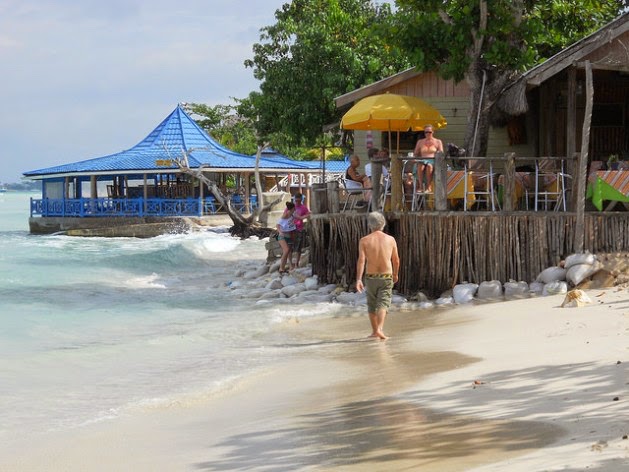
Jamaica's Negril beach
Work is set to begin in March, but some in the tourist town continue to resist the planned construction of two breakwaters, which experts say is one of a series of actions aimed at protecting the beach and slowing persistent erosion. Those opposing the plan say the structures will do more damage than good.
The construction of the two breakwaters 1.2 kilometres offshore follows on previous work to strengthen the natural ecosystem protection of the coastal communities by replanting sea grass beds and mangroves in several vulnerable communities, including Negril.
“Building breakwaters is not what stakeholders here want. These hard structures cause more erosion than they prevent,” Couples Resort’s Mary Veira told IPS.
There is fear, Veira explained, that the structures will hinder the natural regeneration of the beach that currently occurs after each extreme weather event.
Government targeted the ‘Seven Mile’ stretch of Negril’s coast as its climate change adaptation project after several studies indicated that more than 55 metres of beach had been eroded in the last 40 plus years. The tourist Mecca is said to account for 25 per cent of the earnings of an industry that is responsible for about half of Jamaica’s GDP.
Veira is one of a group of hoteliers calling for a halt to the breakwater project, fearing its construction will irreparably damage Negril’s tourism industry. The environmental activist also pointed out that the structure is significantly different to that proposed by Smith Warner International (SWI) in 2008, in a consultation paid for by the community.
In addition she said, “The engineers who have been awarded the job are not coastal engineers.”
In a newspaper article dated May 2014, Veira noted: “Also of concern to stakeholders is the fact that the Environmental Engineer of National Works Agency, Dr. Mark Richards, admits such a major project of sea defense has really never been done.”
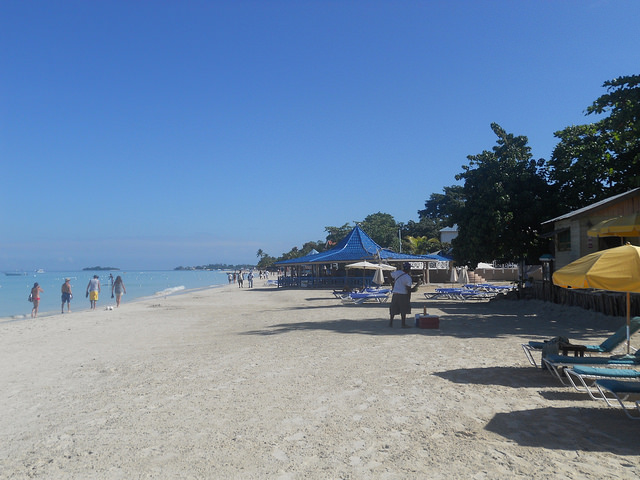
Taken Apr. 19, 2014, this photo shows a fully restored beach at Negril. The sand is taken away by storms and returns a few months later. Hoteliers fear that the breakwater will prevent the natural generation from occuring. Credit: Mary Veira/IPS
Business owners expressed concerns that boulders from the two “large rubble mound breakwaters” could break loose and destroy properties during rough weather. They also worry that it will create an eyesore as well as cause further damage to the fragile marine ecosystem, effectively killing snorkeling beds.
Both the National Environment and Planning Agency (NEPA), which overseas environment and planning on the island, and the National Works Agency (NWA), the entity overseeing the project, are adamant that the fears are unwarranted. Many hoteliers, however, continue to dig in.
The government has accused Veira and others of conducting a misinformation campaign to undermine the project’s credibility and the issue has divided the community.
The construction of the two breakwaters 1.2 kilometres off shore follows on previous work to strengthen the natural ecosystem protection of the coastal communities by replanting sea grass beds and mangroves in several vulnerable communities, including Negril. The structures are expected to break wave action and allow other remedial work to take place.
Government has said the beach nurturing option is out of the question. In May 2014, director of environment in the project’s implementing agency the Planning Institute of Jamaica (PIOJ) Clare Bernard told Negril’s business community in a meeting that the 5.4 million dollars earmarked for construction of the breakwaters could not be used for beach nourishment.
With the start date fast approaching, Sandals Resorts International (SRI) has thrown its weight behind the government’s plan. The popular hotel chain’s position was made clear in a Jan. 13 letter to the Jamaica Observer newspaper by SRI director of business processes and administration Wayne Cummings and reiterated at Friday’s meeting.
“It would be irresponsible of the agency to use government-guaranteed funds to reseed the beach for short-term gain, without treating with the known problems of wave action, only to see the beach retreat once again,” Cummings said in his statement.
Sandals operates three properties along what is said to be the most impacted section of the coastline – the Long Bay Beach also known as the Seven-Mile-Beach, as well as a ‘yet-to-be-developed’ property on the Bloody Bay Beach. The company has over the years invested in its own solutions to protect its properties.
“Let’s get this corrective phase done and commit to working with the Government to initiate a phase two for reseeding and maintaining the beach to bring Negril back to its world-class conditions,” Cummings continued.
On Jan. 23, those for and against faced off in a meeting that authorities hoped would have settled the matter once and for all. But both sides dug in and the meeting ended in a stalemate.
In addition to the fear of property damage from boulders, opponents contend that the current project bears no resemblance to that in a 2008 proposal by Smith Warner International (SWI).
In fact even more recent plans for the beach’s restoration included a comprehensive ecosystem upgrade to include sediment trend analysis, hydrological studies, artificial reefs and other “soft engineering approaches to build disaster resilience”, NEPA’s Manager of Strategic Planning and Policies Anthony McKenzie told IPS in 2012.
But authorities say the plans changed, in part because of the community’s advocacy. And the PIOJ and other government organisations have also expressed shock at the community’s apparent about-face. They have been in constant dialogue since the start, they said.
On Jan. 7, in a statement to the Parliament’s Public Administration and Appropriations Committee, NEPA’s CEO Peter Knight blamed the ongoing row on the lack of “institutional memory”, and a changing of the guard at the helm of various interest groups, such as the Negril Chamber of Commerce.
Knight told the house that as a precautionary measure, an experienced disaster mitigation expert had been contracted to review the plans, pushing the project six-months behind its original schedule.
A onetime head of the Negril Chamber of Commerce and the Jamaica Hotel and Tourist Association, Cummings implored the Negril community to remain focused. He pointed out that the solutions now being presented by government came from its own ‘cause and effect study’ that highlighted the loss of the reef due to due to natural and man-made issues.
Cummings accepted the community’s arguments that businesses will be negatively affected during the construction phase of the project and called on government to help them by providing “economic breathing room” in the form of tax breaks to keep companies afloat.
But marine biologist Andrew Ross understands why the community is upset.
“The engineering reports to which these proposed groynes are modelled only look at the current state and make no reference to the ecosystem services that accumulated sands for the grass meadows, beach and dunes over the previous thousands of years, namely the coral reef ticket,” he noted.
Ross, who specialises in the restoration of coral reefs, added that, “Any sand-targeted engineered solution can only be a band-aid, at best.”
In fact, the sea grass beds replanted two years ago in a multi-sector project funded by the European Union is all but gone, washed out by storms after only a few months. And the introduction of Shorelock, a so-called ‘sand-magnet’ chemical being used on the beach, has not rested well with folks.
Both Cummings and Ross agree on one thing: with all efforts combined, “Negril’s ecosystem can be fixed.” But as Cummings puts it, “As long as the finished product ‘plugs the holes’ identified as being the main causes of the aggressive wave actions.” More
13 August 2013: Three regional youth workshops took place in conjunction with the Regional Preparatory Meetings for the UN Small Island Developing States (SIDS) 2014 Global Conference.
Held in Jamaica, Fiji and Seychelles, in July 2013, these meetings brought together over 70 young people representing 30 different small island countries to discuss SIDS' development issues.
Sponsored by the UN Educational, Scientific, and Cultural Organization (UNESCO), the UN Population Fund (UNFPA) and the UN Children's Fund (UNICEF), the workshops allowed youth from the Caribbean, Pacific and Atlantic, Indian Ocean, Mediterranean and South China Seas (AIMS) regions to participate in the regional preparatory process for the Conference, which will take place in Apia, Samoa, in September 2014.
Important issues for island development identified by the participants included education, climate change, health and sustainable energy. Participants from all three regions made individual commitments to take action on these issues in their home communities, and highlighted the overall importance of youth partnership and activism.
UNITED NATIONS: Small island nations, whose very existence is threatened by the rising sea levels brought about by global warming, are seeking to take the issue of climate change before the International Court of Justice.
Johnson Toribiong, president of Palau, said Friday his country and other island nations had formed an expert advisory committee to bring the issue before the U.N. General Assembly. That would allow the world court in the Hague to determine the legal ramifications of climate change under international law.
”If 20 years of climate change negotiations have taught us anything, it’s that every state sees climate change differently. For some, it is mainly an economic issue … for others it’s about geopolitics and their past or future place in the global economy, but for us it’s about survival,” Toribiong said.
”Pacific countries are in the red zone, a swell of ocean where waters have risen two or three times higher than anywhere else in the world. That differential might explain why we speak about climate change so urgently and we look to everyone in every corner of the United Nations to find a solution,” he added.
Michael Gerrard, director of the Center for Climate Change Law at Colombia University and a member the advisory committee, said the idea is to have a court determination compelling developed nations to control emissions of the greenhouse gases believed to cause global warming in the absence of an international treaty. More
“It was the voice of the Caribbean that changed the world at Durban,” says John Ashton, the UK Foreign Secretary’s Special Representative for Climate Change.
The Caribbean, perhaps more than any region in the world, faces an existential threat from global climate change. It is that threat which has spurred the region to band together and provide a voice to larger countries, urging them to confront the realities of what is a clear and present danger. Accordingly, climate change was a major subject of discussion at the recent UK-Caribbean Forum in Grenada, a country that has been putting climate issues at the forefront. To learn more, Caribbean Journal talked to Ashton about Caribbean-UK climate talks, regional integration and what Caribbean intervention meant at Durban.
What were the major points of discussion on climate at the forum?
Well I came here in this visit sort of on the back of my experiences in Durban at the end of last year. And I think there’s a very important experience from Durban that deserves to be much better understood around the world. In the last night, the final few hours of Durban, this whole 20 years of global climate diplomacy was on knife-edge – if it had gone the other way, we would not able to pick up the pieces. You can have a Copenhagen experience but you can’t have it twice – it would have turned into a zombie process.
What was it that made the critical difference? It was the voice of the Caribbean, and particularly [Grenadian Foreign Minister] Karl Hood’s intervention. But Karl Hood’s intervention was kind of on the shoulders of a really sustained effort on the part of some Caribbean leaders, like former President Jagdeo of Guyana, of people and institutions like the Climate Change Coordinating Centre in Belize – for example, and all of that effort came to a kind of crescendo that night. Because what needed to happen that night was for there to be an overwhelming emotional momentum in favour of a high-ambition outcome. And in the end, in that kind of circumstance, it was only the voices of the vulnerable countries – the people who were going to be existentially damaged by climate change soon – we’re all going to be existentially damaged by climate change if we don’t get a grip on it – but it will happen in a sequence. And you needed to hear from those countries that really are on the front line of it, and the Caribbean participants, and particularly Grenada, in their capacity as chairman of AOSIS, were right at the front of that. And just remembering back, it was this intervention that then triggered a number of others interventions that created that overwhelming momentum in the room. More
This short video was produced by the Caribbean Community Climate Change Centre for viewing at the 17th Conference of the Parties (COP) in Durban, South Africa.
It underscores the gravity of the threat of climate change to the Caribbean region and the role that the CARICOM Climate Change Centre (CCCCC) plays in preparing the region for these threats.
More specifically, it outlines the impending threats to tourism, agriculture, public health and other sectors while also explaining, through interviews with senior staff, the extensive achievements of past and current regional projects and initiatives.
The video ends on a cautionary note, pointing to the urgency of policy to commit to a reduction in emissions in order to stem the tide of climate related impacts. http://www.youtube.com/watch?v=HjR3mdwqVUM.
ECLAC Report Examines Climate Change Impacts on Latin America and Caribbean Coasts
The UN Economic Commission for Latin America and the Caribbean (ECLAC) has published a report that examines current and future trends in climate variability and their likely impacts on the region's extensive coastline.The report, prepared by the Environmental Hydraulics Institute of the University of Cantabria, Spain, analyzes and provides an atlas of the current physical conditions and changes detected in key coastal variables in 44,851 miles of LAC coastline, such as average sea level, surface temperature of the sea, salinity, swells, astronomical tides, air temperature anomalies, wind changes and hurricanes. The report further looks at how these variables might be affected by 2040, 2050 and 2070.
The analysis divides results into four basic geographic areas: North America; Central America; South America; and Caribbean islands. Where possible, the report tries to identify subregional differences in the variables. For example, it notes that the fastest sea level rise (three centimeters per year) is in Northern Brazil, Venezuela, Colombia's Caribbean coast and some Caribbean islands, and the slowest in Ecuador.The report is the first in a series of four, which are planned to be released in 2012 as part of an ECLAC project on climate change and LAC coastal regions financed by the Government of Spain. The second will look in greater detail at the vulnerability and exposure to climate change of LAC coasts, the third will detail probable climate change impacts, and the fourth will evaluate the climate change risks faced by LAC coasts. ECLAC also plans to release support documents on the theories and methodology used to project climate change impacts on LAC's coastal regions and analyze their risks.
What can we learn from islands on ecosystem-based adaptation (EbA) in a changing climate: from practice to policy? Read the summary and download presentations of the event on the topic convened at the Rio Conventions Pavilion during the recent United Nations Climate Change Conference (UNFCCC COP 17), in Durban, South Africa.
During the event on Ecosystem-based Adaptation in a Changing Climate: From Practice to Policy? Lessons learnt from islands Ambassador Ronald Jumeau, Permanent Representative of the Republic of Seychelles to the United Nations reminded that Islands are places of high biodiversity and that local economies and identity are highly dependent on islands ecosystems and associated natural resources. Yet islands are highly vulnerable to climate change impacts and least able to address them effectively. ‘Working with nature’ as EbA proposes is an attractive and cost-effective measure to build the resilience of island environments in the face of climate change.
The event outlined the complexity of developing effective EbA responses from problem identification through to policy, strategic partnerships, good practice guidelines and the need for strategic adaptation of plans. These plans should be supported by good science and vulnerability assessment and lead to implementation, political advocacy and the need for innovative financial mechanisms.The full summary of the event can be accessed here. It includes the key messages on:Implementing climate change adaptation programmes in island regions: A European Union perspective on the role of EbA;What can we learn from implementing EbA in islands and island territories: From practice to policy;Principles and guidelines for mainstreaming EbA in policy making and project development;Debt-for-Adaptation-Swaps in SIDS.All presentations can be downloaded from the links on the the right-hand side of this page.The event was organized by IUCN and the European Commission as partners to the Rio Conventions Pavilion, with participation of the Global Islands Partnership (GLISPA), IUCN Commission on Ecosystem Management (CEM), and IUCN Members: BirdLife International and The Nature Conservancy (TNC). For more information on this session, please contact Dominique Benzaken, IUCN.For information on other adaptation-related events at the UNFCCC COP 17, please write to the Adaptation Hub or visit the Adaptation Hub online. More
PRIME Minister Andrew Holness has called on the Latin American States to give special attention to small developing states in fighting vulnerabilities such as socio-economic challenges.
Addressing the Latin American and Caribbean Summit on Integration and Development (CALC) in Caracas, Venezuela on the weekend, the prime minister said the socio-economic challenges that confront the small developing states include the impact of natural disasters and climate change; high prevalence of HIV/AIDS and non-communicable diseases; high levels of indebtedness and the categorization of some countries as upper middle income which affects access to concessional forms of loan financing and debt relief.
"The time has come to expand our horizons towards regional integration respecting the principles of solidarity, flexibility, pluralism, diversity and complementarity of actions, taking into account the importance of ensuring favourable treatment for the small vulnerable economies and island developing states. We must seek to do that now as a region... to foster our own solutions and to promote integrated regional development," the Jamaican prime minister said.
He said the CALC Summit was "another significant step to consolidate our own regional space and to construct the political, economic, social and cultural integration of Latin America and the Caribbean through the vehicle of the Community of Latin American and Caribbean States".


 © Climate War Room


 Originally posted on