Tuesday, November 18, 2014

President of Palau becomes Champion of the Earth for his pioneering Green Economy Policies

Bangkok, 17 November 2014 – President of Palau, Tommy Remengesau, Jr, was announced as a winner of the UN’s top environmental accolade, the Champions of the Earth award.

The Policy Leadership award, which has been won in previous years by European Commissioner for the Environment, Dr. Potocnik, and Brazil’s Environment Minister, Izabella Teixeira, will be awarded to President Remengesau by UN Secretary-General Ban-Ki-moon and UNEP Executive Director Achim Steiner at an awards ceremony attended by UNEP Goodwill Ambassador Gisele Bundchen at the Smithsonian American Art Museum and National Portrait Gallery in Washington D.C. on 19 November 2014.

Tommy Remengesau, President of Palau, said, "I am honored to receive this award on behalf of the traditional leaders, the people of Palau, and the islanders around the world, who are the stewards for the protection of our vast oceans and natural wealth."

"As a fisherman, I have seen first-hand the devastating impacts of overfishing, climate change and pollution on our oceans. As the leader of an island country, I know we have the solutions to tackle these issues. We need to stand together to take action now to protect our oceans and our Mother Earth for our generation and future children."

Under the leadership of President Remengesau, Palau is showing the way to protect its invaluable natural resources while balancing the needs and traditions of its people. Earlier this year the President announced the world’s first Nation-wide Marine Sanctuary that fully protects over 80 per cent of Palau’s 600,000 sq km of Exclusive Economic Zone.

The Sanctuary bans industrial and foreign fishing as well as exports, while establishing a local fishing zone for domestic use. This is a bold step to reverse degradation of the ocean and stands to ignite further global action on oceans.

The President has demonstrated the country's capacity to successfully meet its conservation goals, having established a network of protected areas representing more than 50 per cent of marine and 20 per cent of terrestrial areas through the Micronesia Challenge. This was largely funded by a "Green Fee" where tourists pay US$30 on departure from Palau, generating more than US$1.3 million annually for conservation.

The President has spearheaded a range of local to global initiatives, from the world’s first shark sanctuary to establishing the Global Island Partnership alongside President Michel of Seychelles, which has inspired more than 30 leaders to launch major sustainable island commitments.

UN Under-Secretary-General and UNEP Executive Director Achim Steiner said, "Palau is an inspiring example of a small island nation courageously addressing the global challenges of climate change and biodiversity loss through a blue-green economy transition, and reflects the level of commitment many Small Island Developing States demonstrated earlier this year to advancing national sustainable development goals at the Third International Conference on Small Island Developing States through the S.A.M.O.A Pathway Outcome Document."

"Supporting President Remengesau - and other leaders of other small island nations - on this journey of transition, provides an unprecedented opportunity to be part of game-changing solutions that can be applied in broader contexts and bigger economies."

"In short, we should look upon small island nations like Palau as microcosms of our larger society, and not stand back and leave them to grapple with threats - such as climate change."

Champions of the Earth is the United Nations' flagship environmental award launched in 2005 that recognizes outstanding visionaries and leaders in the fields of policy, science, entrepreneurship, and civil society action. Whether by helping to improve the management of natural resources, demonstrating new ways to tackle climate change or raising awareness of emerging environmental challenges, Champions of the Earth should serve as an inspiration for transformative action across the world. Past laureates have included past laureates Mikhail Gorbachev, Al Gore, Felipe Calderon, Mohamed Nasheed, Marina Silva, Vinod Khosla, and many other such exemplary leaders on the environment and development front.

Visit http://www.unep.org/champions/ for more details.


Friday, November 14, 2014

Signs of stress must not be ignored, IEA warns in its new World Energy Outlook

Energy sector must tackle longer-term pressure points before they reach breaking point

Events of the last year have increased many of the long-term uncertainties facing the global energy sector, says the International Energy Agency’s (IEA) World Energy Outlook 2014 (WEO-2014). It warns against the risk that current events distract decision makers from recognising and tackling the longer-term signs of stress that are emerging in the energy system.

In the central scenario of WEO-2014, world primary energy demand is 37% higher in 2040, putting more pressure on the global energy system. But this pressure would be even greater if not for efficiency measures that play a vital role in holding back global demand growth. The scenario shows that world demand for two out of the three fossil fuels – coal and oil – essentially reaches a plateau by 2040, although, for both fuels, this global outcome is a result of very different trends across countries. At the same time, renewable energy technologies gain ground rapidly, helped by falling costs and subsidies (estimated at $120 billion in 2013). By 2040, world energy supply is divided into four almost equal parts: low-carbon sources (nuclear and renewables), oil, natural gas and coal.

In an in-depth focus on nuclear power, WEO-2014 sees installed capacity grow by 60% to 2040 in the central scenario, with the increase concentrated heavily in just four countries (China, India, Korea and Russia). Despite this, the share of nuclear power in the global power mix remains well below its historic peak. Nuclear power plays an important strategic role in enhancing energy security for some countries. It also avoids almost four years’ worth of global energy-related carbon-dioxide (CO2) emissions by 2040. However, nuclear power faces major challenges in competitive markets where there are significant market and regulatory risks, and public acceptance remains a critical issue worldwide. Many countries must also make important decisions regarding the almost 200 nuclear reactors due to be retired by 2040, and how to manage the growing volumes of spent nuclear fuel in the absence of permanent disposal facilities.

“As our global energy system grows and transforms, signs of stress continue to emerge,” said IEA Executive Director Maria van der Hoeven. “But renewables are expected to go from strength to strength, and it is incredible that we can now see a point where they become the world’s number one source of electricity generation.”

The report sees a positive outlook for renewables, as they are expected to account for nearly half of the global increase in power generation to 2040, and overtake coal as the leading source of electricity. Wind power accounts for the largest share of growth in renewables-based generation, followed by hydropower and solar technologies. However, as the share of wind and solar PV in the world’s power mix quadruples, their integration becomes more challenging both from a technical and market perspective.

World oil supply rises to 104 million barrels per day (mb/d) in 2040, but hinges critically on investments in the Middle East. As tight oil output in the United States levels off, and non-OPEC supply falls back in the 2020s, the Middle East becomes the major source of supply growth. Growth in world oil demand slows to a near halt by 2040: demand in many of today’s largest consumers either already being in long-term decline by 2040 (the United States, European Union and Japan) or having essentially reached a plateau (China, Russia and Brazil). China overtakes the United States as the largest oil consumer around 2030 but, as its demand growth slows, India emerges as a key driver of growth, as do sub-Saharan Africa, the Middle East and Southeast Asia.

“A well-supplied oil market in the short-term should not disguise the challenges that lie ahead, as the world is set to rely more heavily on a relatively small number of producing countries,” said IEA Chief Economist Fatih Birol. “The apparent breathing space provided by rising output in the Americas over the next decade provides little reassurance, given the long lead times of new upstream projects.”

Demand for gas is more than 50% higher in 2040, and it is the only fossil fuel still growing significantly at that time. The United States remains the largest global gas producer, although production levels off in the late-2030s as shale gas output starts to recede. East Africa emerges alongside Qatar, Australia, North America and others as an important source of liquefied natural gas (LNG), which is an increasingly important tool for gas security. A key uncertainty for gas outside of North America is whether it can be made available at prices that are low enough to be attractive for consumers and yet high enough to incentivise large investments in supply.

While coal is abundant and its supply relatively secure, its future use is constrained by measures to improve efficiency, tackle local pollution and reduce CO2 emissions. Coal demand is 15% higher in 2040 but growth slows to a near halt in the 2020s. Regional trends vary, with demand reaching a peak in China, dropping by one-third in the United States, but continuing to grow in India.

The global energy system continues to face a major energy poverty crisis. In sub-Saharan Africa (the regional focus of WEO-2014), two out of every three people do not have access to electricity, and this is acting as a severe constraint on economic and social development. Meanwhile, costly fossil-fuel consumption subsidies (estimated at $550 billion in 2013) are often intended to help increase energy access, but fail to help those that need it most and discourage investment in efficiency and renewables.

A critical “sign of stress” is the failure to transform the energy system quickly enough to stem the rise in energy-related CO2 emissions (which grow by one-fifth to 2040) and put the world on a path consistent with a long-term global temperature increase of 2°C. In the central scenario, the entire carbon budget allowed under a 2°C climate trajectory is consumed by 2040, highlighting the need for a comprehensive and ambitious agreement at the COP21 meeting in Paris in 2015.

The World Energy Outlook is for sale at the IEA bookshop. Journalists who would like more information should contact ieapressoffice@iea.org.

Download the following resources:

About the IEA

The International Energy Agency is an autonomous organisation that works to ensure reliable, affordable and clean energy for its 29 member countries and beyond. Founded in response to the 1973/4 oil crisis, the IEA’s initial role was to help countries co-ordinate a collective response to major disruptions in oil supply. While this remains a key aspect of its work, the IEA has evolved and expanded. It is at the heart of global dialogue on energy, providing authoritative research, statistics, analysis and recommendations.

Alternative Download


Sunday, November 9, 2014

The end of beaches? Why the world’s shorelines are in serious trouble

We can have our beachfront properties — our Miami high-rises, our Hamptons mansions, our Jersey boardwalks — or we can have our beaches. But as geologist and Duke University emeritus professor Orrin Pilkey has been arguing for decades now, we can’t have both.

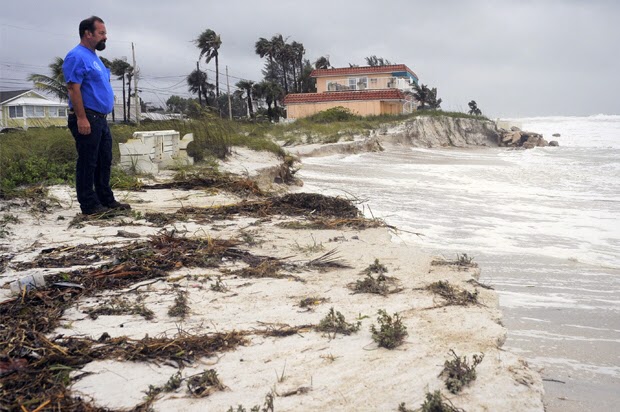
Bradenton Beach, June 2012

As the oceans warm and sea levels rise, coastal living is becoming an increasingly risky proposition. Any climate scientist would tell you not to invest in a beach house, and yet large-scale migration inland is something we’ve yet to see. The beaches themselves can withstand extreme weather, of course. But it’s our attempts to hold them in place, through techno-fixes like seawalls and beach replenishment, that ironically enough will end up destroying them. Sooner or later, Pilkey argues, we’re going to be forced to retreat. The question is whether there’ll be any beach left by then.

The Last Beach,” which Pilkey co-wrote with J. Andrew G. Cooper, a professor of coastal studies at the University of Ulster, is but his latest attempt to drive home just how wrong-headed our push to build on and preserve shorelines is. It’s been an uphill battle; for Pilkey, what counts as progress was that people acknowledged his plea not to rebuild after Superstorm Sandy instead of just attacking him for suggesting it — even if they didn’t really end up following his advice.

Bring pollution, oil spills and the destructive business of sand mining into the picture, and it’s not so extreme, Pilkey told Salon, to imagine a future where beaches as we know them — as places to live and even as places to visit — will no longer exist.

Our conversation, which has been lightly edited for length and clarity, follows.

We don’t typically think of beaches as something that can “go extinct,” but it seems like that’s basically what you’re arguing here.

That’s exactly what we argue: that beaches in developed areas will not be there, that they will be replaced by seawalls large and small. There will be beaches left in remote places and on national seashores and things like that, perhaps — although they’ll be suffering too, because they’ll be eroding and retreating back separately from the developed areas, which will be standing still for a while.

By the time we really begin to see what’s happening, like we are right now in Florida, we’ll be worrying about Manhattan and Queens and Boston and Washington, D.C., Philadelphia, Miami, Charleston, all those cities. We fully expect that the great expense required to hold back the shoreline — which is a losing proposition in any event — will be overwhelming for them.

It seems to us to be pretty obvious — and I think most geologists would agree with this — that in a 50- to 100-year timeframe we’re in trouble. The best example of that, the proof in the pudding, is Florida, where they have hundreds of miles of highrise-lined shoreline. What can they do? You could move the buildings back, but that’s very costly and there’s no place to move them to. So what we see right now, especially with the current governor of Florida, is the building of seawalls right and left. All you have to do is declare an emergency and you can build a seawall.

In the book, you also discuss how beaches have become dangerous places. So would you say there’s also a loss of beaches, not physically, but as we are able to enjoy them?

Yeah, that was the point of that. We, by the way, were really shocked — the one chapter that was really out of our range was pollution, and we were rather shocked at the numbers. We saw repeated statements about how to use a beach, if you’re going to go to a beach what should you do and how should you use it, in the technical literature, but it hasn’t been getting out to the public. Maybe that’s a little bit of irresponsibility on the part of some of the biochemists in not getting that out to the public. On the other hand, I know what would happen. They would get heavily criticized, probably, as being alarmists.

But yes, the fact is that the beaches are getting more and more polluted, and as more and more villages and towns and cities crowd up against the beaches that’s going to continue. Some of the things the literature said seemed rather outrageous to us. One is never to go barefoot on a beach. That’s a tough one. The one thing that everyone agrees is a bad thing to do is to get buried in the sand. And who in this world has not been buried in the sand at some time in their life? If you have a cut or an abrasion of some kind… I’ve always thought that going in the salt water had a healing effect on cuts, but that was really wrong. I’ve told that to a thousand students over the years, and if any of them are reading this I take it all back. It’s very dangerous.

Well, not very dangerous. There’s a very low probability of getting something, but if you do, the probability of getting something serious is high.

And that’s worse than it used to be?

There are no numbers to show it, that we know of, but yes. The pollutants on beaches are higher than they used to be, we think.

I imagine that you must have trouble getting people to take some of the issues you write about seriously. For example, there’s the beach that was stolen in Jamaica — something like that can come off as an offbeat, funny news story instead of a serious environmental crime. Do you come across that sort of response often?

Where we are not taken seriously? Of course, but I’m used to that because I’ve been arguing for years that we need to move houses back and retreat from the shoreline, or let houses fall in, but not leave them in place. My argument in the past in similar situations has been that we have a choice at the shoreline: We can have beaches or we can have buildings, but we can’t have them both. You have to take your choice — and of course, that is met with a lot of derision by beach property owners.

“The Last Beach,” I anticipate, will be met with some derision, because it seems a little extreme. But it’s not extreme at all. Of that I am certain. In my 40 years of working on this I can see the situation deteriorating. We’re going down a bad road, no question about it, and I feel confident about that.

Right after Superstorm Sandy, you wrote an article for the New York Times arguing that we shouldn’t rebuild. What kind of response did that get?

I got some money — somebody wanted to support my next book. Everything that happened to me directly was good, and I think the response was really good, surprisingly good. I heard that the American Shore & Beach Preservation Association (ASBPA) — which is a civilian group beating a hard drum of “there’s no need to retreat” — in their newsletter they made a few nasty comments about me…

A long time ago, when I started saying these things, the response was really negative, like “aw, c’mon, don’t be stupid, nobody’s going to move back.” Now, moving back is not outrageous, and the relationship between seawalls and the loss of beaches is pretty widely known. I think I can say that the response to that editorial was so different than it would have been 30 years ago, 20 years ago. And that’s a good thing.

What about the actual response from people working on recovery from the storm? Did anyone listen? Is the East Coast going to be just as vulnerable the next time a storm comes?

Thirty years ago, the response would have been massive seawalls, there’s no question of that. Hurricane Sandy was the first time I’ve heard serious discussion on the part of the governors of New Jersey and New York about maybe moving back and not rebuilding. As it was, they didn’t do much — they basically rebuilt — but that was music to my ears. I’ve never heard that before. In the past it’s always been “c’mon, we’re Americans, we’re not going to throw up our hands and slink away.”

Almost every house, if there was a house left, had an American flag in front of it. It brought out patriotism, for some reason or another. I guess that’s better than depression, but it’s different. Even though most of these things didn’t bear fruit, we’re getting there. I guess I’m learning that it takes years to get this into the public understanding. I don’t know how many years it’s going to take before we really start moving back, but we’re going to have to, no question about it, or we’ll just give up on the beach. I really believe that we will give up on the beach, for the most part. Beach replenishment, you see, will not be feasible as the sea level rises, because you’re holding the shoreline back in place, where it doesn’t want to be.

The beaches will disappear much faster than they are now. In North Carolina a typical beach lasts about three years. In New Jersey it’s probably about the same, and in Florida, where the wave energy is a little lower, it’s about seven to nine years. In any case, it’s a very costly proposition and it’s definitely going to get more costly.

How far back do people realistically need to move?

It all depends on where you are. If you’re on a barrier island you can move to the back side of the island, but the problem with that is that the back side of the island is lower in elevation. The highest elevation on most barrier islands is at the front of the island, so you’re moving back but on the other hand the chance of being struck directly by waves is increased.

For the most part, if someone is going to go through the cost of moving they ought to get off the island. In Florida, there ain’t no place to get off the island. It’s very, very low and flooding quickly as the sea level rises. We have a photograph in the book of the so-called “Outlaw House” in North Carolina (Outlaw was the family name). It was moved back three or five times, depending on who you believe, and right now it’s very close to the beach once again. That’s a mom-and-pop cottage, and initially it was moved by mules. All the houses near the Outlaw House now are all McMansions. They can be moved, but they’re expensive. The McMansion that was in the movie “Nights in Rodanthe” was just moved down the highway a bit to a safer place — I say safer, but not safe.

In a recent interview, you said you’ve stopped defining yourself as a scientist and have instead become a scientific advocate. When and how did that change come about?

I started out as a deep-sea sedimentologist. I worked on the continental margin of North Carolina and the abyssal plains — I sampled 13 abyssal plains around the world — but I got tired of going to sea. When my parents’ house was damaged in Hurricane Camille, my father and I wrote this little book called “How to Live On an Island,” and it was three eighths of an inch thick and it cost a dollar fifty, and I couldn’t believe the impact it had. People were asking to quote us and so forth, and I realized there was a real vacuum here and I began to move to the beach. I traded a research vessel for a 16-foot skiff, and I’m very happy about that. It’s been very satisfying.

When I first came to Duke it was not possible, before you get tenured, to get involved with controversial things with the general public. One had to wait until one had tenure before one could start pounding on the table about these things, and by the time I got my 16-foot skiff I was already tenured. I had also been a journal editor and a couple other things, and that gave me credibility in the scientific community. Nonetheless, I remember a number of times being criticized by scientists, basically saying “you’re off-base for doing this kind of thing.” I have a 25-book series, “Living with the Shore” for every state, and we have local geologists who were the senior authors of each of these books. I think for probably every book, at least one of the authors would say “I’m not going to lower myself and make science so simple,” or something to that effect, saying that “we can’t expect the public to understand everything we’re doing.”

But I don’t think I hear much of that anymore. I think at least geologists, and probably a lot of others now, are recognizing the value of being able to converse with the public. I know that most universities, Duke included, appreciate work that has an impact on the general public. It’s not like it was when I started at all. We are rewarded for doing such work, although there are local problems in individual states, probably in every state, where public schools still have problems. Here in North Carolina, I know at least two, maybe three geologists who have been asked to turn in their emails, or to furnish all emails that have to do with sea-level rise.

What you’re asking of the public is really difficult: You’re asking them to give up something they love, that they can protect in the short term, in favor of looking at the big picture. It’s something that people come up against with a lot of these environmental and climate problems. Do you have any insights into how to get that message through to people?

The reason you go to beaches is because you went down there with your mother and father during the summer and had the most wonderful time in your whole life, and what could be better than to live there year-round? But here in North Carolina we have some really good newspapers, at least on this issue. I spent a few years back in Woods Hole, Massachusetts, and I found that the people there were far less educated on the problem of beaches and seawalls and retreating shorelines. It was a very marginal thing in Massachusetts, but in North Carolina we have a much longer shoreline and a much higher-energy shoreline. So it’s not a surprise to most people. If they come here from Kansas it might be a surprise, but the locals here are pretty well-educated. Excepting the particular political situation we have right now, which is very pro-development — but that comes and goes — I think in North Carolina we’re better prepared than some other states.

The real resistance to good coastal management with a long-term view is coming not from the people who came down there because their mommy and daddy brought them to the beach. It’s coming from the people who are making money on it. From what I’ve seen here, the high-cost developments are the ones who are trying to change the laws to let them build seawalls. They’re going to protect the houses; they couldn’t give a damn about the general public. Up on South Hampton, New York, rich people are building massive walls. They’re doing things that are illegal in some communities, but when you have billions of dollars you can get an army of lawyers to hold off the community very readily. Wealthy communities are the problem. More


Thursday, November 6, 2014

Lord Stern: global warming may create billions of climate refugees

Lord Nicholas Stern, one of the world’s most influential voices on climate economics, does not mince his words when it comes to criticising those who take a narrow view of prosperity and highlighting the devastating consequences of global warming.

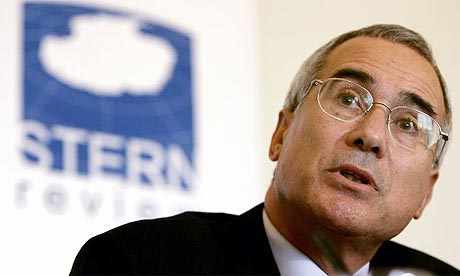
Nicholas Stern

"You have to be a complete idiot to think that GDP sums up prosperity," says Stern, who believes we need to develop broader measures of success and combine this with a return to core values if we are to convince people to act to prevent runaway climate change.

Stern, who wrote the landmark 2006 Stern review of the economics of climate change, says if we fail to take heed of the danger signals, we risk temperatures rising this century to levels we haven’t seen for tens of millions of years.

"Hundreds of millions of people, perhaps billions of people would have to move," he warns. "If we’ve learned anything from history that means severe and extended conflict.

"We couldn’t just turn it off. You can’t make a peace treaty with the planet, you can’t negotiate with the laws of physics. You’re in there, you’re stuck. Those are the stakes we’re playing for and that’s why we have to make this second transformation, the climate transformation and move to low carbon economy."

Stern has co-authored the recently published New Climate Economy report, which argues that the world can head off the worst effects of climate change, and enjoy the fruits of continued economic expansion, if it moves quickly to invest in a low-carbon economy.

He says he hopes the study will influence key decision makers because it was written with the support of a coalition of respected politicians, economists, think tanks and institutions, including the World Bank, the International Monetary Fund, the OECD, the International Energy Agency and the UN.

He dismisses the arguments of more radical economists who believe that we need to stop our fixation with growth, arguing that the economy needs to keep expanding if we are to have a hope of eradicating poverty.

"To those who want to knock out growth from objectives, I find they’re close to reprehensible because for me the two defining challenges of this century are overcoming poverty and managing climate change.

"We fail on one, we fail on the other. So I think to say that we should just switch off growth is to miss big aspects of what matters about poverty. And so it worries me. It’s also politically very naive. If you turn it into a pissing contest between growth on the one hand and climate and environment on the other and say you’ve got to choose, you’re setting yourself up for failure."

Stern says investments in renewable energy must be combined with a rethinking of our understanding of prosperity, which he believes will lead to what he terms better growth.

"It means thinking differently about health, about the way we live in our cities and about the strengths of our communities," he says. "It’s not that GDP is idiotic but it’s mostly about the use of labour resources and what it produces. But there are very important parts of this story about prosperity that get missed out."

How does Stern, who is president of the British Academy, believe we can start to measure prosperity that goes beyond GDP?

He says it is vital to start from the perspective of people understanding what they mean by wellbeing and what they value, whether it is family, community, arts or sport.

"You can be reasonably empirical about what moves people and then you go and try to collect data on that," he says. "Once you understand what it is it you’re trying to capture and create indicators, you can then start to talk about policy."

The 68-year-old peer says it’s vital we go back to recognising the importance of Aristotle’s belief in the need to understand what it means to be a virtuous person and to whom we owe a duty of care.

"I’ve been an academic all my life and I look at the evidence of what works and what doesn’t work," he says. "But if you ask yourself what you’re trying to do, that’s spurred by values, by what’s important to you."

For Stern, the heart of his values lies in the importance of family. Speaking immediately after introducing his two-week old granddaughter Rosa on stage at a TEDx talk in New York, he said: "I’m 68 and I am thinking what will Rosa be like when she’s 68? We’re talking about towards the end of this century and what we do now will determine whether the next 100 years is the best of centuries or the worst of centuries."

"Are we going to look our grandchildren in the eye and tell them that we understood the issues, that we recognised the dangers and the opportunities, and still we failed to act?"

Stern believes that it is time for religious leaders, politicians and the media to act more responsibly, pointing in particular to the importance of the Pope’s statement earlier this year that if we destroy creation, creation will destroy us.

Also key to changing hearts and minds is the field of arts, with Stern pointing to Barbara Kingsolver’s book Flight Behaviour, which he says is not only wonderful in describing the human condition but also in questioning our relationship with the environment.

"It’s not just the policy wonks like me we need to try to assemble the evidence and set it out," he says. "You have to do that because emotional argument without rational evidence on cause and effect doesn’t get you all that far. But rational argument about cause and effect alone doesn’t get you there either." More


Monday, November 3, 2014

Caribbean small islands will be first in region to suffer from rising sea levels

NAROBI, Kenya, Monday November 3, 2014, CMC - A top United Nations official has warned that the small islands of the Caribbean will be the first territories in the region to suffer the effects of rising sea levels due to climate change.

Executive Director of the United Nations Environment Program, Achim Steiner, said here on Saturday that the effects of climate change threaten the Caribbean’s tourism industries and, eventually, their “very existence”.

Speaking ahead of Sunday’s release of the Fifth Assessment Report from the Intergovernmental Panel on Climate Change, Steiner said sea-level rise will have an “immediate impact in economic terms” on the Caribbean Small Island Developing States (SIDS), stating that the Caribbean’s tourism infrastructure is 99 per cent along the coastline.

“Many small island nations are in a far more exposed situation simply because their territory is sometimes only two, three, four meters (6.5-13 ft.) above sea level,” he said, adding “therefore their very existence is being threatened.

“The changes also in, for instance, coral reefs and mangroves that are natural barriers and help strengthen the resilience of these countries, if coral reefs are dying then clearly countries become more vulnerable,” he added.

Steiner also cited the impact of more intense hurricanes and other extreme weather events on countries whose economies cannot bear the cost of reconstruction.

On a more hopeful note, he praised proactive efforts by some Caribbean countries, such as Barbados, where “energy efficiency efforts and renewable deployment are now on the agenda of investment and national development planning”.

The efforts of the Barbados government were one reason the United Nations decided to mark 2014 World Environment Day in Barbados, Steiner said. More


Tuesday, October 28, 2014

IPCC’s Fifth Assessment Report on Climate Change. What does it mean for the Caribbean?IPCC’s Fifth Assessment Report on Climate Change. What does it mean for the Caribbean?

The Caribbean’s response to Climate Change is grounded in a firm regional commitment, policy and strategy. Our three foundation documents – The Liliendaal Declaration (July 2009), The Regional Framework for Achieving Development Resilient to Climate Change (July 2009) and its Implementation Plan (March 2012) – are the basis for climate action in the region.

The Fifth Assessment Report (AR5) of the United Nations Intergovernmental Panel on Climate Change (IPCC) underscores the importance, scientific rigour and utility of these landmark documents. The IPCC’s latest assessment confirms the Caribbean Community’s longstanding call to limit global temperature rise to 1.5 degrees celsius as outlined in the Liliendaal Declaration. At the Nations Nation Framework Convention on Climate Change (UNFCCC) Conference of the Parties (COP) Meeting in 2009, which took place in Copenhagen, Denmark, the Caribbean Community indicated to the world community that a global temperature rise above 1.50C would seriously affect the survival of the community.

In 2010 at the UNFCCC COP Meeting in Cancun, governments agreed that emissions ought to be kept at a level that would ensure global temperature increases would be limited to below 20C. At that time, the Alliance of Small Island States (AOSIS), which includes the Caribbean, re-iterated that any rise in temperature above 1.50C would seriously affect their survival and compromise their development agenda. The United Nations Human Development Report (2008) and the State of the World Report (2009) of The Worldwatch Institute supports this position and have identified 20C as the threshold above which irreversible and dangerous Climate Change will become unavoidable.

Accordingly, the Caribbean welcomes the IPCC’s Fifth Assessment Report prepared by over 2000 eminent scientists. It verifies observations in the Caribbean that temperatures are rising, extreme weather events are occurring more frequently, sea levels are rising, and there are more incidences of coral bleaching. These climatic changes will further exacerbate the limited availability of fresh water, agricultural productivity, result in more erosion and inundation, and increase the migration of fish from the Caribbean to cooler waters and more hospitable habitats. The cumulative effect is reduced food security, malnutrition, and productivity, thus increasing the challenges to achieving poverty reduction and socio-economic development.

The report notes that greenhouse gases emissions, the cause of Climate Change, continues to rise at an ever increasing rate. Unless this trend is arrested and rectified by 2050, global temperatures could rise by at least 4°C by 2100. This would be catastrophic for the Caribbean. However, the report is not all gloom and doom. More than half of the new energy plants for electricity are from renewable resources, a trend that must accelerate substantially if the goal of limiting global warming to below 2°C by 2100 is to remain feasible.

The IPCC AR5 Report should therefore serve as a further wake up call to our region that we cannot continue on a business as usual trajectory. It is an imperative that Climate Change be integrated in every aspect of the region’s development agenda, as well as its short, medium and long-term planning. The region must also continue to aggressively engage its partners at the bilateral and multilateral levels to reduce their emissions. The best form of adaptation is reduction in emissions level.

Dr Kenrick Leslie

The IPCC will adopt the Synthesis Report of the AR5 in Copenhagen, Denmark in late October 2014. Caribbean negotiators are already preparing to ensure that the most important information from the report are captured in the Synthesis Report.

See the highlights of the Caribbean Launch of the UN IPCC AR5 Report in this video:

Learn more about the implications of the IPCC AR5 Report via www.caribbeanclimate.bz and @CaribbeanClimate.

* Dr Kenrick Leslie is the Executive Director of the Caribbean Community Climate Change Centre, the regional focal point for Climate Change.

Wednesday, October 22, 2014

Belize Fights to Save a Crucial Barrier Reef

BELIZE CITY, Oct 20 2014 (IPS) - Home to the second longest barrier reef in the world and the largest in the Western Hemisphere, which provides jobs in fishing, tourism and other industries which feed the lifeblood of the economy, Belize has long been acutely aware of the need to protect its marine resources from both human and natural activities.

However, there has been a recent decline in the production and export of marine products including conch, lobster, and fish, even as tourism figures continue to increase.

"What happens on the land will eventually reach the sea, via our rivers." -- Dr. Kenrick Leslie

The decline is not helped by overfishing and the harvest of immature conch and lobster outside of the standard fishing season. But the primary reason for less conch and lobster in Belize’s waters, according to local experts, is excess ocean acidity which is making it difficult for popular crustacean species such as conch and lobster, which depend on their hard, spiny shells to survive, to grow and mature.

According to the executive director of the Caribbean Community Climate Change Center (CCCCC), Dr. Kenrick Leslie, acidification is as important and as detrimental to the sustainability of the Barrier Reef and the ocean generally as warming of the atmosphere and other factors generally associated with climate change.

Carbon dioxide which is emitted in the atmosphere from greenhouse gases is absorbed into the ocean as carbonic acid, which interacts with the calcium present in the shells of conch and lobster to form calcium carbonate, dissolving those shells and reducing their numbers. Belize also faces continuous difficulties with coral bleaching, which has attacked several key sections of the reef in recent years.

Dr. Leslie told IPS that activities on Belize’s terrestrial land mass are also contributing to the problems under Belize’s waters. "What happens on the land will eventually reach the sea, via our rivers," he noted.

To fight these new problems, there is need for more research and accurate, up to the minute data.

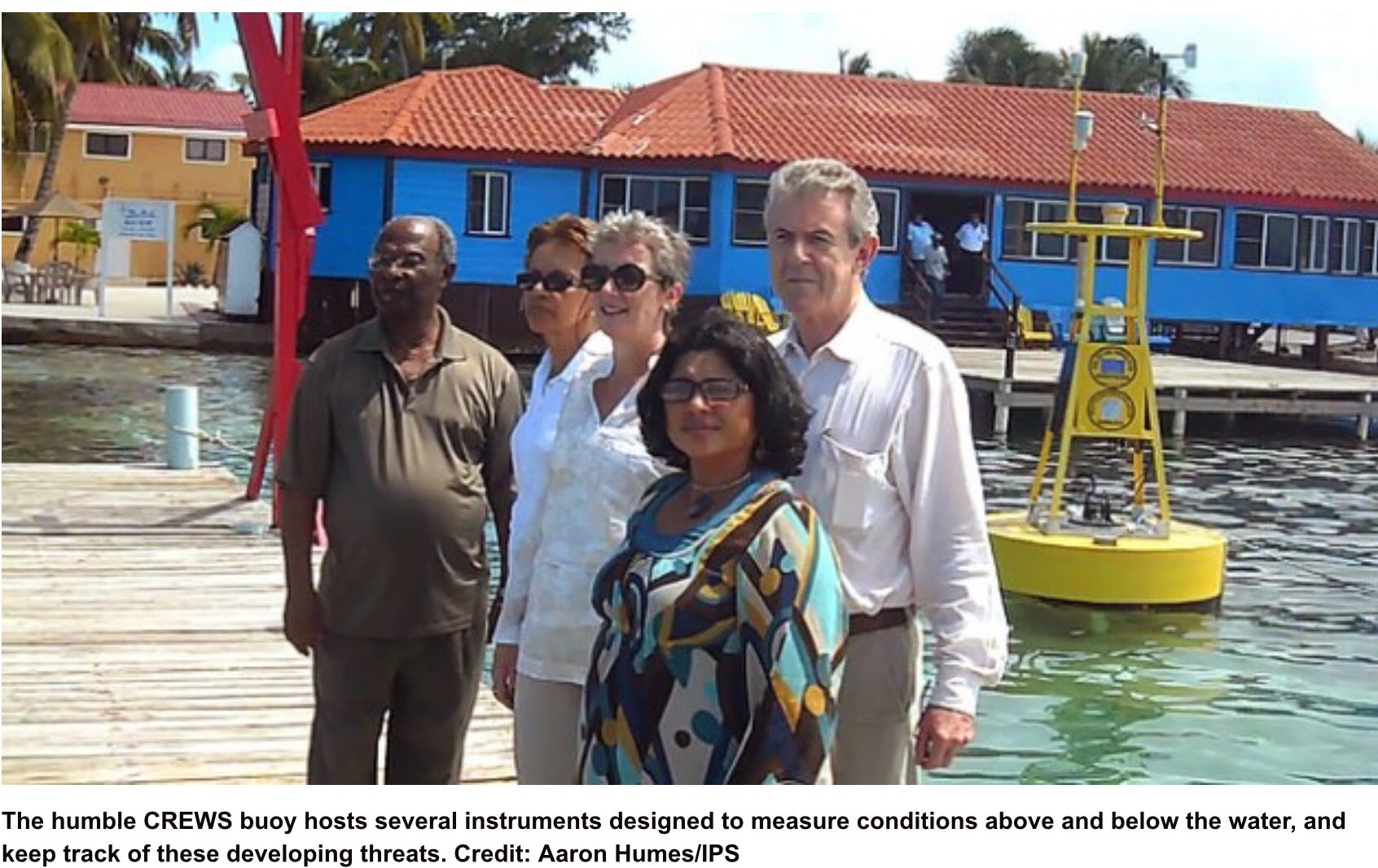
Last month, the European Union (EU), as part of its Global Climate Change Alliance Caribbean Support Project handed over to the government of Belize and specifically the Ministry of Forestry, Fisheries and Sustainable Development for its continued usage a Coral Reef Early Warning System (CREWS) buoy based at South Water Caye off the Stann Creek District in southern Belize. More


Monday, October 20, 2014

Turks & Caicos Joins The Caribbean's Renewable Energy Race

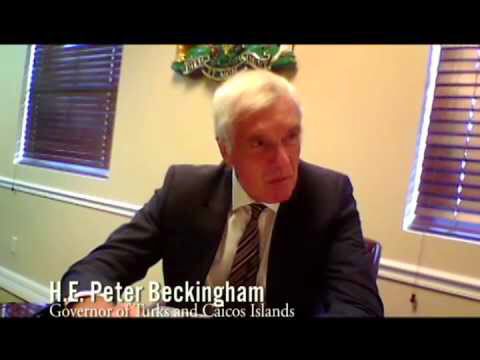
Governor Peter Beckingham

New York, October 16,2014— Tlirks & Caicos fTCI) deepened its commitment to advancing renewable energy by joining the Carbon War Room's Ten Island Challenge today.

The Premier of Turks and Caicos, the Honorable Doctor Rufus Ewing, and Carbon War Room Operation Director, Justine Locke, signed a Memorandum of Understanding, committing to work together to reduce the island's dependence on fossil fuels through increased renewable energy production and improved energy efficiency.

"With the addition of Turks & Caicos, the Ten Island Challenge continues to expand its efforts to transform Caribbean economies and help the region achieve independence from fossil fuels."Sir Richard Branson, Founder of Carbon War Room

The Ten Island Challenge, driven by partners Carbon War Room and Rocky Mountain Institute, provides the Government of TCI the opportunity and platform to define and realize its own vision of a clean economy. In order to achieve this vision, the Carbon War Room and Rocky Mountain Institute will provide a range of technical, project management, communications, and business advisory support services.

The MOU signing builds on a commitment made by the Governor of Turks and Caicos, Peter Beckingham at the Creating Climate Wealth Islands Summit in February 2014, when Turks & Caicos expressed interest in joining the Challenge

The Ten Island Challenge

The Ten Island Challenge works to accelerate the transition of Caribbean island economies from a heavy dependence on fossil fuels to renewable resources. Caribbean economies suffer from some of the highest electricity prices in the world—contributing to their national debts, and slowing efforts toward sustainable development. Despite an abundance of sun and wind, Caribbean islands have implemented relatively low amounts of renewables to date. The Ten Island Challenge is tackling this by identifying the technical and commercial solutions that can facilitate low-carbon energy use in the Caribbean.

In 2013, Sir Richard Branson committed his home of Necker Island in the British Virgin Islands to serve as a 'demo' island in the Challenge, and, in February of this year, US energy giant NRG Energy was awarded the contract to transition the island to renewables. More


Monday, October 13, 2014

I'm fighting to keep my home above water

My name is Milañ Loeak, I’m from the Marshall Islands, and I bring you a message on behalf of my Climate Warrior brothers and sisters from across Oceania.

You've probably heard it all before -- that the climate is changing, that the ocean is rising, that my home in the islands will be the first to go. But the people of the Pacific are not drowning, we are fighting. And the biggest threat to our homes is the fossil fuel industry.

So here's how we're fighting back: there's a coal port in Newcastle, Australia and it's the largest in the world, shipping approximately 617,000 tons of coal every single day. If the port were a country, it would be the 9th highest emitting country in the world. That’s why I have travelled to Australia to shut it down for a day.

Using traditional canoes, I and 30 other Pacific Climate Warriors are going to paddle into the oncoming path of coal ships. Behind us will be hundreds of Australians in kayaks, on surfboards and whatever else they can find, united with us as we stand up to the fossil fuel industry.

But we need more than hundreds of Australians standing with us -- we are going to need you too.

The fossil fuel industry will try to dismiss us. They will launch their PR machine to say that we are just a small group acting alone and that we do not speak for others. But we know that we are not acting alone. We are standing with front line communities around the world when we say it is time to end our addiction to fossil fuels before it destroys our homes, our communities, and our culture.

As the Pacific Climate Warriors paddle into the water on October 17th, show that you stand with us -- click here to sign on to our call for solidarity.

Stopping one day of coal exports alone won't keep our homes above water, but it marks the rise of the Pacific Climate Warriors, and the beginning of our defense of the Pacific Islands.

I ask you to join us in this fight -- because we cannot save the Pacific Islands on our own.

Warm Pacific wishes,

Milañ Loeak, Republic of the Marshall Islands


350.org is building a global climate movement. Become a sustaining donor to keep this movement strong and growing.


Monday, October 6, 2014

Antigua Faces Climate Risks with Ambitious Renewables Target

Ruth Spencer is a pioneer in the field of solar energy. She promotes renewable technologies to communities throughout her homeland of Antigua and Barbuda, playing a small but important part in helping the country achieve its goal of a 20-percent reduction in the use of fossil fuels by 2020.

She also believes that small non-governmental organisations (NGOs) have a crucial role to play in the bigger projects aimed at tackling the problems caused by the burning of fossil fuels, such as coal, oil and gas.

Spencer, who serves as National Focal Point for the Global Environment Facility (GEF)-Small Grants Programme (SGP) in Antigua and Barbuda, has been at the forefront of an initiative to bring representatives of civil society, business owners and NGOs together to educate them about the dangers posed by climate change.

“The GEF/SGP is going to be the delivery mechanism to get to the communities, preparing them well in advance for what is to come,” she told IPS.

The GEF Small Grants Programme in the Eastern Caribbean is administered by the United Nations office in Barbados.

“Since climate change is heavily impacting the twin islands of Antigua and Barbuda, it is important that we bring all the stakeholders together,” said Spencer, a Yale development economist who also coordinates the East Caribbean Marine Managed Areas Network funded by the German government.

“The coastal developments are very much at risk and we wanted to share the findings of the IPCC report with them to let them see for themselves what all these scientists are saying,” Spencer told IPS.

“We are in a small island so we have to build synergies, we have to network, we have to partner to assist each other. By providing the information, they can be aware and we are going to continue doing follow up….so together we can tackle the problem in a holistic manner,” she added.

The United Nations’ Intergovernmental Panel on Climate Change (IPCC) has sent governments a final draft of its synthesis report, which paints a harsh picture of what is causing global warming and what it will do to humans and the environment. It also describes what can be done about it.

Ruleta Camacho, project coordinator for the sustainable island resource management mechanism within Antigua and Barbuda’s Ministry of the Environment, told IPS there is documented observation of sea level rise which has resulted in coastal erosion and infrastructure destruction on the coastline.

She said there is also evidence of ocean acidification and coral bleaching, an increase in the prevalence of extreme weather events – extreme drought conditions and extreme rainfall events – all of which affect the country’s vital tourism industry.

“The drought and the rainfall events have impacts on the tourism sector because it impacts the ancillary services – the drought affects your productivity of local food products as well as your supply of water to the hotel industry,” she said.

“And then you have the rainfall events impacting the flooding so you have days where you cannot access certain sites and you have flood conditions which affect not only the hotels in terms of the guests but it also affects the staff that work at the hotels. If we get a direct hit from a storm we have significant instant dropoff in the productivity levels in the hotel sector.”

Antigua and Barbuda, which is known for its sandy beaches and luxurious resorts, draws nearly one million visitors each year. Tourism accounts for 60 to 75 percent of the country’s gross domestic product, and employs nearly 90 percent of the population.

Like Camacho, Ediniz Norde, an environment officer, believes sea level rise is likely to worsen existing environmental stresses such as a scarcity of freshwater for drinking and other uses.

“Many years ago in St. John’s we had seawater intrusion all the way up to Tanner Street. It cut the street in half. It used to be a whole street and now there is a big gutter running through it, a ship was lodged in Tanner Street,” she recalled.

“Now it only shows if we have these levels of sea water rising that this is going to be a reality here in Antigua and Barbuda,” Norde told IPS. “This is how far the water can get and this is how much of our environment, of our earth space that we can lose in St. John’s. It’s a reality that we won’t be able to shy away from if we don’t act now.”

As the earth’s climate continues to warm, rainfall in Antigua and Barbuda is projected to decrease, and winds and rainfall associated with episodic hurricanes are projected to become more intense. Scientists say these changes would likely amplify the impact of sea level rise on the islands.

But Camacho said climate change presents opportunities for Antigua and Barbuda and the country must do its part to implement mitigation measures.

She explained that early moves towards mitigation and building renewable energy infrastructure can bring long-term economic benefits.

“If we retrain our population early enough in terms of our technical expertise and getting into the renewable market, we can actually lead the way in the Caribbean and we can offer services to other Caribbean countries and that’s a positive economic step,” she said.

“Additionally, the quicker we get into the renewable market, the lower our energy cost will be and if we can get our energy costs down, it opens us for economic productivity in other sectors, not just tourism.

“If we can get our electricity costs down we can have financial resources that would have gone toward your electricity bills freed up for improvement of the [tourism] industry and you can have a better product being offered,” she added. More