|


|


Lawmakers voted in favour of a private member’s motion by UDP backbencher Cline Glidden to make it easier for people to produce and use renewable energy in their homes or businesses.
.jpg)
The motion by Mr. Glidden, a West Bay Member of the Legislative Assembly, called for the government to “take all necessary steps to eliminate all utility-imposed restrictions on a person’s individual or business right to use renewable energy systems to offset utility consumption, thus reducing or eliminating utility costs and … to implement net metering using the [US] Interstate Renewable Energy Commission model rules for both net metering and grid interconnection”.
Under the current Consumer-owned Renewable Energy arrangement of Feed-in Tariff System, or FITS, the Caribbean Utilities Company, which has the exclusive right to distribute electricity in Grand Cayman, buys 100 per cent of electricity produced by alternative energy systems from those who have signed up for the programme at 37 cents per kilowatt hour. Those individuals then buy electricity back from CUC’s main grid at the retail rate, which is currently 29 cents per kilowatt hour.
Net metering enables a bi-directional flow of electricity. Throughout the day, a customer’s solar, wind-generated or other alternative energy system may produce more or less electricity than is needed for his or her home or business. When the system’s production exceeds the customer demand, the excess energy generation automatically goes through the electric meter into the utility grid, running the meter backward to credit the customer’s account. When the customer’s electricity demand is higher than the renewable energy system is producing, the customer relies on additional power from the utility company.
Mr. Glidden pointed out that there had not been much uptake from consumers of the pilot FITS system.
The one-year pilot programme was introduced in January 2010 and is under review. By last month, only nine people had signed up for the programme – eight residential customers and one commercial business.
“What is proposed in this motion is a system that would allow a homeowner to produce electricity for his own use and whatever electricity that is not used in its own facility, that would then be sold on to the gird, sold to CUC, at a rate equivalent to the rate that is charged by CUC. Hence, we have net metering,” said Mr Glidden. More
The Caribbean region including Jamaica and other Small Island Developing States lacks the resources to combat a major oil spill, delegates to a regional convention on oil spill prevention and response have been warned.

Opening the convention to discuss oil spill prevention, preparedness and response in the Gulf of Mexico, keynote speaker Christopher Cargill, Chairman of the Petroleum Corporation of Jamaica, said Jamaica and other islands in the region do not have access to vast amounts of resources to combat major oil spills of the magnitude of the BP Deepwater Horizon incident – which occurred two years ago this month in the Gulf of Mexico.
He told delegates: “We understand that the BP Deepwater Horizon incident involved 47,000 persons, 600 vessels and 120 aircraft and the responders had access to a Spill Liability Trust Fund.
The development of a mechanism for cooperation is therefore a critical part of the preparedness in the region as Jamaica and other small states will have to rely heavily on their neighbours to the north for assistance in dealing with such events. “
The objective of last week’s convention, held in Kingston, Jamaica from April 11-13th, was to further regional preparedness and cooperation to oversee the offshore oil exploration and exploitation industry and to improve oil spill response preparedness and capabilities.
This was third such forum and aimed to complete a Caribbean Multinational Authorities Matrix to aid regional plans towards the offshore oil exploration industry. The previous discussions looked at the legal and policy frame work for drilling operations and issues related to preparedness and response to pollution incidents arising from oil and gas exploration and exploitation.
According to Bertrand Smith, Director of Legal Affairs at the Maritime Authority of Jamaica (MAJ): “This meeting was important to Jamaica as we ratified the IMO Oil Pollution and Response Convention (OPRC) two years ago and are currently incorporating its provisions into national legislation to deal with discharges from oil and gas platforms, among other things.”
The convention was sponsored by the Maritime Authority of Jamaica and the Petroleum Corporation of Jamaica under the auspices of the International Maritime Organization (IMO), United Nations Environment Programme (UNEP) and the Regional Activity Centre/Regional Marine Pollution Emergency Information and Training Centre (RAC/REMPEITC).
In attendance were US Ambassador, Ms. Pamela Bridgewater Ambassador Extraordinary and Plenipotentiary, Embassy of the United States of America, His Excellency, Mr. Yuri Gala Lopez, Ambassador, Embassy of the Republic of Cuba, and Mr. Raul Mendoza-Gallo, Head of Consular, Commercial and Cooperation Affairs, Embassy of Mexico. Attendees also included representatives from the US State Department and other regulators from the USA as well as delegates from Jamaica, Cuba, Mexico, The Bahamas and Guyana and representatives from RAC/RECPEITC-Caribe. More
Havana, April 11, 2012: One of the major challenges facing Cuba as it designs climate change adaptation policies is the preservation of its coastal ecosystems against the predicted rise in sea level and increasingly catastrophic extreme weather events.
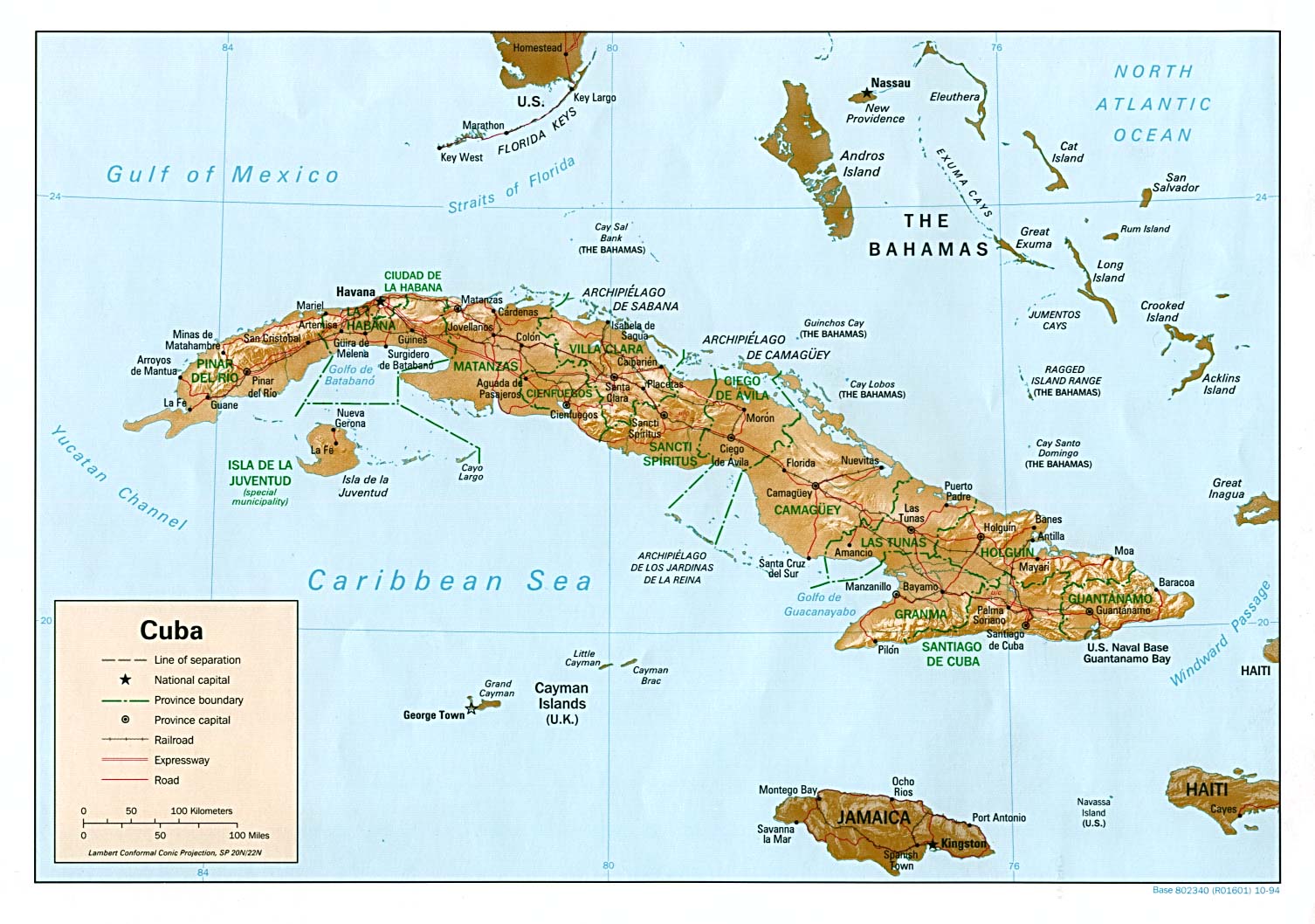
With the country’s 5,500 km of coastline and 4,000 cays and islets, almost everyone on the Cuban archipelago feels their life is tied to the sea in one way or another. “It’s lovely, but it is also dangerous,” said 78-year-old Teresa Marcial, who lives on the coast in Santa Fé, in the northern outskirts of Havana.
For decades, Marcial has lived with the ocean practically lapping her patio. In 2005, floods caused by hurricane Wilma left her family and neighbours virtually on the street. “Huge waves swept everything away. We were taken by surprise. The water took away an extremely heavy wardrobe, which simply disappeared,” she told IPS.
Her son, Martín Pérez Marcial, added that they have decided to sell their house and move to a safer place.
“But as you can imagine, with the expectation that future hurricanes will be more intense because of climate change, no one wants to come and live here,” said a neighbour who did not mention his name.
A few blocks away, builders are constructing a house that is raised more than two metres above ground level, using part of an older house and strong pillars for support. “If there is flooding, the water can circulate freely underneath the house,” said the construction foreman, José Luis Martínez.
Behind the house, which is being built by “self help”, as private construction initiatives are called in Cuba, there is an outer wall of solid concrete and hard stone. “It saves on cement, and does not require steel, which rusts over time,” Martínez said.
The talkative builder showed how the base of the containment wall has spillways for drainage, to let water flow back and forth. At the corners, the walls are shaped like a ship’s prow, “to break up the waves.” Several houses in the vicinity have similar walls, which “cost a pretty penny,” Pérez said.
Santa Fé is at permanent risk of flooding due to hurricanes. Studies by state bodies put it among the coastal areas of the capital that face the greatest direct impact of tropical storms, and to a lesser extent of rising sea levels.
Adaptation, an inevitable necessity
Carlos Rodríguez, a researcher on land use planning and the environment for the government’s Physical Planning Institute (IPF), says 577 human settlements could suffer the combined onslaught of rising sea levels and oversized waves from swells and storm surges associated with hurricanes.
In an interview with IPS, Rodríguez emphasised that according to a joint study by several Cuban scientific institutions, led by the Ministry of Science, Technology and the Environment and including IPF, an area of 2,550 square km of coast could be submerged by 2050.
By 2100, the flooded area could expand to some 5,600 square km, according to sea level rise projections, he said. More
The dominant narrative of our culture is that economic growth can continue indefinitely but the realities of resource depletion, peak oil and ecosystem collapse mean this is wishful thinking. Cameron Leckie explains that if permaculture becomes the new dominant narrative, it will ensure that the changes that will eventually be forced upon us will be empowering rather than authoritarian or dictatorial.

Narratives define our society. Pick any significant issue and it is the narrative, rather than the 'facts,' which define it. Narratives have been part of the human experience for millennia and no doubt will continue to do so for millennia to come. They drive how we view the world, the way we live and the decisions that we make.
Narratives do not necessarily reflect reality. Rather they offer a version of reality which suits the group or groups of people that believe in the narrative (or want you to believe). Examples include religious or other groups which try to convince others that the end of the world is nigh but that the true believers will be saved and the cargo cults of the Pacific who believed that a combination of magic and religious rituals would result in more cargo/material goods arriving.
Narratives change over time. Change occurs as societies develop new understandings or differing groups within a society attempt to convince others of a particular narrative. Over time a dominant narrative tends to form. This does not happen by accident but is both perpetuated and strengthened through culture, media institutions, politicians and society at large. More
TRAFALGAR VILLAGE, West Berbice, Guyana (AlertNet) – Rural women living on the coast of Guyana have turned to beekeeping to boost their income while at the same time helping preserve the mangrove forests that protect the coast from rising seas.

Mangroves comprise just one percent of the 160,000 square kilometres (62,000 square miles) of natural vegetation in this South American nation. But the mangroves stabilise sediment and play an important role in coastal protection, vital for a coastline vulnerable to rising seas and heavy storms, problems experts link to climate change.
Now a project funded by the government of Guyana and the European Union to strengthen the country’s sea defences is giving local women the opportunity to profit from keeping bees, which thrive in and around the mangroves.
The scheme aims to give the women an economic stake in preserving the mangroves and thereby help protect some of the country’s prime agricultural land on the coast from flooding.
Donette Cummings, a recent convert to beekeeping in Trafalgar village, has learned through the project about the varied benefits of the mangrove ecosystem.
“I know that the mangroves protect the coastline from the sea and that (they are) a home for the bees. The mangroves have a lot of flowers and you get a lot of honey at a faster rate from them,” Cummings said.
She and some of her neighbours began keeping bees in October and are looking forward to their first honey harvest.
“We hope that in a next three months we start getting honey, and from our projection we think it will be good for us and at least bring in some income,” she said. More
BRIDGETOWN, Barbados, April 12, 2012 - A waste-to-energy facility expected to process approximately 350 tonnes of solid waste a day, and provide between 10 to 14 megawatts of electricity is on the cards for Barbados.

This was announced by the island’s Minister of the Environment and Drainage, Dr Denis Lowe, as he disclosed that Cabinet had recently approved BDS$377 million for the creation of a Mangrove Pond Green Energy Complex.
Along with the waste-to-energy facility, this complex will include a solar power facility, a wind energy facility, the Mangrove Pond Beautification Programme, the construction of a new mechanical maintenance facility, and the Landfill Gas Management System.
Dr Lowe said the complex formed part of Government's efforts to develop a comprehensive programme to manage solid waste disposal and create energy options for the country.
"What we are also going to be doing in that package of services is to decommission cells one, two and three [at the Landfill], and commission the new cell four towards the end of June," he said.
The projects listed under the programme are expected to assist with the development of the infrastructure that is necessary for achieving sustainability, efficiency and effectiveness in the execution of solid waste management in Barbados. More
The Cayman Islands should, no matter where the new land-fill is placed, seriously consider a major recycling program. Editor
The Pentagon knows it. The world’s largest insurers know it. Now, governments may be overthrown because of it. It is climate change, and it is real. According to the U.S. National Oceanic and Atmospheric Administration, last month was the hottest March on record for the United States since 1895, when records were first kept, with average temperatures of 8.6 degrees F above average. More than 15,000 March high-temperature records were broken nationally. Drought, wildfires, tornadoes and other extreme weather events are already plaguing the country.

Across the world in the Maldives, rising sea levels continue to threaten this Indian Ocean archipelago. It is the world’s lowest-lying nation, on average only 1.3 meters above sea level. The plight of the Maldives gained global prominence when its young president, the first-ever democratically elected there, Mohamed Nasheed, became one of the world’s leading voices against climate change, especially in the lead-up to the 2009 U.N. climate-change summit in Copenhagen. Nasheed held a ministerial meeting underwater, with his cabinet in scuba gear, to illustrate the potential disaster.
In February, Nasheed was ousted from his presidency at gunpoint. The Obama administration, through State Department spokesperson Victoria Nuland, said of the coup d’etat, “This was handled constitutionally.” When I spoke to Nasheed last month, he told me: “It was really shocking and deeply disturbing that the United States government so instantly recognized the former dictatorship coming back again. ... The European governments have not recognized the new regime in the Maldives.” There is a parallel between national positions on climate change and support or opposition to the Maldives coup.
Nasheed is the subject of a new documentary, “The Island President,” in which his remarkable trajectory is traced. He was a student activist under the dictatorship of Maumoon Abdul Gayoom and was arrested and tortured, along with many others. By 2008, when elections were finally held, Gayoom lost, and Nasheed was elected. As he told me, though: “It’s easy to beat a dictator, but it’s not so easy to get rid of a dictatorship. The networks, the intricacies, the institutions and everything that the dictatorship has established remains, even after the elections.” On the morning of Feb. 7, 2012, under threat of death to him and his supporters from rebelling army generals, Nasheed resigned.
While no direct link has been found yet between Nasheed’s climate activism and the coup, it was clear in Copenhagen in 2009 that he was a thorn in the Obama administration’s side. Nasheed and other representatives from AOSIS, the Alliance of Small Island States, were taking a stand to defend their nations’ very existence, and building alliances with grass-roots groups like 350.org, that challenge corporate-dominated climate policy. More
Another sign of the rapidly changing (for the better) energy landscape: the southeastern Caribbean island nation of Barbados is taking an integrated, multiple source-multiple use approach as it launches a program to shift away from its almost total reliance on imported fossil fuel imports to clean, homegrown renewable sources for electricity generation and other uses.

The Barbadian cabinet on April 5 approved the US$188.5 million Mangrove Pond Green Energy Complex, according to a Caribbean Journal report. The complex is to include solar power and wind power facilities, a new Mechanical Maintenance Facility, a Waste-to-Energy Facility, and a Landfill Gas Management System.
In total, the Barbadian government expects the Mangrove Pond Green Energy Complex to produce more than 25 MW of clean electrical power that can be sold on to the island nation’s grid, reducing dependence on fossil fuels and helping reduce greenhouse gas emissions.
Barbados relies almost entirely (96%) on fuel oil and diesel to generate electricity; 90% of it imported. That’s comparable to what the island nation spends on education. Barbados’s bill for oil imports in 2009 and 2010 totaled some $230 million, which amounts to nearly 6% of national GDP, about what it spends on education, Senator Darcy Boyce was quoted as saying in a Barbados Today article.
Barbados’s Sustainable Energy Framework
The government intends to reduce Barbados’s oil import bill significantly, Boyce, who heads the Prime Minister’s Energy Office, told attendees gathered for the launch of the Energy Efficiency Awareness Programme of the Sustainable Energy Framework for Barbados Pilot Project.
The aim of the Sustainable Energy Framework for Barbados Pilot Project is to reduce fossil fuel use by some 30% by bringing renewable energy resources online, and to reduce electricity demand by over 21% by implementing energy efficiency measures and technologies over a 20-year period. TheInter-American Development Bank (IADB) is contributing $1 million in investment grants and loans through the World Bank Group’s Global Environment Facility (GEF).
Rising global market prices for crude oil and derivatives have been rising consistently for several years, putting greater financial pressure on local businesses and residents alike. The direct effect rising fuel costs have on ratepayers’ pocketbooks and businesses’ operating budgets is compounded by the indirect effects, as they flow through into prices of all imports and are passed on to consumers. More
To deal with the threats and challenges of climate change we need solidarity. We need to recognize that no matter where we live, we are one people on a single planet, the only planet that we have. We need many strong voices speaking together -- the voices of people from all those regions that the 2007 IPCC IV Report identified as “vulnerable.”
by: Sheila Watt-Cloutier, Inuit environment, culture and human rights advocate, and former political leader, Ronald Jumeau, Seychelles Ambassador for Climate Change and Small Island Developing State Issues

We need the Arctic, where the rapidly melting multi-year sea ice is just one symptom of massive changes now underway. We need the small island developing States (SIDS) like Tuvalu, Barbados and Seychelles whose homes are threatened with inundation. And we need voices of people who live in high mountain regions, on deltas and in the vast Savannah of the Sahel.
We need many strong voices, united in their resolve to defend human rights and determined to see their cultures survive and thrive.
Twenty years. That's how long we have both petitioned the world community to save our lands, our peoples and ways of life. We have done so in every conceivable manner and with ever-increasing urgency. Twenty years ago, when we began to experience climate change in our lands and communities, we began to worry that our children would no longer grow up in a safe and nurturing environment. We worried too that our ancient cultures, deeply connected to our lands, might not survive into future generations. Today, our children now experience those changes with us every day, and join in the appeal for future generations.
It is hard to imagine us coming from more different backgrounds: one from a balmy archipelago in the Indian Ocean and the other from the cold expanse of the northern tundra. Yet today we join with our brothers and sisters from other islands and polar regions through the Many Strong Voices programme[3] — a network of individuals and communities in the Arctic and SIDS connecting for strategic action on climate change mitigation and adaptation. We reiterate our unequivocal appeal: The world must take action now to stop climate change and address the damage already done.
Now as we approach the 20th anniversary of the United Nations Framework Convention on Climate Change (UNFCCC), we are running out of time. Last year’s climate change negotiations in Durban produced an agreement to adopt a binding legal agreement on climate change “as soon as possible, and no later than 2015.”[4]
We heard this kind of pledge leading up to the 2009 negotiations in Copenhagen that produced little of substance. Indeed, at the time the fact that the negotiation process itself lived on was heralded as a major victory.
Not to us.
As climate science has advanced, we now know the consequences of the world’s unwillingness to act. Even once the world agrees to stabilize and reduce greenhouse gas (GHG) emissions, warming from gases already in the atmosphere will tragically affect the most vulnerable regions of our planet. Sadly, as we have seen in places such as the Pacific island of Kiribati and the Alaskan community of Shishmaref, it may already be too late.
Even if the world forges an agreement three years from now, it will be very difficult to make the deep GHG emissions reductions that hundreds of scientific studies tell us -- clearly -- that we need to make in order to keep the world’s global average temperature from rising 2ºC above pre-industrial levels, let alone the 1.5ºC that the SIDS and a majority of the countries that have signed the UNFCCC are calling for. And we need to make sure that the rising line of emissions starts to bend down as 2020 dawns or it may be too late for our peoples and lands.
The impacts of climate change may be affecting small island states and remote Arctic communities with small populations, but they are also affecting hundreds of millions of people in the Ganges, Indus, Yangtze and other river systems dependent on glacial water for agriculture and drinking. If you look at it this way, the majority of the world’s population is experiencing the effects of climate change now.
Let’s be clear. This isn’t a numbers game. Article 3 of the UNFCCC clearly states that countries “should protect the climate system for the benefit of future and present generations of human kind on the basis of equity and in accordance with their common but differentiated responsibility and respective capabilities.” This means “developed countries should take the lead in combating climate change and the adverse effects thereof.” We haven’t seen much of this leadership in the negotiating process.
Other major emitters and emerging economies cannot afford to continue with business as usual.
Now, as the world approaches the 20th anniversary of the Rio Summit where the UNFCCC was negotiated, much attention is being placed on how to achieve a sustainable future. We would like to point out that our peoples have overcome innumerable challenges to thrive in our Arctic and island communities for hundreds and thousands of years. Our cultures are sustainable. But recently, our elders have been warning us that the changes we witness are unprecedented in our histories. They see our ice melting and our seas rising and are very concerned about how the next generation will thrive in the rapidly changing lands of our ancestors. If we lose our ice and our lands, we lose our cultures — some of the richest on Earth.
Our primary objectives are clear: reduce global emissions to avoid catastrophic warming while recognizing common but differentiated responsibilities between countries; ensure adequate adaptation measures are taken in areas facing the adverse effects of climate change now and in the future; and include human rights protections in the final agreement.
If we can achieve these goals, it will mark a watershed in humankind's ability to look beyond immediate and parochial interests and to reconnect as a shared humanity. It isn’t that complicated. All it takes is for us to recognize our common interest and that we are all here on this planet together. More
For more information visitwww.manystrongvoices.org or contact John Crump (john.crump [at] grida.no).
[1] Sheila Watt- Cloutier is an award winning Inuit environment, culture and human rights advocate and former political leader who was nominated for the Nobel Peace Prize in 2007.
[2] H.E. Ronald Jumeau is the Seychelles Ambassador for Climate Change and Small Island Developing State Issues.
[4] http://unfccc.int/meetings/durban_nov_2011/meeting/6245.php