Tuesday, October 28, 2014

IPCC’s Fifth Assessment Report on Climate Change. What does it mean for the Caribbean?IPCC’s Fifth Assessment Report on Climate Change. What does it mean for the Caribbean?

The Caribbean’s response to Climate Change is grounded in a firm regional commitment, policy and strategy. Our three foundation documents – The Liliendaal Declaration (July 2009), The Regional Framework for Achieving Development Resilient to Climate Change (July 2009) and its Implementation Plan (March 2012) – are the basis for climate action in the region.
The Fifth Assessment Report (AR5) of the United Nations Intergovernmental Panel on Climate Change (IPCC) underscores the importance, scientific rigour and utility of these landmark documents. The IPCC’s latest assessment confirms the Caribbean Community’s longstanding call to limit global temperature rise to 1.5 degrees celsius as outlined in the Liliendaal Declaration. At the Nations Nation Framework Convention on Climate Change (UNFCCC) Conference of the Parties (COP) Meeting in 2009, which took place in Copenhagen, Denmark, the Caribbean Community indicated to the world community that a global temperature rise above 1.50C would seriously affect the survival of the community.

In 2010 at the UNFCCC COP Meeting in Cancun, governments agreed that emissions ought to be kept at a level that would ensure global temperature increases would be limited to below 20C. At that time, the Alliance of Small Island States (AOSIS), which includes the Caribbean, re-iterated that any rise in temperature above 1.50C would seriously affect their survival and compromise their development agenda. The United Nations Human Development Report (2008) and the State of the World Report (2009) of The Worldwatch Institute supports this position and have identified 20C as the threshold above which irreversible and dangerous Climate Change will become unavoidable.

Accordingly, the Caribbean welcomes the IPCC’s Fifth Assessment Report prepared by over 2000 eminent scientists. It verifies observations in the Caribbean that temperatures are rising, extreme weather events are occurring more frequently, sea levels are rising, and there are more incidences of coral bleaching. These climatic changes will further exacerbate the limited availability of fresh water, agricultural productivity, result in more erosion and inundation, and increase the migration of fish from the Caribbean to cooler waters and more hospitable habitats. The cumulative effect is reduced food security, malnutrition, and productivity, thus increasing the challenges to achieving poverty reduction and socio-economic development.

The report notes that greenhouse gases emissions, the cause of Climate Change, continues to rise at an ever increasing rate. Unless this trend is arrested and rectified by 2050, global temperatures could rise by at least 4°C by 2100. This would be catastrophic for the Caribbean. However, the report is not all gloom and doom. More than half of the new energy plants for electricity are from renewable resources, a trend that must accelerate substantially if the goal of limiting global warming to below 2°C by 2100 is to remain feasible.

The IPCC AR5 Report should therefore serve as a further wake up call to our region that we cannot continue on a business as usual trajectory. It is an imperative that Climate Change be integrated in every aspect of the region’s development agenda, as well as its short, medium and long-term planning. The region must also continue to aggressively engage its partners at the bilateral and multilateral levels to reduce their emissions. The best form of adaptation is reduction in emissions level.

Dr Kenrick Leslie

The IPCC will adopt the Synthesis Report of the AR5 in Copenhagen, Denmark in late October 2014. Caribbean negotiators are already preparing to ensure that the most important information from the report are captured in the Synthesis Report.

See the highlights of the Caribbean Launch of the UN IPCC AR5 Report in this video:

Learn more about the implications of the IPCC AR5 Report via www.caribbeanclimate.bz and @CaribbeanClimate.

* Dr Kenrick Leslie is the Executive Director of the Caribbean Community Climate Change Centre, the regional focal point for Climate Change.

Wednesday, October 22, 2014

Belize Fights to Save a Crucial Barrier Reef

BELIZE CITY, Oct 20 2014 (IPS) - Home to the second longest barrier reef in the world and the largest in the Western Hemisphere, which provides jobs in fishing, tourism and other industries which feed the lifeblood of the economy, Belize has long been acutely aware of the need to protect its marine resources from both human and natural activities.

However, there has been a recent decline in the production and export of marine products including conch, lobster, and fish, even as tourism figures continue to increase.

"What happens on the land will eventually reach the sea, via our rivers." -- Dr. Kenrick Leslie

The decline is not helped by overfishing and the harvest of immature conch and lobster outside of the standard fishing season. But the primary reason for less conch and lobster in Belize’s waters, according to local experts, is excess ocean acidity which is making it difficult for popular crustacean species such as conch and lobster, which depend on their hard, spiny shells to survive, to grow and mature.

According to the executive director of the Caribbean Community Climate Change Center (CCCCC), Dr. Kenrick Leslie, acidification is as important and as detrimental to the sustainability of the Barrier Reef and the ocean generally as warming of the atmosphere and other factors generally associated with climate change.

Carbon dioxide which is emitted in the atmosphere from greenhouse gases is absorbed into the ocean as carbonic acid, which interacts with the calcium present in the shells of conch and lobster to form calcium carbonate, dissolving those shells and reducing their numbers. Belize also faces continuous difficulties with coral bleaching, which has attacked several key sections of the reef in recent years.

Dr. Leslie told IPS that activities on Belize’s terrestrial land mass are also contributing to the problems under Belize’s waters. "What happens on the land will eventually reach the sea, via our rivers," he noted.

To fight these new problems, there is need for more research and accurate, up to the minute data.

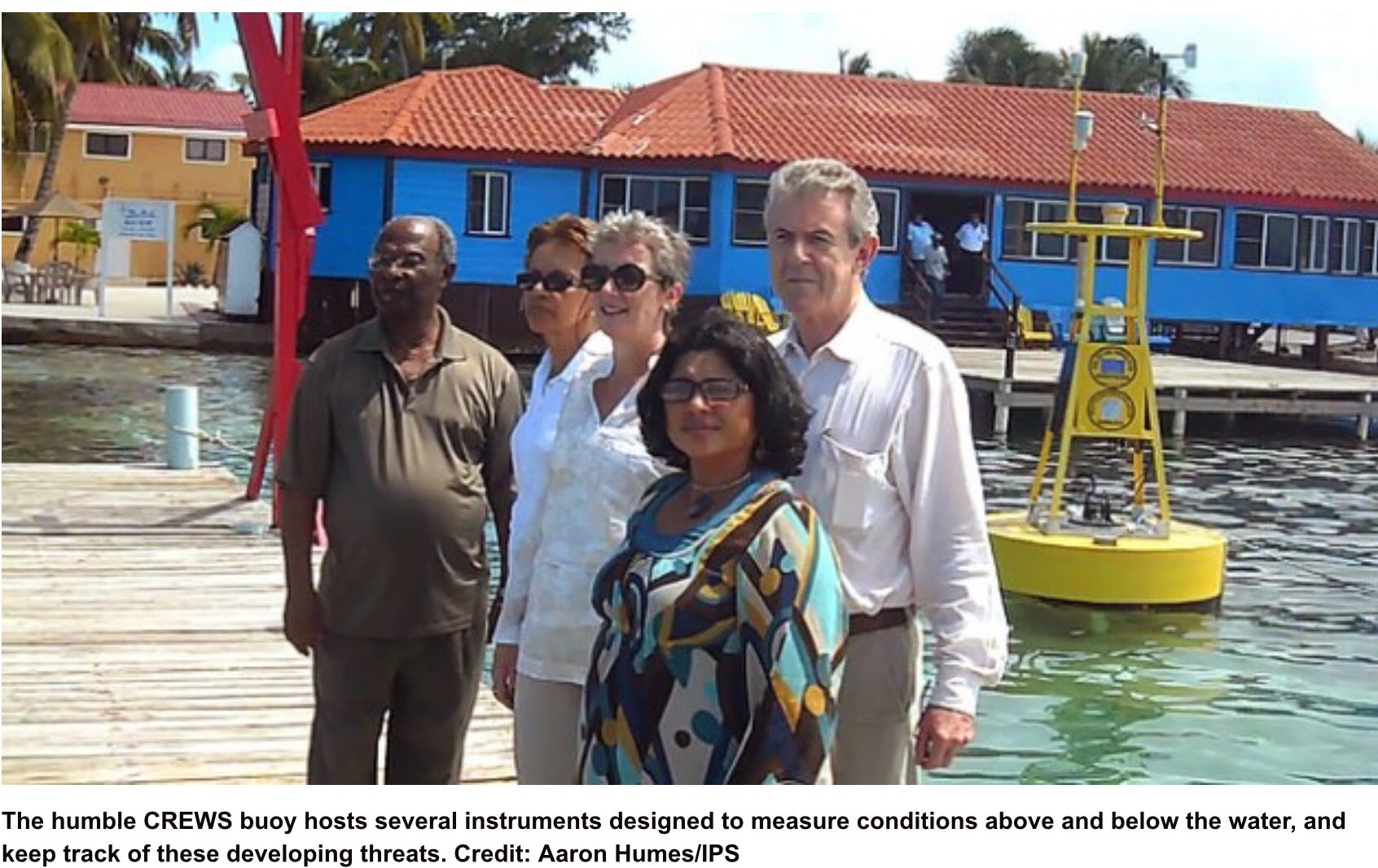
Last month, the European Union (EU), as part of its Global Climate Change Alliance Caribbean Support Project handed over to the government of Belize and specifically the Ministry of Forestry, Fisheries and Sustainable Development for its continued usage a Coral Reef Early Warning System (CREWS) buoy based at South Water Caye off the Stann Creek District in southern Belize. More


Monday, October 20, 2014

Turks & Caicos Joins The Caribbean's Renewable Energy Race

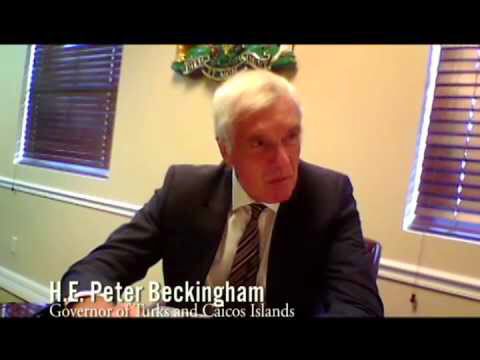
Governor Peter Beckingham

New York, October 16,2014— Tlirks & Caicos fTCI) deepened its commitment to advancing renewable energy by joining the Carbon War Room's Ten Island Challenge today.

The Premier of Turks and Caicos, the Honorable Doctor Rufus Ewing, and Carbon War Room Operation Director, Justine Locke, signed a Memorandum of Understanding, committing to work together to reduce the island's dependence on fossil fuels through increased renewable energy production and improved energy efficiency.

"With the addition of Turks & Caicos, the Ten Island Challenge continues to expand its efforts to transform Caribbean economies and help the region achieve independence from fossil fuels."Sir Richard Branson, Founder of Carbon War Room

The Ten Island Challenge, driven by partners Carbon War Room and Rocky Mountain Institute, provides the Government of TCI the opportunity and platform to define and realize its own vision of a clean economy. In order to achieve this vision, the Carbon War Room and Rocky Mountain Institute will provide a range of technical, project management, communications, and business advisory support services.

The MOU signing builds on a commitment made by the Governor of Turks and Caicos, Peter Beckingham at the Creating Climate Wealth Islands Summit in February 2014, when Turks & Caicos expressed interest in joining the Challenge

The Ten Island Challenge

The Ten Island Challenge works to accelerate the transition of Caribbean island economies from a heavy dependence on fossil fuels to renewable resources. Caribbean economies suffer from some of the highest electricity prices in the world—contributing to their national debts, and slowing efforts toward sustainable development. Despite an abundance of sun and wind, Caribbean islands have implemented relatively low amounts of renewables to date. The Ten Island Challenge is tackling this by identifying the technical and commercial solutions that can facilitate low-carbon energy use in the Caribbean.

In 2013, Sir Richard Branson committed his home of Necker Island in the British Virgin Islands to serve as a 'demo' island in the Challenge, and, in February of this year, US energy giant NRG Energy was awarded the contract to transition the island to renewables. More


Monday, October 13, 2014

I'm fighting to keep my home above water

My name is Milañ Loeak, I’m from the Marshall Islands, and I bring you a message on behalf of my Climate Warrior brothers and sisters from across Oceania.

You've probably heard it all before -- that the climate is changing, that the ocean is rising, that my home in the islands will be the first to go. But the people of the Pacific are not drowning, we are fighting. And the biggest threat to our homes is the fossil fuel industry.

So here's how we're fighting back: there's a coal port in Newcastle, Australia and it's the largest in the world, shipping approximately 617,000 tons of coal every single day. If the port were a country, it would be the 9th highest emitting country in the world. That’s why I have travelled to Australia to shut it down for a day.

Using traditional canoes, I and 30 other Pacific Climate Warriors are going to paddle into the oncoming path of coal ships. Behind us will be hundreds of Australians in kayaks, on surfboards and whatever else they can find, united with us as we stand up to the fossil fuel industry.

But we need more than hundreds of Australians standing with us -- we are going to need you too.

The fossil fuel industry will try to dismiss us. They will launch their PR machine to say that we are just a small group acting alone and that we do not speak for others. But we know that we are not acting alone. We are standing with front line communities around the world when we say it is time to end our addiction to fossil fuels before it destroys our homes, our communities, and our culture.

As the Pacific Climate Warriors paddle into the water on October 17th, show that you stand with us -- click here to sign on to our call for solidarity.

Stopping one day of coal exports alone won't keep our homes above water, but it marks the rise of the Pacific Climate Warriors, and the beginning of our defense of the Pacific Islands.

I ask you to join us in this fight -- because we cannot save the Pacific Islands on our own.

Warm Pacific wishes,

Milañ Loeak, Republic of the Marshall Islands


350.org is building a global climate movement. Become a sustaining donor to keep this movement strong and growing.


Monday, October 6, 2014

Antigua Faces Climate Risks with Ambitious Renewables Target

Ruth Spencer is a pioneer in the field of solar energy. She promotes renewable technologies to communities throughout her homeland of Antigua and Barbuda, playing a small but important part in helping the country achieve its goal of a 20-percent reduction in the use of fossil fuels by 2020.

She also believes that small non-governmental organisations (NGOs) have a crucial role to play in the bigger projects aimed at tackling the problems caused by the burning of fossil fuels, such as coal, oil and gas.

Spencer, who serves as National Focal Point for the Global Environment Facility (GEF)-Small Grants Programme (SGP) in Antigua and Barbuda, has been at the forefront of an initiative to bring representatives of civil society, business owners and NGOs together to educate them about the dangers posed by climate change.

“The GEF/SGP is going to be the delivery mechanism to get to the communities, preparing them well in advance for what is to come,” she told IPS.

The GEF Small Grants Programme in the Eastern Caribbean is administered by the United Nations office in Barbados.

“Since climate change is heavily impacting the twin islands of Antigua and Barbuda, it is important that we bring all the stakeholders together,” said Spencer, a Yale development economist who also coordinates the East Caribbean Marine Managed Areas Network funded by the German government.

“The coastal developments are very much at risk and we wanted to share the findings of the IPCC report with them to let them see for themselves what all these scientists are saying,” Spencer told IPS.

“We are in a small island so we have to build synergies, we have to network, we have to partner to assist each other. By providing the information, they can be aware and we are going to continue doing follow up….so together we can tackle the problem in a holistic manner,” she added.

The United Nations’ Intergovernmental Panel on Climate Change (IPCC) has sent governments a final draft of its synthesis report, which paints a harsh picture of what is causing global warming and what it will do to humans and the environment. It also describes what can be done about it.

Ruleta Camacho, project coordinator for the sustainable island resource management mechanism within Antigua and Barbuda’s Ministry of the Environment, told IPS there is documented observation of sea level rise which has resulted in coastal erosion and infrastructure destruction on the coastline.

She said there is also evidence of ocean acidification and coral bleaching, an increase in the prevalence of extreme weather events – extreme drought conditions and extreme rainfall events – all of which affect the country’s vital tourism industry.

“The drought and the rainfall events have impacts on the tourism sector because it impacts the ancillary services – the drought affects your productivity of local food products as well as your supply of water to the hotel industry,” she said.

“And then you have the rainfall events impacting the flooding so you have days where you cannot access certain sites and you have flood conditions which affect not only the hotels in terms of the guests but it also affects the staff that work at the hotels. If we get a direct hit from a storm we have significant instant dropoff in the productivity levels in the hotel sector.”

Antigua and Barbuda, which is known for its sandy beaches and luxurious resorts, draws nearly one million visitors each year. Tourism accounts for 60 to 75 percent of the country’s gross domestic product, and employs nearly 90 percent of the population.

Like Camacho, Ediniz Norde, an environment officer, believes sea level rise is likely to worsen existing environmental stresses such as a scarcity of freshwater for drinking and other uses.

“Many years ago in St. John’s we had seawater intrusion all the way up to Tanner Street. It cut the street in half. It used to be a whole street and now there is a big gutter running through it, a ship was lodged in Tanner Street,” she recalled.

“Now it only shows if we have these levels of sea water rising that this is going to be a reality here in Antigua and Barbuda,” Norde told IPS. “This is how far the water can get and this is how much of our environment, of our earth space that we can lose in St. John’s. It’s a reality that we won’t be able to shy away from if we don’t act now.”

As the earth’s climate continues to warm, rainfall in Antigua and Barbuda is projected to decrease, and winds and rainfall associated with episodic hurricanes are projected to become more intense. Scientists say these changes would likely amplify the impact of sea level rise on the islands.

But Camacho said climate change presents opportunities for Antigua and Barbuda and the country must do its part to implement mitigation measures.

She explained that early moves towards mitigation and building renewable energy infrastructure can bring long-term economic benefits.

“If we retrain our population early enough in terms of our technical expertise and getting into the renewable market, we can actually lead the way in the Caribbean and we can offer services to other Caribbean countries and that’s a positive economic step,” she said.

“Additionally, the quicker we get into the renewable market, the lower our energy cost will be and if we can get our energy costs down, it opens us for economic productivity in other sectors, not just tourism.

“If we can get our electricity costs down we can have financial resources that would have gone toward your electricity bills freed up for improvement of the [tourism] industry and you can have a better product being offered,” she added. More


Wednesday, October 1, 2014

UNGA General Debate 2014 Addresses Climate Agreement, Financing, SIDS


United Nations27 September 2014: During days three and four of the UN General Assembly (UNGA) General Debate 2014, many speakers addressed climate change. Speakers focused on international and national action, including transitions to renewable energy, and financing. Small island developing States (SIDS) particularly urged action, emphasizing they are already experiencing adverse effects on food and water security, biodiversity and oceans.


“Some members have criticized us for focusing too much on climate change and sea level rise, but these issues influence our every decision and affect every aspect of life on our islands,” said Christopher J. Loeak, President of the Marshall Islands, stressing that small island countries cannot afford to speak of climate change as a future threat. Tuilaepa Sailele Malielegaoi, Prime Minister of Samoa, underscored that apportioning blame serves no useful purpose, saying “those who exploit the traditional divide between developed and developing countries and ideological and political differences do so conveniently to mask their unwillingness to be part of the solution to an impending global catastrophe.” He suggested viewing the world as a single constituency where everyone must work together within the limits of their capacity and capability to address climate change. Charles Angelo Savarin, President of Dominica, Anote Tong, President of Kiribati, and Malielegaoi emphasized climate change is not an event in the future but an issue SIDS are already experiencing.


Several speakers commended the Climate Summit, welcoming its political momentum. Tong, Ikililou Dhoinine, President of the Comoros, Enele Sosene Sopoga, Prime Minister of Tuvalu, and Carlos Raúl Morales, Minister for Foreign Affairs of Guatemala, called for translating Summit commitments into action. Malielegaoi said the Summit underscored that the world is focusing more on symptoms of climate change than on the root causes.


Many supported a global, legally binding agreement on climate change by 2015, including Donald Rabindranauth Ramotar, President of Guyana, Tomislav Nikolić, President of Serbia, Alpha Condé, President of Guinea, Lubomír Zaorálek, Minister for Foreign Affairs of the Czech Republic, Salva Kiir, President of South Sudan, Frank-Walter Steinmeier, Minister for Foreign Affairs of Germany, Tong and Savarin. Malielegaoi said the agreement should be ambitious, effective, binding and capable of swift implementation. Hifikepunye Pohamba, President of Namibia, supported a coordinated global agreement. Denis Sassou Nguesso, President of the Republic of Congo, supported a binding agreement that included adaptation. Sopoga said a new protocol must: curb greenhouse gas (GHG) emissions; keep average temperature well below 1.5 degrees Celsius; include loss and damage and insurance mechanisms for SIDS; and provide adequate and accessible financing for SIDS' adaption support.


Noting Luxembourg will assume the Presidency of the Council of the EU in the second semester of 2015, Xavier Bettel, Prime Minister of Luxembourg, said his country would "spare no effort" to find an international agreement on climate, applicable to all countries, with the objective of keeping global warming below two degrees.


Sushil Koirala, Prime Minister of Nepal, supported a binding agreement on climate change with long-term and comprehensive global commitment based on common but differentiated responsibilities (CBDR), equity and respective capabilities. King Tupou VI of Tonga emphasized CBDR and equity principles.


Catherine Samba-Panza, President of the Transitional Government of the Central African Republic, urged ratification of the Doha amendment to the Kyoto Protocol.


Several speakers outlined national action on climate change, including Pohamba, Gjorge Ivanov, President of Macedonia, and Erlan A. Idrissov, Minister for Foreign Affairs of Kazakhstan. Bettel said the EU will present additional contributions to reduce GHG emissions and mitigate climate change, in accordance with the timetable agreed in Warsaw, Poland. At the national level, Bettel said Luxembourg is supporting carbon pricing.


Tong, Loeak and Tupou highlighted national action on adaptation and integrated disaster risk management (DRM). Tong said Kiribati's ‘migration with dignity' strategy is an investment in youth education to allow them to develop employable skills so that they can migrate to other countries voluntarily.


Several countries mentioned renewable energy efforts as part of contributions to addressing climate change, including Steinmeier, Sopoga, Nicos Anastasiades, President of Cyprus, Tomislav Nikolić, President of Serbia, and Morales. Savarin and Loeak described their efforts to increase renewable energy, including through SIDS DOCK, a platform for the development of sustainable energy in SIDS. Erlan A. Idrissov, Minister for Foreign Affairs of Kazakhstan, highlighted the promotion of best practices in sustainable energy, noting it is launching a project on the installation of biogas systems in nine Pacific SIDS. Sheikh Abdullah Bin Zayed Al Nahyan, Minister for Foreign Affairs of the United Arab Emirates (UAE), described his country's efforts and investments in renewable energy throughout the world. Muhammad Nawaz Sharif, Prime Minister of Pakistan, said his country's goals are aligned with the Sustainable Energy for All (SE4ALL) Initiative.


Emanuel Mori, President, Federated States of Micronesia, described its proposal to amend the Montreal Protocol to phase down the production and consumption of hydrofluorocarbons (HFCs), which are GHGs, to prevent temperature increases. He stressed success with the Montreal Protocol over the next six months is “our ticket to a successful outcome in Paris” and urged adoption of the HFC amendment.


On climate financing, Loeak urged the full capitalization of the Green Climate Fund (GCF) and other financial mechanisms to address climate change and support the post-2015 agenda. He applauded nations who have pledged specific amounts and urged delivery of real money by major economic powers who he said are also major polluters. Sopoga stressed adequate resources for the GCF, particularly access for SIDS. Nguesso identified innovative financing, technology transfer and capitalization of the GCF as critical. Koirala, Bangladesh and Serbia stressed financing for adaptation, with Koirala saying there should be special provisions for addressing least developed countries (LDCs) and SIDS mitigation and adaptation needs in additional to regular official development assistance (ODA). Bangladesh also recommended adequate, predictable and additional climate finance, support for capacity and institution building and access to locally adaptable technologies.


Bettel highlighted Luxembourg's contribution of 5 million Euros to the GCF, which is new and additional to its ODA. Steinmeier stated Germany's commitment of US$1 billion to the GCF.


Climate change should be included in the post-2015 agenda, according to Savarin and Morales. Sopoga supported a standalone Sustainable Development Goal (SDG) on climate change. Idrissov and San Marino highlighted links between climate change and sustainable development. Bangladesh reiterated the need to integrate the UNFCCC, DRR and SDG processes.


Tupou and Sopoga underscored the link between climate change and peace and security, with Tupou advocating for Ban to appoint a Special Representative on Climate and Security and Sopoga supporting addressing climate change and security through the UN Security Council. More


[UNGA General Debate 26 September 2014] [UNGA General Debate 27 September 2014] [UN Press Release on SIDS]


Tuesday, September 30, 2014

We throw out more food than plastic, paper, metal, and glass

The much-anticipated U.N. Climate Summit, which began a few days ago in New York, and was ostensibly a platform for world leaders to leap frog debates over whether climate change is real, and skip straight to discussions centered around how to overcome the challenges it poses.

But it’s also an impetus for those beyond the sessions’ panels to illuminate troubling patterns of behavior that are contributing to our collective carbon footprint—and food waste is without question one of the most egregious, especially in the United States.

In 2012, the most recent year for which estimates are available, Americans threw out roughly 35 million tons of food, according to the Environmental Protection Agency. That’s almost 20 percent more food than the United States tossed out in 2000, 50 percent more than in 1990, and nearly three times what Americans discarded in 1960, when the country threw out a now seemingly paltry 12.2 million tons.

“Food waste is an incredible and absurd issue for the world today,” Jose Lopez, Nestle’s head of operations said of the issue earlier this month.

Take as percentages, not tonnage.

Roughly a third of the food produced worldwide never gets eaten. The problem is particularly egregious in developed countries, where food is seen as being more expendable than it is elsewhere. “Every year, consumers in rich countries waste almost as much food (222 million tonnes) as the entire net food production of sub-Saharan Africa (230 million tonnes),” the U.N. notes on its website.

This country is one of the worst offenders: a 2012 paper by the Natural Resources Defense Council estimated that as much as 40 percent of America’s food supply ends up in a dumpster.

The most obvious problem with this waste is that while Americans are throwing out their food, an estimated one in every nine people in the world still suffers from chronic hunger—that is, insufficient food—including more than 200 million in Sub-Saharan Africa and more than 500 million Asia. Even in the United States, where that number is significantly lower, some 14 percent of U.S. households still struggled to put food on the table for a portion of last year, according to the USDA.

The level of food waste suggests that curbing hunger isn’t a matter of producing more food so much as better preserving and distributing the food currently being produced. As the United Nations noted in its report on world hunger last week, there is actually enough food to feed all seven billion people living in the world today.

But there’s another less apparent problem with food waste: the threat to the environment. Landfills full of decomposing food release methane, which is said to be at least 20 times more lethal a greenhouse gas than carbon dioxide. And America’s landfills are full of food—organic waste is the second largest contributor to the country’s landfills. Those same landfills are the single largest producer of methane emissions in the United States—they produce almost a quarter of the country’s total methane emissions, according to the NRDC.

The environmental cost of food waste goes further than just methane emissions. Producing food is a costly affair for the environment—an estimated one third of global carbon emissions come from agriculture—but it’s one society pays to feed itself.

The price for producing food that never ends up in someone’s mouth is much more—it includes both the resources and environmental decay sacrificed for its making. The livestock industry contributes more than 15 percent of global carbon emissions, according to the U.N, which means that when Americans throw out meat, they are wasting some of the most environmentally costly food available. More

Given all the discussions concerning the creation of a new landfill here in the Cayman Islands, here a link to creating healthy soil using composted food scraps and hervested water, and helping to reduce waste going to the dump.

Read about what how you can build better soil with all that food "waste" in the WMG's Soil Resource Guide: Here or here from the Watershed Management group's site here


UN:Rapid mangrove loss costing $ billions

(CNS): The world is losing its mangroves at a faster rate than global deforestation, the United Nations has revealed in a new report which points to billions of dollars in economic damage impacting millions of lives.

Mangrove Destruction in Cancun

The destruction of the coastal habitats is said to now be three to five times faster than global forest loss resulting in $42 billion losses annually and exposing ecosystems and coastal habitats to an increased risk of devastation from climate change. The report was launched Monday at the 16th Global Meeting of the Regional Seas Conventions and Action Plans, held in Athens, Greece, the UN Environment Programme (UNEP) warned of the far reaching implications of the habitat loss. Although a global phenomenon the Cayman Islands has seen miles of costal mangrove sacrificed in the name of development in recent years

“The escalating destruction and degradation of mangroves – driven by land conversion for aquaculture and agriculture, coastal development, and pollution – is occurring at an alarming rate,” said UNEP Executive Director Achim Steiner who added that over a quarter of the earth’s original mangrove cover has gone.“This has potentially devastating effects on biodiversity, food security and the livelihoods of some of the most marginalized coastal communities in developing countries, where more than 90 per cent of the world’s mangroves are found,” he added.Steiner said mangroves – which are found in 123 countries around the world – provide ecosystem services worth up to $57,000 per hectare per year, storing carbon that would otherwise be released into the atmosphere and providing the over 100 million people who live in their vicinity with a variety of goods and services such as fisheries and forest products, clean water and protection against erosion and extreme weather events. He stressed that their continued destruction “makes neither ecological nor economic sense.”As well as the economic problems posed by mangrove deforestation, the report, entitled The Importance of Mangroves: A Call to Action, also cautions that a continued reduction in the surface area of mangrove forests would inevitably expose coastal environments to the harmful effects of climate change.In the Caribbean, mangrove-lined “hurricane holes” have functioned for centuries as safe-havens for boaters needing to ride out storms. The complex network of mangrove roots can also help reduce wave energy, limit erosion and form a critical barrier to the dangers posed by the strengthening tropical storms, cyclones and tsunamis which have been assailing coastal communities in recent years due to climate change.In order to safeguard what UNEP calls “one of the most threatened ecosystems on the planet,” the report outlines a number of financial mechanisms and incentives designed to stimulate conservation, including the creation of a Global Mangrove Fund, encouraging mangrove conservation and restoration through carbon credit markets, and promoting economic incentives as a source of local income from mangrove protection, sustainable use, and restoration activities.Steiner said it was important to spell out the need to preserve mangroves in real terms, underlining the economic impact their destruction has on the local and global communities.“By quantifying in economic terms the value of the ecosystem services provided by mangroves as well as the critical role they play in global climate regulation, the report aims to encourage policymakers to use the tools and guidelines outlined to better ensure the conservation and sustainable management of mangroves.” More


Monday, September 29, 2014

Explaining Extreme Events of 2013

A report released today investigates the causes of a wide variety of extreme weather and climate events from around the world in 2013. Published by the Bulletin of the American Meteorological Society, "Explaining Extreme Events of 2013 from a Climate Perspective (link is external)" addresses the causes of 16 individual extreme events that occurred on four continents in 2013. NOAA scientists served as three of the four lead editors on the report.

Of the five heat waves studied in the report, human-caused climate change was found to have clearly increased the severity and likelihood of those events. On the other hand, for other events examined like droughts, heavy rain events, and storms, fingerprinting the influence of human activity was more challenging. Human influence on these kinds of events—primarily through the burning of fossil fuels—was sometimes evident, but often less clear, suggesting natural factors played a far more dominant role.

"This annual report contributes to a growing field of science which helps communities, businesses and nations alike understand the impacts of natural and human-caused climate change," said Thomas R. Karl, L.H.D., director of NOAA’s National Climatic Data Center. "The science remains challenging, but the environmental intelligence it yields to decision makers is invaluable and the demand is ever-growing."

Confidence in the role of climate change about any one event is increased when multiple groups using independent methods come to similar conclusions. For example, in this report, five independent research teams looked at specific factors related to the record heat in Australia in 2013. Each consistently found that human-caused climate change increased the likelihood and severity of that event. However, for the California drought, which was investigated by three teams from the United States, human factors were found not to have influenced the lack of rainfall. One team found evidence that atmospheric pressure patterns increased due to human causes, but the influence on the California drought remains uncertain.

When human influence for an event cannot be conclusively identified with the scientific tools available today, this means that if there is a human contribution, it cannot be distinguished from natural climate variability.

"There is great scientific value in having multiple studies analyze the same extreme event to determine the underlying factors that may have influenced it," said Stephanie C. Herring, PhD, lead editor for the report at NOAA’s National Climatic Data Center. "Results from this report not only add to our body of knowledge about what drives extreme events, but what the odds are of these events happening again—and to what severity."

The report was edited by Herring, along with Martin P. Hoerling, NOAA’s Earth System Research Laboratory; Thomas Peterson, NOAA’s National Climatic Data Center, and Peter A. Stott, UK Met Office Hadley Centre and written by 92 scientists from 14 countries. View the full report online (link is external).

Also, view the slides for the media briefing on the "Explaining Extreme Events of 2013 from a Climate Perspective" report. More


Tuesday, September 23, 2014

Kathy Jetnil-Kijiner speaking to the UN Climate Summit


Marshallese poet Kathy Jetnil-Kijiner speaking at the UN Climate Leaders Summit in 2014

Published on Sep 23, 201 4 • Marshallese poet Kathy Jetnil-Kijiner speaks on behalf of civil society during the opening ceremony of the UN Climate Leaders Summit in New York City. Check out this high-quality version of Kathy's poem with footage of climate action around the world: https://www.youtube.com/watch?v=DJuRjy9k7GA

Kathy performed a new poem entitled "Dear Matafele Peinem", written to her daughter. The poem received a standing ovation. Kathy is also a teacher, Journalist and founder of the environmental NGO, Jo-Jikum.

Commentary: Christopher Jorebon Loeak - President of the Republic of the Marshall Islands


This is the transcript of a video "address to the world" released by President Loeak on 18 September 2014 ahead of the UN Secretary-General's Climate Summit. The full video can be viewed here.https://www.youtube.com/watch?v=i8t7ElMPS_8

Out here in the middle of the Pacific Ocean, climate change has arrived.

In the last year alone, my country has suffered through unprecedented droughts in the north, and the biggest ever king tides in the south; and we have watched the most devastating typhoons in history leave a trail of death and destruction across the region.

Lying just two meters above sea level, my atoll nation stands at the frontline in the battle against climate change. The beaches of Buoj where I use to fish as a boy are already under water, and the fresh water we need to grow our food gets saltier every day. As scientists had predicted, some of our islands have already completely disappeared, gone forever under the ever-rising waves. For the Marshall Islands and our friends in the Pacific, this is already a full-blown climate emergency.

Some tell us that we should begin planning to leave. But how can we? And why should we? These islands are our home. They hold our history, our heritage and our hopes for the future. Are the world's polluters asking us to give up our language, our culture, and our national identity? We are not prepared to do that - we will stay and fight. If the water comes, it comes.

Brick by brick, I built the seawall behind me with my own hands. But even this is barely enough to protect my family from the encroaching waves. Last year, after returning from a visit to the United Nations in New York, I was so shocked by the damage from the rising tides that I added another foot of bricks to the wall.

In the Marshall Islands we have a saying - "Wa kuk wa jimer". It means that we are all in the same boat together. What is happening here is a mere preview of the havoc that awaits if we continue with our polluting ways. If my country goes, others will surely follow. We are the canary in the coalmine.

The climate crisis is forcing us to take matters into our own hands, both at home and on the international stage. Last year the Marshall Islands hosted the largest-ever Pacific Islands Forum Leaders' meeting in Majuro and it remains one of the proudest moments of my Presidency.

The big outcome was the Majuro Declaration for Climate Leadership, a powerful message from the world's most vulnerable countries to the big emitters that surround us that the time for talk is over, and the time for action is now. Our efforts had an impact with the United States, the European Union, the United Kingdom, Mexico and Japan all committing to be climate leaders, and to do more to tackle climate change. At this time last year, I presented the Declaration to UN Secretary-General Ban Ki-moon, and promised to bring the spirit of Majuro to his Climate Change Leaders' Summit in New York, which is now less than a week away.

The Summit comes not a moment too soon. It is the first gathering of world leaders on climate change in nearly five years, and just over a year before our deadline to sign a new global treaty on climate change in Paris at the end of 2015.

Paris cannot be another Copenhagen. The world has changed too much. The science is more alarming, the impacts more severe, the economics more compelling, and the politics more potent. Even the world's two biggest polluters - China and the United States - are working together to find a pathway to a new global agreement.

But there are still some that seek to slow us down.

To my fellow world leaders I say "next week's Summit is a chance for all of us to be the leaders we were elected to be". We must send a strong and united message to the world - and to the people that we represent - that we are ready to do a deal next year. And to avoid the worst impacts of a warmer world, this new deal must capture a vision for a carbon-free world by the middle of the century. Without it, no seawall will be high enough to save my country. Together, we must find the courage to rise to this challenge. It is time to build the greatest climate change alliance the world has ever seen.

My people are counting on it, as is all of humanity.

Christopher J. Loeak is the President of the Republic of the Marshall Islands


Tuesday, September 16, 2014

Why Greenland’s “Dark Snow” Should Worry You

Jason Box's research into Greenland's dark snow raises more concerns about climate change.

Jason Box knows ice. That’s why what’s happened this year concerns him so much. Box just returned from a trip to Greenland. Right now, the ice there is … black:

The ice in Greenland this year isn’t just a little dark—it’s record-setting dark. Box says he’s never seen anything like it. I spoke to Box by phone earlier this month, just days after he returned from his summer field research campaign.

"I was just stunned, really," Box told me.

The photos he took this summer in Greenland are frightening. But their implications are even more so. Just like black cars are hotter to the touch than white ones on sunny summer days, dark ice melts much more quickly.

As a member of the Geological Survey of Denmark and Greenland, Box travels to Greenland from his home in Copenhagen to track down the source of the soot that’s speeding up the glaciers’ disappearance. He aptly calls his crowdfunded scientific survey Dark Snow.

There are several potential explanations for what’s going on here. The most likely is that some combination of increasingly infrequent summer snowstorms, wind-blown dust, microbial activity, and forest fire soot led to this year’s exceptionally dark ice. A more ominous possibility is that what we’re seeing is the start of a cascading feedback loop tied to global warming. Box mentions this summer’s mysterious Siberian holes and offshore methane bubbles as evidence that the Arctic can quickly change in unpredictable ways.

This year, Greenland’s ice sheet was the darkest Box (or anyone else) has ever measured. Box gives the stunning stats: "In 2014 the ice sheet is precisely 5.6 percent darker, producing an additional absorption of energy equivalent with roughly twice the US annual electricity consumption."

Perhaps coincidentally, 2014 will also be the year with the highest number of forest fires ever measured in Arctic.

Box ran these numbers exclusively for Slate, and what he found shocked him. Since comprehensive satellite measurements began in 2000, never before have Arctic wildfires been as powerful as this year. In fact, over the last two or three years, Box calculated that Arctic fires have been burning at a rate that’s double that of just a decade ago. Box felt this finding was so important that he didn’t want to wait for peer review, and instead decided to publish first on Slate. He’s planning on submitting these and other recent findings to a formal scientific journal later this year.

Box’s findings are in line with recent research that shows the Arctic is in the midst of dramatic change.

A recent study has found that, as the Arctic warms, forests there are turning to flame at rates unprecedented in the last 10,000 years. This year, those fires produced volumes of smoke and soot that Box says drifted over to Greenland.

In total, more than 3.3 million hectares burned in Canada’s Northwest Territories alone this year—nearly 9 times the long term average—resulting in a charred area bigger than the states of Connecticut and Massachusetts combined. That figure includes the massive Birch Creek Complex, which could end up being the biggest wildfire in modern Canadian history. In July, it spread a smoke plume all the way to Portugal.

In an interview with Canada’s National Post earlier this year, NASA scientist Douglas Morton said, "It’s a major event in the life of the earth system to have a huge set of fires like what you are seeing in Western Canada."

Box says the real challenge is to rank what fraction of the soot he finds on the Greenland ice is from forest fires, and what is from other sources, like factories. Box says the decline of snow cover in other parts of the Arctic (like Canada) is also exposing more dirt to the air, which can then be more easily transported by the wind. Regardless of their ultimate darkening effect on Greenland, this year’s vast Arctic fires have become a major new source of greenhouse gas emissions from the thawing Arctic. Last year, NASA scientists found "amazing" levels of carbon dioxide and methane emanating from Alaskan permafrost.

Earlier this year, Box made headlines for a strongly worded statement along these lines:

That tweet landed Box in a bit of hot water with his department, which he said now has to approve his media appearances. Still, Box’s sentiment is inspiring millions. His "f’d" quote is serving as the centerpiece of a massive petition (with nearly 2 million signatures at last count) that the activist organization Avaaz will deliver to "national, local, and international leaders" at this month’s global warming rally in New York City on Sept. 21. More